Creative Strategy

How to Improve Your Ad Hook Rate and Use It to Reach the Right Audience

The first few seconds of an ad do a lot of work.

Before someone understands your product, evaluates the offer or clicks through to your site, you have to give them a reason to stop scrolling. That is where hook rate comes in.

Hook rate helps you understand whether the beginning of your video is strong enough to earn attention. It can also tell you whether your message is connecting with the right audience. That makes hook rate an important targeting signal, not just a measure of creative performance. Comparing it across audiences can help reveal where your message feels most relevant and who is most likely to keep watching.

The important part is not looking at hook rate by itself. A high hook rate does not automatically mean you have a winning ad. Sometimes it means you have a great opening. Other times, it means you created something interesting that attracted a lot of people who were never going to buy.

The real goal is not to catch the attention of everyone. It is to engage with the right people.

What Is Hook Rate?

Hook rate measures how many people watched the opening portion of your video after seeing the ad.

Most teams calculate it using:

Hook rate = 3-second video views ÷ impressions

Some platforms or reporting tools may use video starts instead of impressions. Either method can work. The most important thing is using the same calculation every time so you are making an apples-to-apples comparison.

Hook rate answers one basic question:

Was the beginning of the ad strong enough to get someone to keep watching?

There is not one universal benchmark for a “good” hook rate. Performance will vary by platform, placement, audience, video length and creative format.

Benchmarks are a great starting point, but you want to compare your hook rate against other ads in the same account. That will give you a much better idea of what is actually strong for your brand.

Your Creative Is Doing Some of the Targeting

Meta, TikTok and other paid-social platforms are increasingly pushing advertisers toward AI targeting.

That means your creative is doing more of the audience targeting than it used to.

The person featured in the ad, the language being used and the problem being discussed all help the platform understand who might be interested. They also help viewers quickly decide whether the ad is relevant to them.

Compare these two hooks:

  • “Meet the skincare product everyone is talking about.”

  • “Still dealing with breakouts on your back and chest?”

The first hook could apply to almost anyone. The second immediately speaks to someone dealing with a specific problem.

The more specific hook may reach fewer people, but that is not necessarily a bad thing. If the people who stop are more likely to click and purchase, it is doing a better job.

This is also why the ad with the highest hook rate is not always your best ad. A broad or entertaining hook may earn more views, while a more specific hook may bring in fewer, but much more qualified, viewers.

Start With a Specific Problem or Outcome

One of the easiest ways to improve hook rate is to get to the point faster.

Do not spend the first few seconds introducing your company, explaining your background or slowly building up to the product. Start with the problem your customer wants to solve or the result they want.

For example:

  • “Why does your skin clear up everywhere except your back?”

  • “If getting dressed feels impossible after having kids, try this.”

  • “Here’s how I cut ten minutes from my morning routine.”

The more specific the problem, the easier it is for the right person to recognize that the ad is meant for them.

Generic hooks may reach a larger audience, but specific hooks are usually better at qualifying that audience.

Call Out the Audience Early

Sometimes the simplest way to target the right person is to name them.

That could mean calling out a demographic, life stage, frustration, use case or goal:

  • “For busy moms who need an easier weeknight dinner…”

  • “If you have sensitive skin but still struggle with breakouts…”

  • “For anyone tired of jewelry that irritates their skin…”

This will naturally cause some people to keep scrolling. That is okay.

Good targeting is not only about attracting people. It is also about helping people who are not a fit quickly move on. You do not need every impression to turn into a three-second view. You need the right impressions to turn into clicks and purchases.

Show the Product or Result Immediately

Do not make people guess what the ad is about.

Show the product, demonstration, transformation or finished result within the opening frames. Ideally, someone should be able to understand the basic idea even if they are watching without sound.

The first few seconds should communicate at least one of the following:

  • What the product is

  • What problem it solves

  • How it is used

  • What result it creates

  • Why it is different

On-screen text can help, but the visual still needs to do some of the work. A strong headline over an unrelated opening shot will only get you so far.

Make the Ad Feel Native

People are very good at recognizing ads.

Highly polished creative can work, but it can also make someone scroll before they have processed the message. Creator-led videos, reviews, demonstrations and casual product footage often feel more natural in a social feed.

Native-looking does not mean sloppy or low-quality. It means the ad looks and sounds like something the person might already consume on that platform.

The best version usually falls somewhere in the middle: natural enough to earn attention, but structured enough to clearly explain the product and offer. Nuance: high AOV and luxury brands can use more produced or polished creative since that helps align expectations to the high-quality and higher price nature of those products.

Test the Hook Without Changing Everything Else

A common creative-testing mistake is changing too many things at once.

If you change the hook, video body, offer, call to action and landing page, you will have no idea what actually improved performance.

Instead, take one core video and test several openings:

  • A problem-focused hook

  • A benefit-focused hook

  • A customer-review hook

  • A direct audience callout

  • A surprising statement

  • A question

  • A product demonstration

Keeping the rest of the ad relatively consistent gives you a much cleaner read on which message is actually earning attention.

It also makes creative production more efficient. You do not need seven completely different videos to test seven hooks.

Hook Rate Is Only the First Step

Hook rate tells you whether the opening worked. It does not tell you whether the rest of the ad worked.

You still need to evaluate click-through rate, conversion rate, CPA and ROAS.

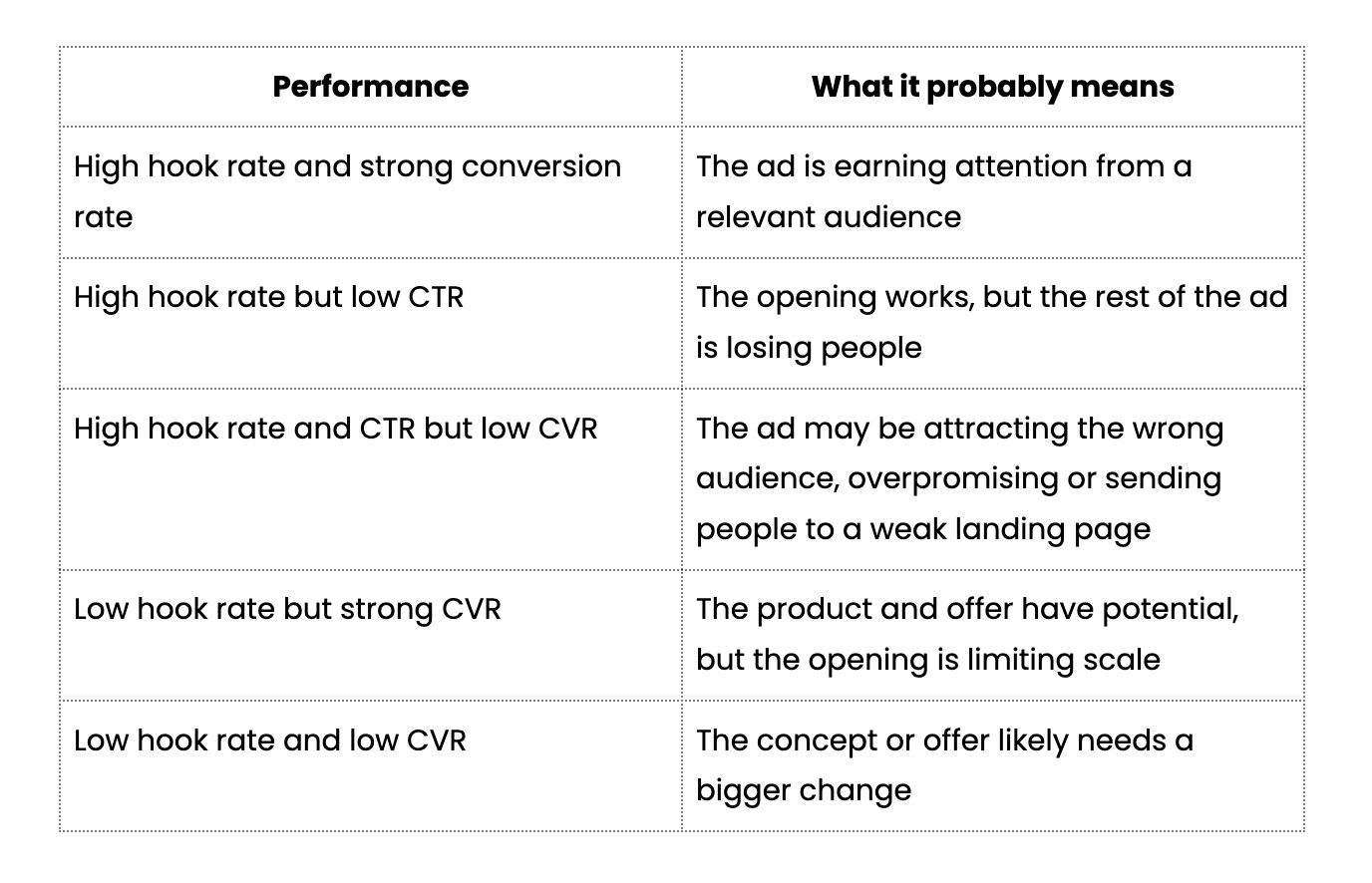
Here is how to interpret the most common performance combinations:

This is where advertisers can get into trouble by optimizing only toward engagement.

You can create a sensational hook that generates a lot of video views, but if those viewers never click or purchase, you did not actually improve the campaign. You just made the top of the funnel look better.

If new-customer acquisition is the goal, take it one step further. Look at new-to-file orders, new-customer CPA and new-customer ROAS. A high hook rate and strong platform ROAS do not mean as much if the ad is mainly reaching existing customers.

Hook Rate Can Also Help Identify Creative Fatigue

Creative fatigue happens when an audience has seen the same ad enough times that it stops getting the same response.

A declining hook rate can be one of the earliest signs. An opening that originally stopped people may become easy to ignore after repeated exposure.

Other signs include:

  • CTR steadily declining

  • Frequency increasing

  • CPM or CPA rising

  • Video completion rate falling

  • Conversions declining despite similar delivery

  • Comments mentioning that the ad keeps appearing

The key word here is “steadily.”

One bad day does not mean your creative is fatigued. Performance can move because of competition, seasonality, budget changes, site conversion rate or normal day-to-day volatility.

Creative fatigue is more likely when hook rate and CTR continue to trend down while frequency and costs move up.

It is also important to consider spend and audience size. A high-spend campaign targeting a limited audience can fatigue quickly. An ad running at a lower budget against a large audience may stay productive much longer.

There is no set number of days after which an ad automatically becomes fatigued.

Refresh the Part That Is Actually Fatigued

Creative fatigue does not always mean you need to throw out the entire ad.

If hook rate is declining but the people who continue watching are still clicking and converting, the opening may be the problem. Try a new first visual, opening line or on-screen headline while keeping the rest of the video.

If hook rate is still strong but CTR and conversion rate are falling, the problem may be deeper. People are interested enough to watch, but the product story, value proposition or offer is no longer convincing them.

Think about creative refreshes at three levels:

  1. Hook refresh: Change the first visual, opening line or headline.

  2. Format refresh: Turn the same message into a review, demonstration, comparison, static image or creator video.

  3. Concept refresh: Introduce a new customer problem, benefit, objection or use case.

Small changes such as switching the music, background color or caption style may extend an ad’s life, but they usually will not fix true concept fatigue.

Use Your Customers to Find Better Hooks

The best hooks usually come from real customer language.

Look at:

  • Product reviews

  • Customer-service questions

  • Social comments

  • Website searches

  • Frequently mentioned objections

  • Reasons customers say they purchased

  • Products or solutions they tried before finding yours

These sources will show you how customers describe the problem in their own words.

From there, build different hooks around different motivations. A skincare brand, for example, could test hooks focused on embarrassment, convenience, sensitive skin, visible results or failed alternatives.

Each hook gives the platform a slightly different audience signal. More importantly, each one gives a different type of customer a reason to stop.

The performance data will then tell you which problems and motivations are attracting the most valuable people, not just the most viewers.

The Takeaway

Improving hook rate is not about making every ad louder, faster or more dramatic.

It is about making the opening more relevant.

A strong hook should quickly communicate who the ad is for, what problem it addresses and why someone should keep watching. From there, your click and conversion metrics will tell you whether that attention came from the right audience.

Watch how hook rate changes over time, compare it against downstream performance and look for fatigue as frequency increases.

The goal is not just to stop more thumbs. It is to stop the right thumbs and give those people a reason to take the next step.

Summer Social Strategy: Platform Trends, Seasonal Content, and Budget Reallocation for Peak Performance

Summer presents both opportunities and challenges for advertisers. Consumer behavior shifts as vacations, holidays, and key promotions periods compete for attention, often leading to fluctuating engagement and conversion rates. While many brands experience softer performance during the summer months, those that use this time as an opportunity to test new creative, optimize budgets, and maintain a full funnel paid social strategy are often best positioned for success heading into the Fall.

Here are a few specific strategies we recommend to help brands get the most out of their social investment this summer.

Understand How Consumer Behavior Changes

Summer doesn't necessarily mean consumers stop shopping, they may just shop differently.

While people continue discovering brands and interacting with ads, they're often less ready to purchase immediately as disposable income is spent on travel, entertainment, and other seasonal expenses. This makes upper-funnel engagement and remarketing even more important.

Lean Into Seasonal Creative

Creative is often the biggest lever advertisers can pull during slower periods.

Summer messaging should feel fresh and reflect the season without forcing promotions and messages on users that ultimately don't align with the brand. 

Consider incorporating:

  • Bright, seasonal imagery paired with on-brand seasonal value propositions

  • Outdoor lifestyle photography that demonstrates summer use cases

  • Vacation-inspired messaging

  • User-generated content to capture top of funnel engagement

  • Fast-paced video demonstrating products in relevant real-life settings

Refreshing creative every few weeks is key to combating ad fatigue, particularly on Meta and TikTok where creative newness heavily influences performance.

Reallocate Budget Based on Seasonal Performance

Summer is an especially important time to evaluate channel efficiency when setting budgets, rather than maintaining static ad spend.

Thoroughly analyze which campaigns and channels are consistently generating the most profitable returns or the strongest top-of-funnel efficiency, then reallocate investment accordingly.

For example:

  • Allocate more spend to creative formats with stronger engagement, such as Reels or TikTok Spark Ads.

  • Reduce investment in campaigns experiencing rising CPMs and declining conversion rates.

  • Reserve budget for major promotional / key shopping moments like Back to School or Labor Day if historical performance shows stronger returns.

Don't Ignore Upper-Funnel Campaigns

When performance softens, it's tempting to cut awareness campaigns entirely and focus only on campaigns generating conversions and strong ROAS. While revenue efficiency remains important, eliminating top-of-funnel campaigns can shrink your future retargeting audience and make conversion campaigns even more expensive over time, which is especially detrimental as we approach fall & the holidays. 

That said, summer campaigns should be evaluated holistically and measured beyond revenue and ROAS. Metrics such as click through rate, video completion rate, and add to cart rate can provide valuable signals that future conversions are being built even if purchases temporarily soften. Identifying where performance trends exist among these metrics can also help uncover which creative messaging is most impactful at grabbing users attention and moving them along the path to purchase.

Prepare for Fall While Summer Is Still Running

One of the biggest mistakes advertisers make is waiting until September to begin planning for fall campaigns.

Summer is the ideal time to:

  • Test new creative concepts

  • Build remarketing audiences

  • Identify winning messaging

The learnings gathered during summer campaigns can significantly improve efficiency heading into higher volume shopping periods.

Final Thoughts

While conversion rates may soften during the summer, the season presents a valuable opportunity to improve long-term performance. By leveraging seasonal content, proactively reallocating budgets based on performance, and maintaining a balanced full-funnel approach, brands can maximize efficiency during the summer months while setting themselves up for stronger results in the busy shopping season ahead.

Instead of viewing summer as a period to simply maintain performance, use it as an opportunity to learn, optimize, and build momentum for what's next.

Creative Fatigue Solutions: Advanced Refresh Strategies and Performance Indicators Across Platforms

As digital marketers, we all know the importance of staying on top of refreshed creative in our accounts. If you're already rotating headlines, swapping assets, and refreshing CTAs, you're probably addressing creative fatigue at the surface level. To take it a level deeper, we need to look at reframing the core message, content structure, and creative execution of the ad. Let’s dive into some elevated strategies used to fight creative fatigue. 

Rotate Angles, Not Assets

Most brands' first instinct is to refresh creative by changing the visuals and keeping the same message. The impact of changing the narrative to reach a new audience should not be underestimated. For example, a beauty brand’s product can be repositioned through completely different customer motivations.

Product: Vitamin C

  • Angle 1: Brightening

    • Dull skin? This vitamin C serum helps visibly brighten and even skin tone in as little as 2 weeks.

  • Angle 2: Anti-Aging

    • Fine lines don't start overnight. Add antioxidant protection that helps support firmer, smoother-looking skin.

  • Angle 3: Confidence

    • The makeup artist secret: skin that looks radiant before foundation ever goes on.

  • Angle 4: Efficiency

    • One serum. Multiple benefits. Brightening, antioxidant protection, and hydration in a single step.

  • Angle 5: Ingredient Education

    • Not all vitamin C is created equal. Here's why stabilized vitamin C matters for real results.

One product can support a variety of different angles. 

Move Users Through The Funnel

Often, brands will refresh their creative with the same content throughout the funnel. As audiences become familiar with a message, it's easier for them to scroll past your ads, forget the message, or move on to other options. Instead, we can guide audiences through the funnel with creative messaging, rather than refreshing creative randomly. 

  • Stage 1: Awareness

    • Simple problem statement

  • Stage 2: Education

    • Teach why the problem exists

  • Stage 3: Contrarian

    • Challenge common assumptions

  • Stage 4: Social Proof

    • Customer evidence

  • Stage 5: Authority

    • Industry trends and expertise

  • Stage 6: Conversion

    • Offer-focused messaging

Structuring creative in this way allows us to guide the message, and ensure users are experiencing a cohesive customer journey. 

Don’t Underestimate Social Listening

There’s a rich source of inspiration right under our noses that often gets neglected— the comment section! While most brands can be quick to disregard a negative comment, or breeze past a positive one, social listening provides an opportunity for brands to create content that directly addresses consumer concerns. For example, if you receive the following comment: “This product doesn’t look like it does anything”, use that as an opportunity to create a new ad highlighting the product benefits. 

Any objection, praise, misunderstanding, or question can be turned into new content. 

Turn Winning Ads Into Series

Most marketers follow this pattern: Find a winning ad, scale it, performance drops, replace with something new. This approach disregards the learnings contained in that winner. Instead, ads should be treated like a TV series, not a movie. 

Let’s say your top performing ad focusing on a customer reducing her dark spots in 8 weeks using your vitamin C serum. Instead of making a handful of before-and-afters, create a series from this video:

  1. The transformation

  2. Her exact routine

  3. What she tried before

  4. The mistake that slowed progress

  5. Week-by-week journey

  6. Her morning routine

  7. Her favorite product in the regimen

Now you’ve turned this success story into seven creative assets. With this structure, users feel like they’re learning, not being sold to. The product becomes a natural conclusion instead of the entire ad. 

Refresh Based on Audience Saturation Signals

Different fatigue symptoms require different solutions. If you encounter the below performance indicators, try the following adjustments:

  • Falling CTR: Refresh CTA or update core video

  • Falling Thumbstop Rate: Refresh first 3 seconds

  • Falling CVR: Refresh offer

  • Stable CTR + Rising CPA: Audit landing pages

  • Stable CPA + Rising CPM: Refresh creative volume

Diagnose the issue before rebuilding. 

Refresh With Intention

At the end of the day, there’s not a one size fits all strategy for refreshing creative fatigue. When performance begins to dip, we must first ask ourselves: “Has the audience exhausted the angle, the messenger, the format, or the offer?” Each answer requires us to approach the problem with a different strategy. Let Revel Marketing Partners be your collaborator to find creative solutions that work.

Sources