Revel Marketing Partners

How to Scale Beyond the FYP & Convert With Influencer Marketing

The Shift from Awareness to Conversion

As influencer marketing matures, the focus is shifting from brand awareness to measurable ROI. Traditionally, campaigns were judged by reach and engagement, and success meant hitting a target number of likes, comments, or views. But expectations have changed. Marketers are now asking a more critical question: how does this drive actual business results? Did engagement translate into purchases?

This shift has fueled the rise of shoppable content. This interactive media includes  photos, videos, blog posts, and social content that enables users to purchase directly or seamlessly navigate to product pages. By blending ecommerce with engaging storytelling, shoppable content reduces friction in the buying journey and creates a more fluid, conversion-driven experience.

As a result, influencer content is evolving into a true sales channel, not just a top-of-funnel marketing tactic.

Why Shoppable Influencer Content Matters

Shoppable influencer content matters because of shifting consumer behavior. Social media platforms like TikTok have conditioned users to expect instant gratification, creating an environment that encourages impulse buying. When discovery and purchase happen in the same moment, consumers are far more likely to convert. By making content immediately shoppable, brands can capitalize on this behavior, turning passive scrolling into active purchasing with minimal friction.

Platforms like TikTok Shop and Instagram Checkout are accelerating this shift by enabling users to complete purchases without ever leaving the app. This seamless experience removes traditional barriers, making it easier than ever to act on impulse.

And when it comes to influencers, their role is embedded in the name. They are modern-day curators: trusted voices who shape opinions and guide purchasing decisions. By combining that influence with seamless commerce, brands can turn inspiration into transactions in real time. 

What Makes Content “Shoppable”? 

So, what exactly makes content “shoppable”? At its core, shoppable content reduces the distance between discovery and purchase, either by embedding products directly into the content or by linking users seamlessly to where they can buy.

At a foundational level, brands can use trackable links, such as UTM parameters or affiliate links, to connect influencer content to conversions. These links allow marketers to measure performance while guiding users directly to product pages.

Social platforms have taken this a step further by building native shopping experiences. Instagram’s Shop and product tagging features allow businesses to integrate their storefronts directly into the platform, enabling creators to tag products in posts, Stories, and Reels so their followers can purchase without leaving the app. Similarly, TikTok Shop allows creators to link products within videos, livestreams, and dedicated product showcases on their profiles, creating a fully integrated shopping experience.

TikTok also offers an affiliate ecosystem on the TikTok Shop Seller Center, where brands can invite creators to earn commissions directly through the platform, simplifying both tracking and payouts. Instagram has begun moving in a similar direction, introducing affiliate tools and expanding product linking capabilities, particularly within Reels, signaling a broader shift toward in-app commerce.

Across all of these formats, the common thread is a seamless user experience. The fewer steps it takes for a consumer to go from inspiration to checkout, the more effective shoppable content becomes.

Types of Shoppable Content

Short-Form Video (TikTok, Reels, YouTube Shorts)

Short-form video allows creators to showcase products in an authentic, engaging way – often integrating them naturally into content like “day in the life” videos, quick demos, or trend-driven posts. This format is especially effective for driving impulse purchases. 

Source: @riannagail

Long-Form Content (YouTube, Blogs, Substack)

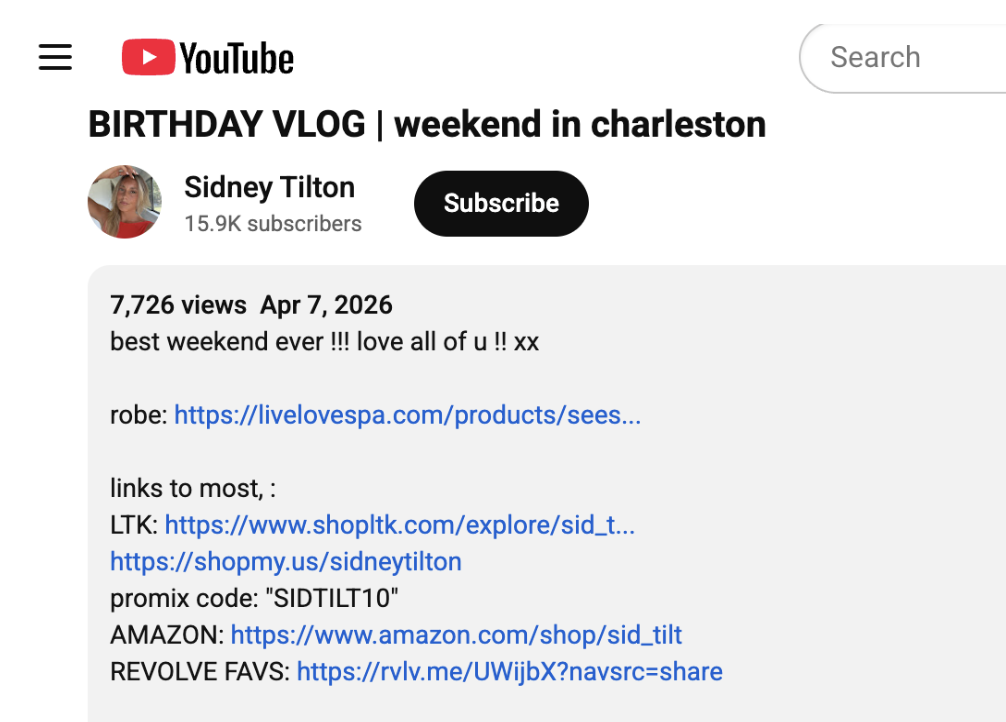
Longer content formats provide space for deeper storytelling, such as tutorials, reviews, or product comparisons. Shoppability is enabled through links in video descriptions or hyperlinked within blog copy, guiding users directly to purchase.

Source: @sidtilt

Livestream Shopping (TikTok)

Livestream shopping, particularly on TikTok, enables real-time interaction and purchasing. Creators can pin products directly from their TikTok Shop showcase during a live session, allowing viewers to buy instantly while engaging with the content.


Static Posts & Stories (Instagram)

Static content like feed posts, carousels, and Stories can be made shoppable through product tags and link stickers, which can be customized with text. These formats offer a simple, low-friction way for users to explore and purchase featured products.

Source: @clarapeirce

How Brands Can Enable Shoppable Content

When building shoppable campaigns, brands should prioritize creator selection based on purchase intent – not just reach. A large following doesn’t always translate to conversions, so it’s critical to vet creators for how effectively they integrate shoppable tactics. This includes using features like link-in-bio tools, Instagram Story links, product tags, or maintaining a TikTok Shop Showcase.

Beyond audience size, brands should evaluate performance metrics such as engagement rate to ensure the creator has an active, responsive audience that is more likely to convert.

To support measurement and optimization, brands should equip creators with trackable assets like UTM links or exclusive discount codes. These tools not only streamline the path to purchase but also provide clear visibility into campaign performance, helping brands understand what’s driving real revenue.

Best Practices for High-Converting Shoppable Content

Creating shoppable content is only the first step—ensuring it actually converts is where the real strategy comes in. At the core of every successful campaign is authenticity. When briefing creators, brands should emphasize the importance of producing content that not only aligns with brand values but also fits naturally within the creator’s existing niche. Audiences are far more likely to engage—and convert—when the content feels genuine rather than forced.

Clear and compelling CTAs are also critical. Especially in short-form video, incorporating a strong CTA within the first few seconds can capture attention and guide viewers toward taking action before they scroll away.

Creator alignment is equally important. Partnering with influencers who genuinely resonate with the brand’s mission helps ensure the content feels organic, increasing both trust and performance.

Finally, campaigns should be tailored to the nuances of each platform. TikTok content tends to perform best when it feels casual, trend-driven, and native to the platform, while Instagram often favors more polished, curated visuals. Adapting creative to match user expectations on each platform can significantly impact conversion rates.

Measuring Success

Since shoppable content is correlated to driving revenue, then the way you measure success needs to align with this objective. Engagement in a report is a win, but these don’t directly generate revenue. 

Here are the metrics that actually tell you if your influencer content is working:

Click-Through Rate (CTR)

First things first – are people taking action? CTR tells you whether your content and CTA are strong enough to move someone from scrolling to clicking. If this number is low, your hook or messaging likely isn’t landing.

Conversion Rate

Clicks are great. Conversions are better. This is where you see if your content – and the shopping experience behind it – actually closes the deal. A strong conversion rate means you’re not just grabbing attention, you’re driving real intent.

Engagement vs. Sales

Here’s the reality: high engagement doesn’t always mean high revenue. Some posts go viral but don’t convert, while others drive serious sales. The key is understanding what kind of engagement actually leads to purchase and doubling down on that.

The Attribution Problem

The path to purchase isn’t always linear. A user might see a product on TikTok, research it on Instagram, and convert somewhere else entirely. That makes attribution messy. The fix? Use trackable links, affiliate codes, and platform analytics to piece together the journey and get a clearer picture of what’s working.

Test, Learn, Repeat

There’s no perfect formula here. The brands winning in shoppable content are the ones constantly testing: different creators, hooks, CTAs, and formats. The more you iterate, the faster you find what drives real revenue.

The Future of Influencer Commerce

Shoppable content isn’t just a trend, it’s the foundation of where influencer marketing is headed. As platforms, creators, and brands continue to evolve, the line between content and commerce will only get thinner.

AI-Driven Personalization

The next wave of influencer commerce will be powered by personalization at scale. Algorithms are already curating content feeds, now they’re starting to shape shopping experiences too. Expect to see more tailored product recommendations based on user behavior, preferences, and past purchases. For brands, this means influencer content won’t just reach audiences—it will reach the right audiences at the right moment, increasing the likelihood of conversion.

In-App Checkout Expansion

The goal is simple: keep users on-platform from discovery to purchase. Platforms like TikTok and Instagram are investing heavily in native checkout experiences, removing the need to redirect users to external sites. As these features expand and become more seamless, friction will continue to drop and conversion rates will rise with it.

Creator-Owned Storefronts

Creators are no longer just promoting products, they’re becoming retailers in their own right. With tools like TikTok Shop, Amazon Storefronts, and link-in-bio commerce hubs, influencers can curate and sell products directly to their audience. This shifts the dynamic from one-off partnerships to long-term, creator-led commerce ecosystems where trust and consistency drive repeat purchases.

The Blurring of Content, Ads, and Retail

Perhaps the biggest shift is that these categories are starting to merge. A TikTok video can be entertainment, an ad, and a storefront all at once. The most effective content doesn’t feel like advertising—it feels native, engaging, and actionable. As a result, brands will need to rethink how they approach campaigns, focusing less on traditional ad formats and more on content that seamlessly integrates into the user experience.

The Bottom Line

Influencer marketing is no longer just about visibility—it’s about velocity. The speed at which a consumer can move from discovery to purchase is now a defining factor in campaign success. Shoppable content bridges that gap, turning passive engagement into measurable action.

As platforms continue to integrate commerce more deeply and creators take on a greater role in driving sales, the brands that win will be the ones that adapt early. This means thinking beyond reach, prioritizing seamless user experiences, and treating influencer content as a core revenue channel—not just a marketing play.

In a landscape where attention is fleeting, the ability to convert in the moment isn’t just an advantage, it’s the new standard.

SOURCES

Beyond Bottom-Funnel: How Demand Gen and YouTube Build Audiences That Convert in Q4

There's a ceiling that every bottom-funnel-heavy program eventually hits. Search and Shopping are good at capturing demand that already exists. The problem is you can only capture so much of it before you run out of people to reach.

The brands seeing real growth right now are investing earlier in the funnel. YouTube and Demand Gen aren't just awareness plays. They're what make your lower-funnel channels more efficient when it counts most. And Q4 is when that gap shows up hardest.

Q4 Performance Doesn't Start in Q4

The audiences converting in November and December are built in Q2 and Q3. If you wait until peak season to start investing in demand creation, you're already behind, competing for the same high-intent traffic as everyone else at the most expensive time of year to do it.

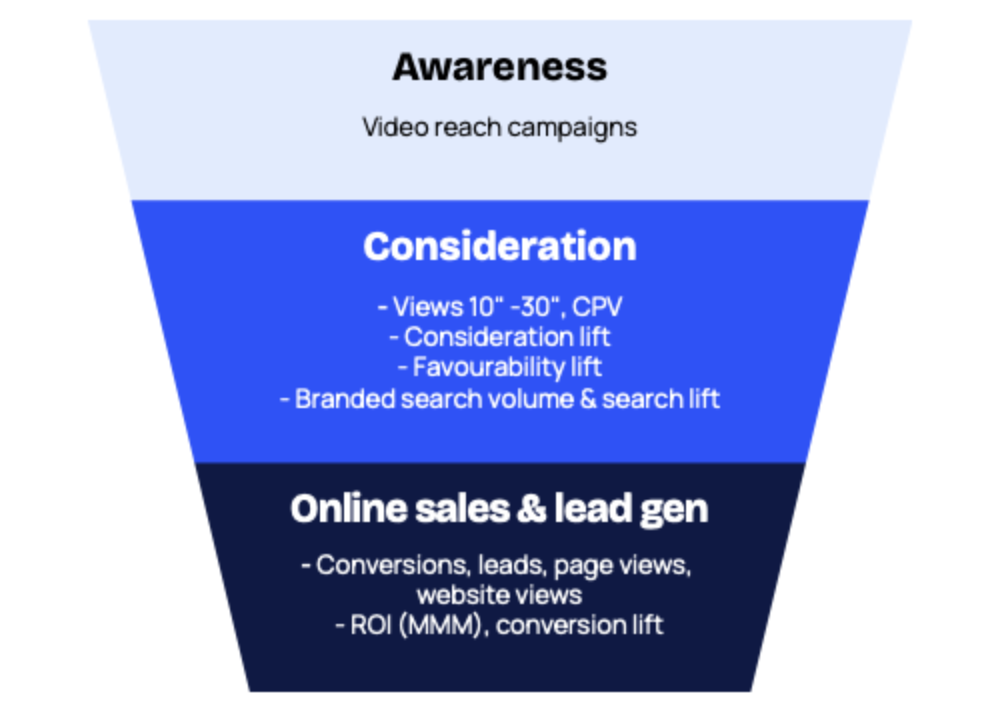
The funnel works in layers. YouTube is where you build familiarity at scale. Demand Gen is where you stay present as users move from passive awareness into consideration, reaching them across YouTube, Discover, and Gmail. Search, remarketing, and Performance Max are still closing the deal. They just do it better when the audience is already warmed up. These pieces work best when they're connected, and the return compounds when upper-funnel activity starts early enough.

That compounding effect is backed by real data. According to Fospha's Full-Funnel Google Report, brands that added just one additional channel to their Google mix saw 14% higher ROAS compared to those that kept their mix unchanged, and brands that added two channels achieved 37% higher ROAS. A broader mix gives Google's systems more signal to optimize against and creates more entry points across the customer journey.

Building Audiences That Pay Off in Q4

Most brands approach audience strategy like a retargeting checklist. Tag visitors, build lists, remarket to people who almost converted. That works fine in a normal environment, but it breaks down during peak season when everyone else is doing the exact same thing with the same audiences.

Building ahead of time looks different. A YouTube view isn't a vanity metric. When someone watches your content beyond a few seconds, that's an early signal of interest. Retargeting those viewers later through Demand Gen is a fundamentally different starting point than going cold. Layering first-party data (customer lists, site visitors, engaged users) across both prospecting and remarketing means your data is working across placements, not just in search. Custom segments built on search behavior let you reach users before they've even clicked an ad, pulling them into environments where you can shape perception earlier.

What ties it all together is thinking in sequences rather than single interactions. Awareness builds in Q2. Consideration develops in Q3. By Q4, you're not introducing your brand. You're reinforcing it. That sequence is what makes peak season more efficient rather than more expensive.

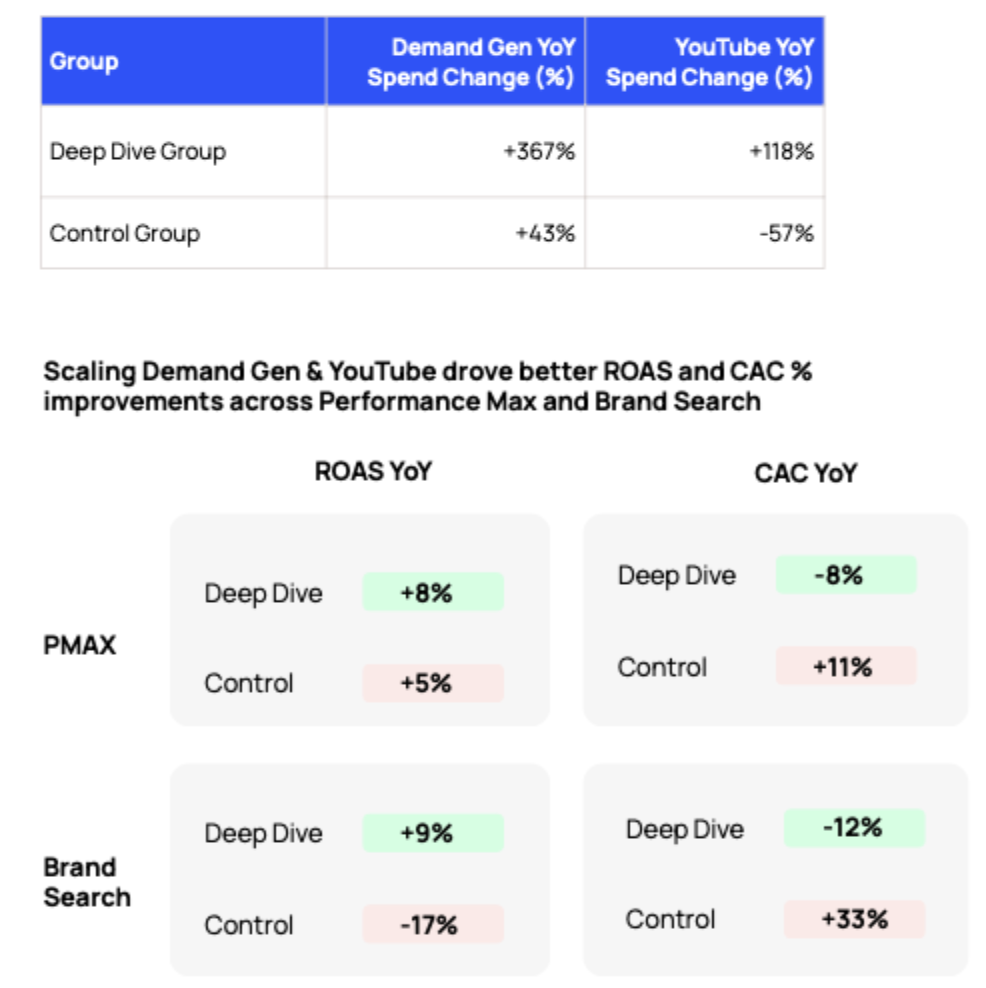
The downstream impact of investing this way shows up clearly in the Fospha data. Brands in their Q4 2025 program that scaled Demand Gen and YouTube saw ROAS and CAC improvements not just in those channels, but in Performance Max and Brand Search as well. Deep Dive brands increased Demand Gen spend 367% and YouTube spend 118% year over year and saw PMAX ROAS improve 8% and Brand Search ROAS improve 9% year over year. The control group, which scaled back YouTube and grew Demand Gen more modestly, saw the opposite.

Measuring What Actually Matters Before Q4

Measurement is usually where the full-funnel argument falls apart internally. If you're relying on last-click attribution, upper-funnel activity will always look undervalued, and that becomes a real problem when you're trying to justify investing in it ahead of peak.

A more complete picture looks at a few things together. Branded search lift is one of the clearest indicators that YouTube investment is working. If people are searching for your brand more after being exposed to video ads, demand is being created at the top of the funnel. Fospha's full-funnel measurement consistently finds that click-based attribution significantly understates YouTube's contribution, with true ROAS coming in substantially higher than what platform reporting shows. Beyond that, blended metrics including revenue trends, new customer acquisition, and overall CPA give you a better read on program health than channel-level ROAS in isolation. And for campaigns where you need a clear business case, incrementality testing through geo holdouts answers the simple question: what wouldn't have happened without this investment?

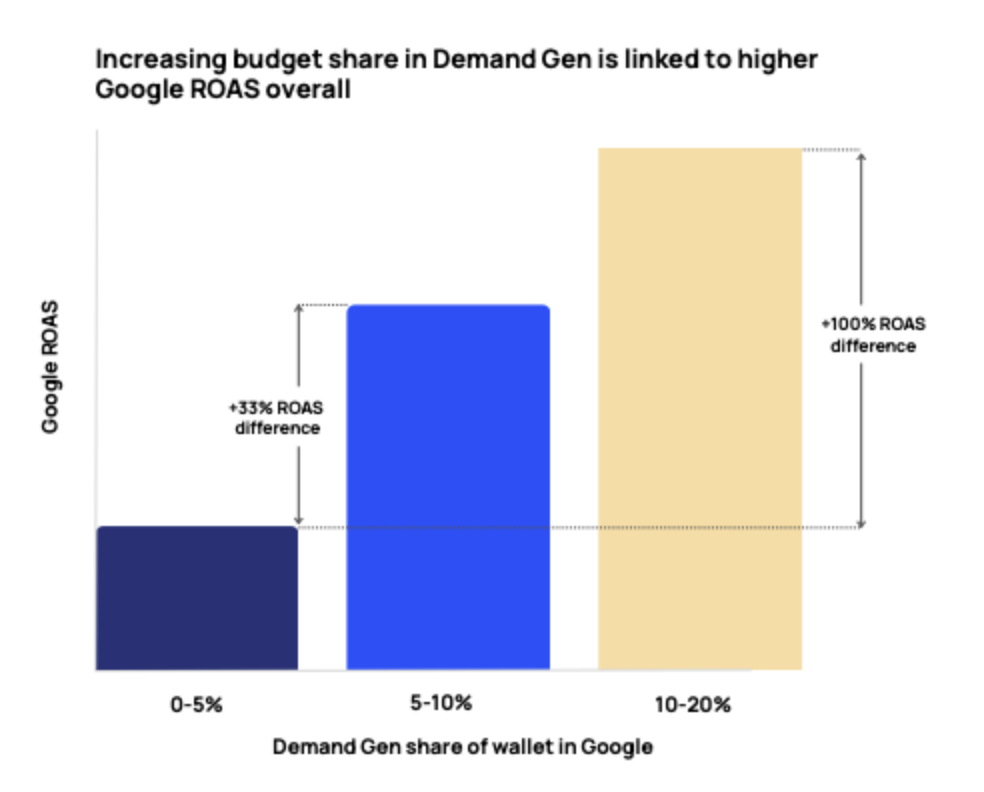
The budget allocation question also has a more concrete answer than most clients expect. In Fospha's research, brands allocating 10-20% of their total Google budget to Demand Gen achieved double the ROAS of brands allocating 0-5%. Most accounts spend well below that threshold, which means there's real headroom before hitting diminishing returns.

Creative That Actually Works on YouTube and Demand Gen

Getting the strategy right is only half of it. Creative usually gets treated as a supporting piece when it actually does most of the work, and if you're planning for Q4, not all creative can do the same job.

On YouTube, the first few seconds carry most of the weight. A clear hook, movement, or a relatable problem gets you past the skip button. Branding needs to show up early enough to be remembered, not saved for the end. On Demand Gen, clarity matters more than cleverness. Headlines have limited space and visuals do most of the work, so the product, use case, or outcome needs to be immediately obvious across Discover and Gmail. Across both, consistency is what builds familiarity. If someone sees your brand on YouTube and then again in Demand Gen, it should feel connected. Visual identity, messaging, and positioning should carry through. Google's ABCD framework (Attention, Branding, Connection, Direction) is worth keeping in mind here, and ads that follow those principles have shown measurable lifts in both short-term sales and long-term brand impact.


RMP's POV: Growth Starts With Demand Creation

The biggest risk heading into Q4 isn't wasted spend. It's underinvesting in the channels that build your future pipeline. At RMP, we treat YouTube and Demand Gen as the upstream investment that makes your entire Google program more effective over time. They're not meant to replace conversion channels, but the data is clear that brands running a connected full-funnel approach consistently outperform those optimizing only for what's easiest to measure. If your strategy only prioritizes immediate returns, you end up reacting to demand instead of creating it, and in Q4, that gets expensive fast.

If you're looking to reduce reliance on bottom-funnel channels and build a strategy that performs when competition peaks, it starts with audience development now. Reach out to our team to start building a full-funnel approach that's ready before peak season hits.

SOURCES

Paid Social Creative Testing Guide: Framework, Strategy, and Iteration

In the world of paid social, we’re always being told by platform reps that “creative is the new targeting”, and that creative diversification and volume are becoming increasingly important as platforms lean into AI-heavy targeting. As performance marketers, what this means for us is that we need an ironclad creative testing approach to maximize the learnings we get from platforms, as our insight into targeting continues to devolve. Let’s dive into what this approach looks like.


The Hypothesis

Every great test must start with a clear hypothesis. Doing so keeps the vision for the test clear, prevents random testing, and ensures insights accumulate over time. Here’s an example of what that might look like: “If we use UGC-style video instead of product demos, CTR will increase because the creative appears more authentic.”


Set Your Testing Criteria

To ensure validity, you should plan on all creative tests following the minimum benchmarks below: 

  • 50 conversion events per test

  • Minimum 2-week test window (1 week to get out of learning phase, and a second week to ensure clear results)

  • Equal budget distribution

If the results aren’t statistically significant, extend the test rather than drawing inconclusive results. 


Define Your Testing Variables

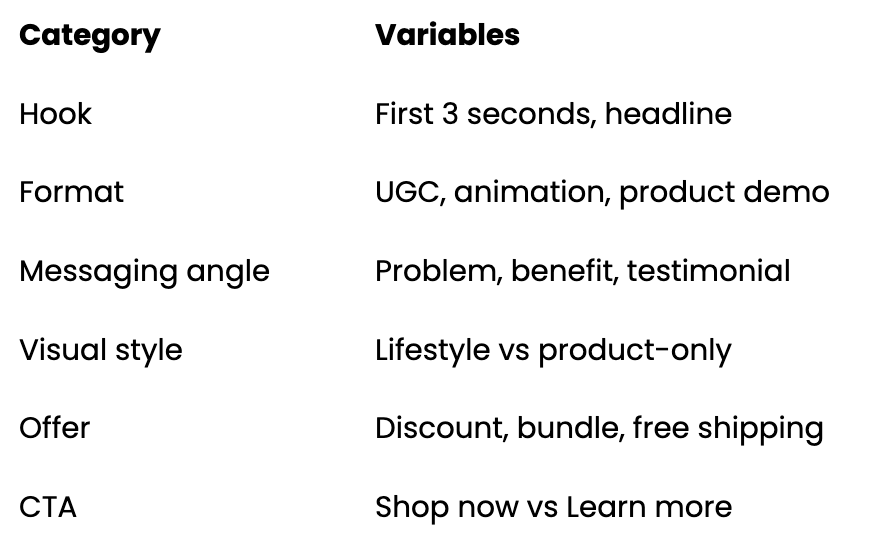
For clear results, only one variable should be tested at a time; Isolating variables helps identify what is really driving performance. Here’s an example of variables you might test:

Leverage New Testing Features

Utilize Meta’s creative testing feature to test creatives against one another and designate a specific amount of your budget to the test ads, without having to scale ads in a separate campaign and constantly restart the learning phase. 


Structure Your Ad Variations

Creative used in your test should follow a structured format that allows clear variables to be identified and tested. If you wanted to test 6 ad variations for example, it might look like this: 

  • 3 Angles: Problem, Benefit, Testimonial

  • 2 Formats: UGC, Product Demo

  • 1 CTA: Shop Now


Follow a Phased Testing Process

Your creative testing should include three main phases: exploration, validation, and scaling.

  1. Exploration: Your primary goal here is to discover what works. Test several different creatives variations (5-10) with different hooks and angles, reviewing engagement metrics like CTR, CPMs, Thumpstop rate, etc.

  2. Validation: Take your top 2-3 winners from phase 1. Test these against existing winners, or other variations of the same hook. Metrics to evaluate are CPA, CVR, ROAS.

  3. Scaling: Once winners are determined, you should increase investment, expand formats and create iterations (shorter version, different hook, new opening frame, etc.). 


Utilize a Creative Testing Matrix

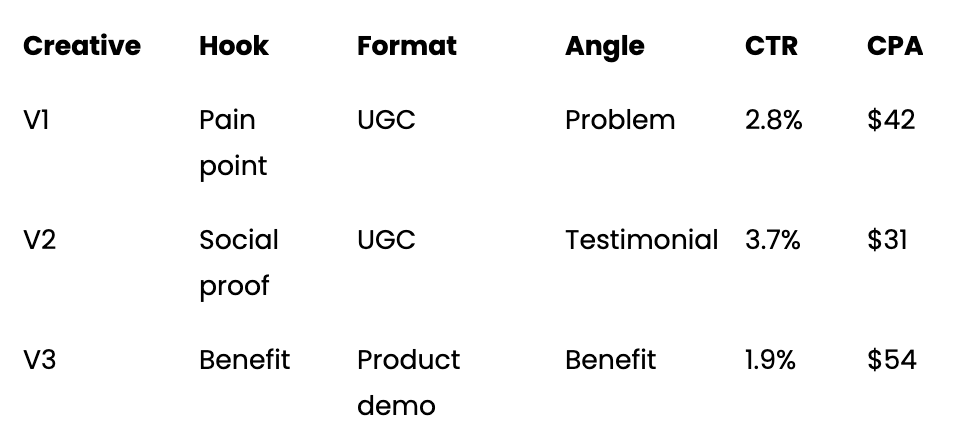
Now that you’ve done all this testing, it's important that you store results in a way that’s clear, organized, and easy to reference. By building and updating a creative testing matrix, you can begin to see trends over time of what has worked and what hasn’t. For example, your matrix may look something like this:

There’s no exact science to the perfect matrix, but it should clearly track everything you are testing and provide valuable insights that are easy for you to reference. Were there nuances from your test you should be aware of? Perhaps a creative performed really strongly with one audience, and struggled with another. You matrix should include data that makes it easy for you to report results and iterate going forward. 


Identify Winners & Iterate

So you’ve completed your test, filled out your matrix with data, and now you can determine winners and iterate on those ads. This cycle would follow this general pattern: launch new creatives, analyze performance, iterate winners, introduce new concepts, then rinse and repeat. 

Ads platforms today are increasingly creative-driven. Formulating a systematic testing plan helps us determine trends and compound insights over time, rather than relying on random experimentation and putting our learnings at the mercy of the algorithm. Let Revel Marketing Partners help you jumpstart your creative testing strategy today.


SOURCES

Why Your Brand Shouldn’t Sleep on Pinterest Paid Ads in 2026

We’re already in Q2 of 2026, and as brands double down on Meta, TikTok, and YouTube, the competition for attention has never been louder. Meanwhile, a quieter channel is steadily driving discovery, inspiration, and sales: Pinterest.

With 578 million monthly active users worldwide and nearly 90 million in the U.S. alone, the platform has evolved far beyond DIY boards and wedding planning. Today, 97% of top searches are unbranded, which means people are arriving open-minded, actively planning, and ready to discover new brands. Add in the fact that Pinterest ads blend seamlessly into the browsing experience, and you’ve got one of the most underutilized yet effective channels in digital advertising.

If your 2026 paid social strategy overlooks Pinterest, you’re missing the chance to reach audiences with intent, purchase power, and a mindset to act.

What Makes Pinterest Different

Pinterest is part search, part visual inspiration. Most users come to Pinterest to find inspiration, plan projects, and pin things they love. That combination of intent and discovery is rare. In contrast to Meta or TikTok, Pinterest feels safer and more positive to users. It does not interrupt their browsing with ads, but instead ads are built to feel native to the Pinterest user experience. 

At Revel, we often say Pinterest is one of the most underused tools in paid social. Brands that treat it not like another ad slot, but like a place to deliver inspiration, see real results. Carousels, video, and interactive formats—used in the right way—build awareness and drive conversions without feeling pushy.

Why 2026 is the Moment for Pinterest

People are open to discovering

Almost all top searches on Pinterest are unbranded. That gives you a chance to get in front of people early, before they have decided who or what to buy. If your content feels like part of someone’s inspiration journey, you win.

Less noise, more breathing room

Because fewer brands are investing heavily in Pinterest, costs are often lower. CPCs and CPMs tend to be more affordable compared to Facebook or Instagram. That means more efficient spending, more room for experimentation.

Long-living content

Pins have a lifespan. They stick around. A campaign might officially finish, but the content keeps surfacing, keeps inspiring, weeks or even months later. Your investment keeps giving back.

Who You’ll Reach (And Why It Matters)

  • There are hundreds of millions of monthly users on Pinterest, many in the U.S.

  • A big portion of those users earn over $100,000 a year. That is serious buying power.

  • Gen Z is growing fast on the platform. They are searching, saving, sharing—and they want products and inspiration.

  • The male audience is rising too. What used to be a platform perceived as more “female centric” is now diversifying in powerful ways.

If you do B2C, this looks like a playground. If you do B2B, it’s a place to build trust, to tell your story, to be discovered.

What Makes Pinterest Ads Work

Pinterest ads, also called promoted pins, don’t feel like ads the way they do elsewhere. They blend into discovery. When someone is searching for ideas, planning a project, trying to figure out what will work for them, a well-designed promoted pin feels less like an interruption and more like helpful inspiration.

Some formats you should work with:

  • Carousels that let people swipe through options

  • Videos that show product in action or tell a story

  • Collections that mix images + video

  • Interactive content like quizzes or inspiration tools

  • Premier placements (like spotlight features) when you want extra visibility

These let you repurpose content you already have while keeping it fresh.

Tips for Pinterest Ads in 2026

  1. Build creative for vertical, mobile first. A lot of Pinterest browsing happens on phones.

  2. Use both keyword targeting and interest targeting. You want relevance.

  3. Try different ad formats and see what sticks: static, video, shopping, etc.

  4. Make sure you are tracking conversions carefully. If you have not set up the Pinterest Tag, do that.

  5. Plan content both for seasonal peaks and evergreen moments. Let content breathe beyond campaign

Why You Should Start Now

Pinterest is evolving. New ad capabilities are rolling out. Audience growth, especially among Gen Z and male users, is accelerating. Brands that get in now have more chance to test, refine, find what works before ad costs creep up.

The Takeaway

Pinterest offers something many platforms don’t: a space where people come ready to be inspired, ready to plan, and ready to buy. If you treat it with care (good creative, smart targeting, relevant content), Pinterest can drive awareness and conversions in a way that feels natural.

If you want help adding Pinterest ads into your paid media mix for 2026, Revel can help make them feel like part of your brand story, not like another ad.

SOURCES

SEO, AEO, GEO, and AIO: What Actually Matters for Brands in AI Search

AI search isn’t replacing SEO, but it is changing how brands earn visibility, how content gets surfaced, and how marketers should think about performance.  For years, search visibility mostly meant one thing: rank well, earn the click, and let the website do the rest.  With AI search that is no longer the whole story.

As AI-powered search experiences continue to expand, users are increasingly getting answers, recommendations, and comparisons before they ever visit a website.  Pew Research found that when Google users encountered an AI summary, they clicked a traditional search result in just 8% of visits, compared to 15% of visits when no AI summary appeared.  Users also clicked links inside the AI summary itself only 1% of the time.  In other words, visibility doesn’t necessarily translate to website traffic anymore.  

That shift is exactly why so many businesses are asking new questions right now.  Do the old rules of SEO still apply? Do we need a new separate AI search strategy? Are terms like AEO, GEO, and AIO actually different, or just new labels for the same thing?

The answer is somewhere in the middle.  SEO still matters a great deal when it comes to AI search, but ranking is no longer the only way a brand earns visibility.  In AI search, businesses also need to be understandable, citable, and recommendable.

The Easiest Way to Understand the New Search Alphabet

The industry has not settled on terminology yet, which is part of the confusion.  You will see terms like SEO, AEO, GEO, and AIO used inconsistently depending on who is writing about them, but the cleanest way to think about them is as a stack.

  • SEO is still the foundation.  It is the technical and content work that helps search engines crawl, index, understand, and rank your site.

  • AEO, or answer engine optimization, builds on SEO.  It focuses on structuring content so it can be pulled into direct-answer experiences like featured snippets, people also ask, voice results, and AI-generated responses.

  • GEO, or generative engine optimization, goes broader.  It is about improving how AI systems interpret, describe, and cite your brand across platforms like ChatGPT, Gemini, and Perplexity.  The academic paper that helped introduce GEO described it as a way to improve visibility in generative engine responses and found that certain optimizations could meaningfully increase visibility.  

  • AIO is probably the least consistent term in the group because it gets used in two different ways.  Sometimes it refers broadly to AI optimization.  In a Google-specific context, though, it is often used as shorthand for AI Overviews in search results.

The important point is that these are not four separate strategies, they build on each other.  SEO is still the foundation.  AEO helps content become answer ready.  GEO expands that thinking across AI systems.  AIO reflects that same shift in a more condensed form within Google’s search results.

What AI Search Changes and What It Doesn’t

This is where a lot of bad AI-search advice goes off the rails.  It jumps too quickly to “everything has changed,” which can create unnecessary alarm, while ignoring that many of the fundamentals still look very familiar.

Google’s own documentation is pretty explicit here: the same SEO best practices still apply to AI Overviews and AI Mode.  There are no additional requirements to appear in those experiences.  Pages still need to be indexed, eligible to appear with a snippet, and supported by the same core SEO fundamentals that have always mattered.  Google specifically calls out things like allowing crawling, making important content available in text form, using internal links, keeping structured data aligned with visible content, and making sure Merchant Center and Business Profile information are up to date.  

That matters because there is a temptation right now to treat AI search as a brand-new channel that sits outside traditional optimization work, which isn’t the case.  If a site has weak technical SEO, poor information architecture, thin content, or blocked crawlers, no amount of GEO language will fix the underlying problem.

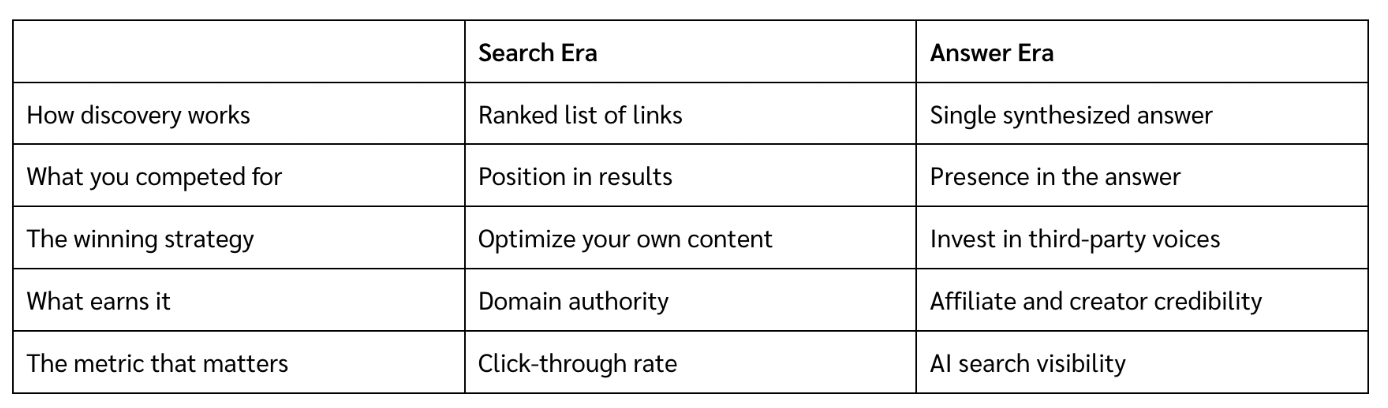
What has changed is how content gets surfaced and how brands earn visibility.  In classic search, success was heavily tied to ranking and click through behavior.  In AI search, a user may get a synthesized answer, a shortlist of brands, or a product recommendation before ever reaching your site.  That means optimization is no longer only about winning the click.  It is also about increasing the chances that your brand is accurately understood and included in the answer set in the first place.  

That also raises the bar for content quality in a slightly different way.  Content needs to be easier to extract, interpret, and summarize.  It should answer real questions clearly, use a strong information structure, and make it obvious what a page is about and why the brand behind it is credible.  At the same time, visibility is no longer driven only by what your website says about you.  AI systems pull from a broader web of signals, including reviews, publisher coverage, product data, structured information, and third-party references.  In other words, brands now need to be not only searchable, but understandable and citable.

Technical access still matters here too.  OpenAI’s documentation distinguishes between OAI-SearchBot, which is used to surface websites in ChatGPT search features, and GPTBot, which relates to training.  Site owners can allow one and block the other independently.  It is a useful reminder that visibility in AI search depends in part on whether your content is actually accessible to the systems surfacing it.

Why Search Reporting Needs to Evolve

The biggest strategic shift may not be content at all, but measurement.

If AI-driven search experiences are reducing clicks on informational queries, then flat or declining CTR does not automatically mean a program is underperforming.  In some cases, it may mean visibility is happening earlier in the journey, before a user ever visits the site.  That matters most for brands that rely on non-branded discovery, educational content, or upper funnel search activity to introduce new users to their category.

That is why traditional SEO reporting needs to expand.  Rankings, clicks, sessions, and conversions still matter, but they no longer tell the full story on their own.  A brand may show up in AI generated answers, be cited in product comparisons, or influence consideration all without earning the same volume of traffic it would have in a more traditional search environment.

For marketers, this means the KPI mix needs to get broader.  Search Console and GA4 still belong at the center of reporting, but they should be paired with workflows and tools that help teams understand visibility beyond the click, including whether brands are being mentioned, cited, or excluded across experiences like ChatGPT, Perplexity, and Google’s AI Overviews.

The goal should not be to replace traditional metrics, but to add context around them.

A stronger reporting framework should answer questions like:

  • Are we appearing in AI-generated answers for our core category and product terms?

  • Are we being cited accurately, and are the right pages or sources being referenced?

  • Are branded search and direct traffic holding up even if some informational CTR softens?

  • Are we seeing changes in assisted conversions, engagement quality, or downstream conversion behavior?

  • Are competitors being surfaced more often than we are for the queries that shape early consideration?

That is a more useful conversation than simply asking whether SEO traffic is up or down.  In AI search, visibility is getting broader, and reporting needs to catch up to reflect that change.

What Brands Should Do Now

The good news is that the right response is not to blow up your search strategy and start from scratch.  It is to tighten the foundation and widen the lens.

For most businesses, that means making sure technical SEO is in good shape, structuring high value content so it answers questions clearly, and strengthening the signals that help AI systems understand and trust your brand across the web.  That includes basics like crawl access, content clarity, internal linking, and structured data hygiene, but also broader authority signals such as reviews, third party mentions, and brand consistency.

It also means updating how performance gets measured.  AI search is creating more situations where a brand can influence the answer without earning the click, so businesses need a broader view of visibility that includes both classic search metrics and emerging AI surface signals.  That does not mean abandoning traffic and conversion goals.  It means recognizing that rankings alone no longer tell the full story.

For marketers, the practical takeaway is simple: start with strong SEO fundamentals, make your content easier to understand and extract, improve the authority signals around your brand, and build a reporting framework that reflects how search behavior is actually changing.

The job is no longer just to rank.  It is to make sure your brand can be found, understood, and included wherever search decisions are being made

SOURCES

AI-Powered Affiliate Marketing Attribution Models: A Complete Guide for Modern Marketers

Affiliate marketing attribution has reached a breaking point. With buyers moving across devices, platforms, and content formats, traditional attribution models can no longer accurately reflect how conversions happen. AI-powered affiliate marketing attribution models are emerging as the solution and helping brands assign credit more fairly, optimize spend, and scale performance with data-driven precision.

This guide explains how AI attribution works, why it matters, and how marketers can use it to gain a competitive edge.

What Is Affiliate Marketing Attribution?

Affiliate marketing attribution is the process of determining which affiliate touchpoints contribute to a conversion and how much credit each should receive. A single purchase may involve multiple interactions, such as blog reviews, influencer posts, retargeting ads, and email offers before a customer converts.

Traditional attribution models include:

  • Last-click attribution, which assigns 100% credit to the final interaction

  • First-click attribution, which credits the initial discovery source

  • Linear attribution, which distributes credit evenly across touchpoints

  • Position-based attribution, which emphasizes first and last interactions

While easy to implement, these rule-based models often oversimplify real customer journeys and undervalue mid-funnel contributors (WeCanTrack).

Why Traditional Attribution Models Fall Short

Modern affiliate ecosystems are multi-channel and multi-device by default. Static attribution models struggle with:

  • Over-rewarding coupon and cashback affiliates

  • Undervaluing content creators and influencers

  • Inaccurate cross-device tracking

  • Inability to adapt to changing user behavior

As a result, brands risk misallocating budgets and discouraging high-value affiliates (Impact).

What Are AI-Powered Attribution Models?

AI-powered attribution models use machine learning algorithms to analyze historical and real-time data across channels, identifying the true influence of each touchpoint on conversion outcomes.

Unlike rule-based models, AI attribution continuously learns and adjusts based on user behavior, conversion patterns, and performance trends (Usermaven).

How AI Improves Affiliate Marketing Attribution

  1. Data-Driven Multi-Touch Attribution

    • AI evaluates every interaction in the customer journey — including impressions, clicks, and assisted conversions — and assigns weighted credit based on real impact rather than assumptions (Impact).

  2. Real-Time Optimization

    • Machine learning models update attribution logic dynamically, allowing marketers to adjust budgets, commission structures, and affiliate strategies while campaigns are live (Usermaven).

  3. Cross-Device and Cross-Channel Accuracy

    • AI can connect fragmented user journeys across devices and platforms, creating a unified view of how customers move from awareness to conversion (UMA Technology).

  4. Reduced Human Bias

    • By automating credit assignment and pattern recognition, AI removes subjective decision-making and manual data interpretation, improving consistency and reliability.

Benefits of AI-Powered Affiliate Attribution

Implementing AI-driven attribution delivers measurable business advantages:

  • Fairer affiliate commissions based on actual contribution (LinkJolt)

  • Improved ROI through smarter budget allocation

  • Fraud detection via anomaly recognition

  • Predictive insights for future campaign optimization

Brands using AI attribution often see stronger affiliate relationships and higher long-term program profitability.

Challenges to Consider

Despite its advantages, AI attribution comes with considerations:

  • Data quality requirements - poor data leads to poor models

  • Transparency concerns - some AI models function as “black boxes”

  • Technical complexity - implementation may require advanced tooling

  • Privacy compliance - models must adhere to GDPR, CCPA, and evolving regulations

Successful adoption requires balancing automation with strategic oversight (Usermaven).

The Future of Affiliate Marketing Attribution

As privacy restrictions increase and customer journeys become more fragmented, AI-powered attribution is becoming the industry standard. Many brands are already moving away from last-click models in favor of data-driven approaches that better reflect reality (Affiliate Summit).

Teams who embrace AI attribution early gain a structural advantage, not just in measurement, but in affiliate loyalty, efficiency, and scalability.

Conclusion

AI-powered affiliate marketing attribution models represent a major evolution in performance measurement. By replacing rigid rules with adaptive, machine-learning-driven insights, brands can more accurately identify what drives conversions, reward affiliates fairly, and maximize ROI across channels.

SOURCES

Marketing Math: How Ecommerce Brands Improve ROAS Without Spending More

You don't need to spend more to earn more — you need to understand the numbers already inside your funnel.

Most ecommerce brands assume growth comes from better ads. Better hooks, better creative, better targeting. Those things matter, but brands that scale consistently understand something else: marketing isn’t magic. It’s math.

Behind every campaign, every creative test, and every budget decision is a system of ecommerce marketing metrics working together. Each time someone sees your ad, clicks it, visits a product page, and completes a purchase, they’re moving through a series of rates. Those rates multiply against each other. Improve one, and you lift everything downstream. Improve several, and the gains compound in ways that most brands underestimate.

That’s what we fondly refer to as Marketing Math here at RMP. Once you understand it, growth stops feeling like a guessing game and starts operating like a system. Here’s how it works.

The Ecommerce Funnel Is a Multiplication Problem

Before we get into individual metrics, it helps to zoom out and look at the ecommerce funnel as one connected equation. At its core, your revenue is the product of a series of rates multiplied together:

Revenue = Impressions × CTR × CVR × AOV

In plain English: the number of people who see your ad, multiplied by the percent who click it, multiplied by the percent who then purchase, multiplied by how much they spend. That's your revenue output.

This is why the compounding effect is so powerful. Improving any one of these rates doesn't just affect that step in isolation. It amplifies everything downstream. A higher CTR means more sessions for your CVR to work on. A higher CVR means more orders for your AOV to multiply. Every improvement feeds every other improvement.

This is the foundation of ecommerce funnel optimization. When you understand how CTR, CVR, and AOV interact, you stop treating them as isolated metrics and start treating them as a system. Understanding this simple chain is the foundation of Marketing Math. Now let's define the terms.

The Core Ecommerce Performance Marketing Metrics

Each of the following metrics is a lever in your funnel. Pull one and it affects the others.

CTR (Click-Through Rate) = Clicks ÷ Impressions

How compelling your ad is to the people who see it. A low CTR means your creative, copy, or audience targeting isn’t resonating. It’s the first gate your performance has to pass through.

CPC (Cost Per Click) = Ad Spend ÷ Clicks

How much you’re paying to get someone to your site. CPC and CTR are directly linked: a higher CTR almost always lowers your CPC, because platforms reward ads that people actually engage with.

CVR (Conversion Rate) = Orders ÷ Clicks

How well your site turns visitors into buyers. This is often the most powerful lever in the funnel and the most neglected, because it lives outside the ad platform and requires a different kind of attention. In ecommerce conversion rate optimization, even small lifts in CVR have outsized impact because they affect every paid and organic visitor. 

AOV (Average Order Value) = Revenue ÷ Orders

How much customers spend per transaction. Improving AOV is almost pure profit leverage because the cost of acquiring that customer is already paid the moment they arrive on your site.

ROAS (Return on Ad Spend) = Revenue ÷ Ad Spend

The headline metric most brands live and die by. ROAS is useful as a summary number, but it hides the specific levers underneath it. Two brands with the same ROAS can have very different underlying health. When brands ask how to improve ROAS, the answer almost always lives inside CTR, CVR, or AOV. ROAS is the output. The levers underneath it are the inputs.

CPA (Cost Per Acquisition) = Ad Spend ÷ Conversions

What it costs you to acquire one order. Your CPA is directly shaped by both your CPC and your CVR, which is why improving either one lowers your acquisition cost without changing your budget.

LTV (Lifetime Value) = Average Revenue Per Customer Over Their Lifetime

The long-game metric. Brands with high LTV can afford to acquire customers at a higher CPA, which is a significant competitive advantage. It’s also the metric that separates brands built to scale from brands stuck in a perpetual acquisition treadmill.

The Compounding Effect

This is where Marketing Math gets genuinely exciting. Let's build a simple model and watch what happens when you improve each metric by just 20%.

The Baseline

Imagine you're running a $10,000/month in paid media campaign with the following performance metrics:

  • $25 CPM

  • 2% CTR

  • 2% CVR

  • $80 AOV

$10,000 ad spend x $25 CPM = 500,000 impressions

500,000 impressions × 2% CTR × 2% CVR × $80 AOV = $16,000 in revenue

$16,000 revenue ÷ $10,000 ad spend = $1.60 ROAS

$16,000 in revenue on $10,000 in spend. Decent, but not great. 

Now let's improve each metric independently by 20% and see what happens.

  • CTR: 2% -> 2.4%

  • CVR: 2% -> 2.4%

  • AOV: $80 -> $96

If you improved each metric in isolation, each one would add roughly $3,200 in additional monthly revenue. Most people would assume that improving all three together produces $9,600 in gains. But that’s not how multiplication works.

When all three improve simultaneously, the math looks like this:

500,000 impressions × 2.4% CTR × 2.4% CVR × $96 AOV = $27,648 in revenue 

$27,648 revenue ÷ $10,000 ad spend = $2.76 ROAS

Three 20% improvements don't produce a 60% revenue lift. They produce a 73% revenue lift and a 73% improvement in ROAS, because each improvement compounds on top of the others. This is the core principle behind effective ROAS optimization. Improvements do not stack linearly. They multiply. That is why performance marketing for ecommerce is about coordinated improvements across the funnel, not isolated tweaks.

Now imagine running that process quarter after quarter, systematically closing the gap between where your metrics are and where they could be.

What Actually Moves Each Metric

Understanding the math is one thing. Knowing what changes the numbers is where it becomes actionable.

 CTR: Make People Stop and Click

CTR is primarily a function of your creative, your copy, and your audience. The highest-leverage improvements are almost always creative-driven: testing new formats, leading with a stronger hook, and being specific about who you’re targeting. In ecommerce performance marketing, creative is often the fastest way to influence CTR and lower CPC at the same time. 

CVR: Fix the Funnel After the Click

Most performance marketing investment goes into the pre-click experience, but CVR lives entirely in what happens after someone arrives on your site. The most common CVR killers are slow page speed, a weak value proposition above the fold, insufficient social proof, and checkout friction. A systematic conversion rate optimization program is often the highest-ROI investment a brand can make, because every CVR improvement is permanent and benefits all traffic, paid and organic alike. For brands serious about ecommerce conversion rate optimization, CVR should be treated as an ongoing optimization, not a one-time redesign.

AOV: Sell More Per Transaction

Since the cost of acquiring the customer is already paid once they click, AOV gains are nearly pure profit. The most reliable levers are product bundling, in-cart upsells and cross-sells, free shipping thresholds set slightly above your current AOV, and post-purchase upsells on the confirmation page. A well-placed threshold prompt like “Add $14 more for free shipping” is consistently one of the highest-converting mechanisms in ecommerce.

LTV: Win the Long Game

LTV is the metric that separates brands that can scale from brands that are stuck. A high ROAS looks great on a dashboard, but if the customers you're acquiring never come back, you're not building a business. You’re running an expensive acquisition treadmill. Brands with strong LTV tend to have something in common: their retention experience, from post-purchase emails to product quality to customer service, is treated with the same rigor as their acquisition strategy. When those two things are aligned, you're not just buying customers. You're investing in relationships that pay out over time.

Build Your Own Marketing Math Model

Reading this post is step one. Actually running the math on your own funnel is where the insight lives. If you want to understand your ecommerce marketing metrics at a deeper level, this exercise is essential.

Here's how to do it. Pull these numbers from your ad platform and analytics for the last 30 days:

  • Monthly ad spend

  • Total impressions

  • Total clicks

  • Total sessions

  • Total purchases

  • Total revenue

Then calculate: CTR = Clicks / Impressions, CVR = Purchases / Sessions, AOV = Revenue / Purchases, and ROAS = Revenue / Spend.

Once you have your baseline, run the compounding scenario. What does a 10% improvement in each metric produce? What about 20%? Where is the gap between your current performance and industry benchmarks largest? That gap is your opportunity, and it’s almost always larger than brands expect. If improving several metrics at once feels overwhelming, start small. Pick the metric that’s easiest to influence with the resources you have today. That’s the essence of Marketing Math. Even if CVR and AOV stay the same, increasing something like CTR still drives more traffic into your funnel, which increases revenue and improves ROAS. One improvement creates momentum, and over time those improvements begin to compound.

The best-performing ecommerce brands treat their funnel metrics the way a CFO treats a P&L: with monthly reviews, quarterly targets, and a systematic program to improve each line item.

Improve Your Ecommerce Marketing Performance Before Increasing Spend

The default response to flat revenue is to increase ad spend. But that just pours more water into a leaky bucket. The smarter move is to fix the leaks first.

Performance marketing for ecommerce isn’t just about managing ads. It’s about managing the math behind customer acquisition and lifetime value. Brands that treat their metrics like a financial model consistently outperform those chasing creative trends, because the difference isn’t budget. It’s Marketing Math. And when that math improves, the compounding effect is real. Three 20% improvements don’t produce a 60% revenue lift. They produce a 73% revenue lift, and that’s just month one. Over time, those gains stack on top of each other. The kind of growth most brands try to buy with larger budgets often starts with something much simpler: understanding the numbers already inside the funnel.

Want to run this analysis on your own funnel? Revel Marketing Partners works with ecommerce brands to identify exactly where their marketing math is breaking down and build systematic programs to fix it. Get in touch to see what’s possible.

The Affiliate Landscape Is Shifting. Is Your Strategy Keeping Up?

For years, affiliate marketing meant one thing: review sites, blogs, coupon pages, and editorial content optimized for search. It was a reliable formula — until it wasn't.

The way consumers discover products has fundamentally changed. AI-generated summaries are answering questions directly inside search results. Algorithms on Google and Meta continue to evolve, and traditional publishers are feeling it — many seeing meaningful drops in SEO rankings and affiliate-attributed revenue. Shoppers aren't clicking through five blog posts before making a purchase decision. They're finding products natively, inside social feeds, short-form video, and creator-driven storefronts on platforms like LTK and ShopMy.

Enter: social commerce affiliates.

What Are Social Commerce Affiliates?

Social commerce affiliates are creators and influencers who drive sales directly through social platforms — using affiliate links, shoppable storefronts, and in-platform checkout experiences. Unlike traditional publishers who depend on search traffic, these affiliates have built audience-driven ecosystems on TikTok, Instagram, YouTube, and Pinterest.

The result? Content and commerce living in the same place. Product reviews, hauls, tutorials, "get ready with me" videos — all with shoppable links baked right in.

Why Traditional Publishers Are Facing Headwinds

Search behavior is evolving fast. AI summaries increasingly answer user questions without requiring a click, making organic traffic less predictable and editorial content less visible. Several of the traditional publishers we work with have reported that algorithm changes have directly impacted their SEO rankings — and in turn, affiliate-attributed revenue for the brands they support.

At the same time, consumers are skipping the research phase altogether. Instead of Googling "best baby clothes," they're searching TikTok or watching YouTube Shorts. Discovery has moved to social, and brand strategies need to follow.

Why Social Commerce Affiliates Are Positioned to Win

They've built real trust. Creators earn loyalty through personality and consistency. Their recommendations feel authentic — not engineered for an algorithm.

Content and checkout live together. With TikTok Shop and Instagram Shopping, users can buy directly in the app. No redirects, no friction.

They can scale fast. One viral video can drive more sales in 48 hours than a traditional publisher might generate in months.

How to Tap Into Social Commerce Affiliates

If your affiliate strategy still leans heavily on traditional publishers, now is a good time to diversify. Here's where to start:

1. Reframe affiliate as creator-led performance. Social commerce affiliates are performance partners — full stop. Like traditional affiliates, they can be measured on ROAS, conversion rate, and assisted revenue, not just clicks.

2. Build a creator program. You don't need to start with celebrities or mega-influencers. Micro-influencers with 1K–50K followers often outperform larger accounts precisely because of the trust they've built with their audience. Our Revel team can help you get a program off the ground.

3. Build platform-specific strategies. What works on Instagram won't automatically work on TikTok or Pinterest. Lean into what each platform does best — viral hooks and raw, less-edited content tend to perform on TikTok, while aesthetic and curated content shines on Instagram.

4. Use commission structures to motivate performance. Social affiliates are driven by upside. Tiered commissions, volume bonuses, and limited-time boosts are proven levers for driving strong results.

5. Repurpose your best-performing content. A high-performing affiliate video doesn't have to live and die on social. Turn it into a paid ad, feature it on your site, and extend its value well beyond organic reach.

The Future of Affiliate Is Feed-Driven

As AI continues to reshape how consumers discover products, brands can't afford to rely solely on traditional content publishers to carry affiliate revenue. The future belongs to creators — built on social platforms, powered by trust, and driven by relevance.

Social commerce affiliates aren't a trend. They represent a structural shift in how products are discovered and purchased. Brands that build this into their affiliate mix now will be far better positioned for what comes next.

Looking to diversify your affiliate strategy with social commerce affiliates?

Revel Marketing Partners is here to help. We're actively guiding our clients through the future of affiliate marketing and creator commerce — driving higher quality traffic and scaled revenue.

SOURCES

Influencer Integration Strategies: Whitelisting, Spark Ads, and Creator Partnerships That Scale

A one-off influencer post is not a strategy. It is a media buy with a short shelf life. You brief the creator, they post, and the content disappears into the feed within 24 to 48 hours, along with whatever budget you spent to make it happen.

The brands that are winning with creator marketing right now have figured out a different approach. They are treating creators as a core piece of their paid social infrastructure. They are whitelisting top-performing content, running it as Spark Ads, and building long-term partnerships that compound over time. And critically, they are using paid amplification to turn good creative into a scalable growth channel.

This post breaks down how those programs work, why the performance data supports them, and how to build them without making the mistakes most brands make the first time around.

What These Terms Actually Mean

Influencer Whitelisting 

Whitelisting means the brand runs paid ads through the creator's account handle. Each platform has a variation of Whitelisting, which is further outlined below. 

Partnership Ads on Meta

The creator grants permission through Meta Business Manager, and the brand controls targeting, budget, and optimization in Ads Manager. The ad shows both the creator's handle and the brand's handle, labeled as a paid partnership between the two. The audience sees it coming from a real person they may recognize, with the brand clearly attached. The brand gets the precision of paid media with the credibility of the creator's identity alongside it.

TikTok Spark Ads

Spark Ads are TikTok’s version of the same concept. The creator generates an authorization code from the video's ad settings, the brand inputs that code into TikTok Ads Manager, and the existing organic post gets amplified as a paid ad. All of the existing engagement stays on the post. Every paid impression adds to the like and comment count the creator's audience already sees, which means social proof compounds as the campaign runs.

Content Licensing

Content Licensing is different from whitelisting. With content licensing, the brand owns the rights to use the creator's content on its own channels, running ads from the brand's handle, embedding video on landing pages, or using the content in email. The creative came from a creator, but the distribution and identity are solely the brands.

Dark Posts

Ad-only promotions that never appear on the creator's organic profile. These are useful for testing creative angles without affecting the creator's feed aesthetic or signaling paid activity to their audience.

Why Creator-Led Paid Social Outperforms Brand Creative

The Numbers

Whitelisted ads consistently outperform standard paid social ads by 20% to 50% (Collabstr). On TikTok, Spark Ads deliver 134% higher video completion rates and 37% lower cost per acquisition than standard in-feed brand creative (TikTok for Business). Both numbers come from primary sources and hold up across programs we have seen in the real world.

Why It Works

Users have become extremely good at filtering out brand content. Scroll behavior is fast, and pattern recognition for polished brand creative is even faster. Partnership Ads and Spark Ads disrupt that pattern. The ad shows both the creator's handle and the brand name, clearly labeled as a paid partnership, but it is rooted in the creator's identity and format rather than a brand-produced unit. That difference in how the creative is framed triggers a different response than a standard brand ad.

On top of that, TikTok Spark Ads preserve all existing engagement on the post. Every paid impression adds to the social proof the creator's organic audience has already validated. That flywheel effect is one of the more underappreciated mechanics in paid social right now. You are not starting with a cold ad. You are amplifying something that already showed signs of resonance.

Paid social and creator content are not two separate channels. When you whitelist a creator's post or run it as a Spark Ad, you are closing the distinction between earned and paid media. The creative performs like earned content because it is. The distribution performs like paid media because it is. That combination is the key to paid social success.

Creator Selection: What Actually Predicts Performance

Follower count is a vanity metric. Engagement rate is a better signal, but it does not tell the full story either. What you actually want to know is whether a creator's audience trusts them enough to act on a recommendation. Here is what a rigorous selection process looks at.

Engagement Quality

Look at the comment sections on a creator's posts. Are there genuine responses, questions, and conversations? Or is it mostly emoji reactions and generic replies? The former signals real community. The latter often signals an inflated audience that is not paying close attention.

Sponsored Content Track Record

Look at how a creator handles their brand partnerships. Do the integrations feel native to how they normally post? Or do they feel like a transaction that was awkwardly inserted into their content? Forced endorsements kill performance regardless of how large the following is.

Audience and Brand Alignment

Use tools like Meta Audience Insights or SparkToro to verify that the creator's follower demographics actually match your target customer. A creator with a million followers in the wrong demographic will underperform a micro-creator with 50,000 followers who are exactly your buyer. Misalignment here wastes spend and tends to hurt creator engagement too, because the promoted content does not land with their audience.

Historical Performance Data

If a creator has run brand partnerships before, ask for performance metrics. Click-through rate, conversion rate, audience sentiment after the post. Brands that have worked with the creator before have this data. If you are a new partner, ask for it. If they cannot provide it, that is useful information too.

The Case for Creator Retainers

One of the clearest patterns in influencer marketing data is the performance lift that comes from repeated creator exposure. Audiences do not convert on first contact. They convert when something feels familiar and trusted. A creator who mentions your brand once is a media buy. A creator who mentions your brand monthly for six months is an advocate, and that distinction shows up in the results.

The industry has largely moved in this direction. More brands are choosing retainer and partnership models over one-off posts because the economics improve over time and the trust compounds in a way that a single campaign simply cannot replicate.

The best creator partnerships are structured like long-term media placements, not PR stunts. A three-month pilot with a structured content cadence, clear performance gates, and renewal terms tied to results will outperform twelve separate one-off campaigns with twelve different creators almost every time.

Micro vs. Macro: How to Think About Creator Tiers

Micro-influencers (10K to 100K followers) tend to have higher engagement rates, stronger audience trust, and more defined niche communities. They are often more cost-effective per impression and ideal for testing creative angles and messaging before scaling.

Macro-influencers (500K and above) offer reach and cultural authority, which is useful for awareness objectives, new product launches, or moments where you need volume quickly. Their audiences are broader, which means targeting precision in your whitelisting campaigns matters more.

The most scalable programs use both tiers together. Micro-creators test messaging and creative concepts at lower cost, and the content that proves itself gets scaled through whitelisting spend or replicated with macro-creators who can amplify it further.

What Effective Whitelisting Ads Look Like

On Meta (Partnership Ads)

Meta's Partnership Ads workflow requires influencers’ permission at the account level, not just at the post level. Get permissions set up before a campaign launch. Back-and-forth on access is the most common source of delays, and it is entirely avoidable. A few things that separate programs that scale from ones that plateau:

  1. Test three to five creator angles simultaneously. Treat whitelisted content like any other creative test in Ads Manager. Run parallel campaigns, maintain clear holdouts, and iterate weekly based on results.

  2. Build lookalike audiences from the creator's engaged followers. This is one of the most underused targeting levers in Partnership Ads. You get the credibility of the creator's identity combined with Meta's targeting infrastructure pointing the ad at people who look like the creator's actual audience.

  3. Use Advantage Plus Shopping alongside Partnership Ads for e-commerce clients. The combination of creator identity and Meta's automated placement optimization has shown consistent return on ad spend improvement.

Budget accordingly for a meaningful test window. A 7-day run per creative is a reasonable minimum to generate reliable learnings before making optimization decisions.

On TikTok (Spark Ads)

TikTok's authorization process is simpler than Meta's. The creator generates an 8-digit code from their video's ad settings, you input it into TikTok Ads Manager, and you are running. The ramp time is faster, but the execution details still matter.

  1. Hook first. TikTok's algorithm prioritizes content that holds attention in the first two seconds, and Spark Ads follow the same logic. Brief creators on this explicitly. The hook is the most important creative decision in the entire video.

  2. Lock music rights before authorization. If a creator used a trending sound you do not have commercial rights to, the ad cannot run. Resolve this at the brief stage, not the launch stage.

  3. You cannot edit captions after authorization. The video that gets authorized is the video that runs as a paid ad. Get captions and calls to action right before the code is generated.

  4. TikTok Shop commission mechanics interact meaningfully with Spark Ads. Creators whose content is amplified through Spark Ads can see significant commission increases, which creates a strong incentive for creators to produce better content and invest in the partnership.

Contracts and Rights: What Cannot Be Skipped

Here is what happens when brands skip the contract work: they run a campaign, the creator gets uncomfortable with how much media spend is running through their handle, the relationship sours, and the program shuts down. Or the authorization window expires mid-campaign and the ads go dark. Or a creator issue surfaces and there is no takedown clause in place. A solid whitelisting agreement covers the following:

  1. Permission scope. Account-level versus post-level access, and which placements and formats are included.

  2. Duration and renewal terms. Authorization windows, pre-agreed renewal fees, and timeline expectations on both sides.

  3. Edit rights. Whether the brand can modify copy, calls to action, or captions, and to what extent.

  4. Exclusivity. Whether the creator can work with competing brands during the campaign period.

  5. Takedown provisions. Clear pause rights and rapid-response protocols if a creator situation requires it.

  6. FTC disclosure. Paid partnership language must appear as on-screen text within the first three seconds of video content. The platform-level partnership toggle alone does not satisfy FTC requirements.

What to Track and How

Influencer marketing measurement has historically been messier than most performance channels, but it is becoming more structured as brands move more of their creator activity through paid infrastructure.

For whitelisted and Spark Ad campaigns, measurement lives in your ads manager, not in the creator's organic analytics. Return on ad spend, click-through rate, conversion rate, and cost per acquisition can all be tracked directly against your standard performance benchmarks. Treat these campaigns like any other paid social campaign.

For organic creator content, use UTM parameters on all landing pages and set clear attribution windows. A 7-day click, 1-day view attribution window is a reasonable starting point for most brands. First-touch and last-touch models both miss something in creator campaigns, so consider a multi-touch approach for programs that have been running long enough to generate the data.

For long-term partnership programs, track brand search lift, repeat purchase rate from creator-attributed customers, and engagement quality trends over the life of the relationship. These are the metrics that tell you whether you are building something durable, not just buying short-term impressions.

How Revel Marketing Partners Think About This

The creator marketing programs that perform at scale have one thing in common: they are built around paid social infrastructure, not around posting schedules. Whitelisting and Spark Ads are what make creator content scalable. Long-term partnerships are what make it sustainable.

The brands seeing the best results are not necessarily working with the biggest creators or spending the most money. They are the ones that built systems around their creator relationships. They test, they measure, they amplify what works, and they invest in partnerships that compound over time.

A one-off creator post is a media buy. A whitelisted creative asset running through paid social is a performance channel. The goal of any well-built influencer program should be to make as much of the former into the latter as possible.

Ready to Build a Creator Program That Scales?


At Revel Marketing Partners, we help brands build influencer programs that go beyond one-off posts. From creator vetting and whitelisting strategy to Spark Ads execution and ongoing optimization, we know how to make paid social and creator content work together. Whether you are launching your first creator campaign or looking to scale what is already working, we can help.

SOURCES

The New PMax: Advanced Segmentation Strategies Using Asset Groups and Channel Insights

If you’ve been managing PMax campaigns for any amount of time, you probably have a complicated relationship with them. The performance can be genuinely great. The transparency? Historically terrible. For a long time, “trust the algorithm” was less a strategy and more a coping mechanism. You could see what was converting, but you had almost no idea which asset groups were pulling weight, which channels were eating your budget, or whether Google’s AI was doing something smart or just confidently wrong.

That’s changed pretty meaningfully over the past year. The updates that have rolled out since early 2025 are worth talking through seriously. Not because PMax is suddenly perfect, but because the tools now exist to be actually strategic about it, if you know what to do with them.

Asset Group Segmentation: What It Actually Unlocks

For most of PMax’s existence, performance data was essentially stuck at the campaign level. You could see clicks, conversions, and ROAS, but none of it was broken out by asset group, which made it genuinely hard to make good structural decisions. Our team has been running third-party scripts to get around this, which calculates channel distribution by pulling display, video, and shopping asset data separately and deriving “search” as whatever spend is left over. Useful, but it’s an approximation, not a direct data pull. And even with that workaround, asset group-level breakdowns, conversion windows, and device splits by group still weren’t accessible. Without something like that in place, you were essentially flying blind on which parts of the campaign were actually working.

In early 2025, Google rolled out asset group segmentation across all PMax campaigns. From the asset group table view, you can now segment results by device, time, conversion action, and a “Top vs. Others” ranking that shows relative asset performance. You can also see days to conversion broken out at the asset group level, which is something we hadn’t been able to access before, even with scripts.

That last one is more useful than it sounds, and it’s genuinely become one of our favorite things to show clients. On accounts with longer purchase cycles (luxury goods, high-consideration DTC, anything with a meaningful research phase), days to conversion tells you something real about how an asset group fits into the customer journey. If one group consistently converts at a 10–14 day lag while another converts same-day, those groups need to be evaluated differently. Applying the same efficiency benchmark to both is going to cause you to make bad decisions. We see this constantly on accounts we audit, and it’s usually the thing that explains why a “low-performing” group was actually doing important work.

One other thing worth mentioning: all of this data is now downloadable. Small quality-of-life thing, but if you’re building client reporting outside of the Google Ads UI (which we always are), it matters.

How We’re Thinking About Asset Group Structure Now

The biggest misconception about PMax structure is that it’s mainly an organizational exercise. It’s not. Asset groups are how you communicate business logic to an algorithm that has no idea what your margins look like, which products are strategically important this quarter, or which customers you actually want to acquire vs. retain. If you set it up loosely, it will optimize loosely.

The most common thing we see in audits is asset groups built around product categories without any thought to the underlying business logic. That’s a starting point, not a strategy. The more useful question is: what do you actually need to be true for this campaign to succeed, and does your structure reflect that?

For ecommerce accounts, margin is usually the right first lens. Your high-margin products and your clearance items should not be competing for the same budget against the same ROAS target. The algorithm will happily spend aggressively on low-margin bestsellers because they’re easy to convert, while your high-margin items that need more reach don’t get enough budget to generate data. Separating them with different targets gives Google clearer guidance about what “good” actually means for each group.

Audience intent is the other axis we think about a lot. A group built around Customer Match lists of your existing buyers needs different creative, different messaging, and probably a different conversion goal than a group targeting custom segments based on competitor search behavior. Bundling those signals together limits what the algorithm can learn from each of them. We know there are performance lifts from splitting audience signal types into their own groups and giving each one tailored creative. With the new segmentation data, you can actually validate whether that structure is working, which changes the client conversation significantly.

A few other structural things worth calling out:

  • Search themes are still one of the most underused levers in PMax. Google quietly doubled the limit from 25 to 50 per asset group in August 2025. Think of them less like keywords and more like intent signals you’re feeding Google to help it find the right traffic faster. Check the usefulness indicator regularly and swap out low-scoring themes. You want every slot working for you.

  • Brand exclusions got a meaningful update in 2025: you can now apply them specifically to Search text ads while leaving Shopping ads open to run on branded queries. For retail clients, this matters a lot. You want to protect brand terms in a dedicated Search campaign while still capturing branded Shopping impressions in PMax. Before this change, it was all-or-nothing. Now you can be more surgical about it.

  • Asset group count is not a metric to optimize for. A campaign with 15 asset groups and a $100/day budget is going to have groups that never gather enough data to exit the learning phase. Consolidation with good structural logic beats fragmentation with granular categories. We generally aim for 5–10 when budgets allow, but tighter accounts can perform well with 3–5 well-funded, well-structured groups.

Channel Performance Reporting: The Thing That Actually Changes the Conversation

If there’s one 2025 update that shifted how we talk about PMax with clients, it’s channel performance reporting. It launched in beta at Google Marketing Live in May and has been rolling out broadly since. As of November 2025, it’s available across all PMax campaigns. Genuinely, we were relieved when it started rolling out.

What it gives you is a breakdown of results across Search, Shopping, YouTube, Display, Discovery, Gmail, Maps, and Search Partners. Clicks, impressions, conversions, conversion value, and cost, all broken out by channel, with format-level detail and a downloadable distribution table. This is the data people have been asking Google for since PMax launched.

What it does most immediately is confirm or challenge your assumptions about where your budget is actually going. We’ve pulled channel reports on accounts that looked great at the campaign level and found real imbalances: significant spend going to channels that weren’t contributing meaningfully to conversions, or channels that were punching well above their weight but getting no creative investment. Neither of those shows up in campaign-level reporting alone.

The thing to understand about channel allocation in PMax is that you can’t control it directly. Google decides where to bid based on predicted conversion probability in real time. But you can influence it:

  1. More search themes = more Search exposure

  2. More video assets = more YouTube and Display

  3. Campaign-level negative keywords (now available for all advertisers, up to 10,000 per campaign) reduce wasted spend on Search and Shopping, which effectively shifts budget elsewhere

These aren’t perfect controls, but they’re real levers, and the channel report is what tells you which ones to pull.

The other thing channel data is good for is distinguishing creative problems from channel problems. If Display is generating a lot of impressions but terrible conversion rates, that’s not necessarily a reason to deprioritize Display. It might mean your image assets aren’t strong enough for that format. The channel performance report now includes creative recommendations linked to an AI-powered image editor in Google Ads, which is a genuinely useful workflow for accounts where creative resources are stretched.

PMax and Your Other Campaigns: The Cannibalization Question

This is something we get asked about constantly, and it’s genuinely under addressed in most PMax content, so we want to spend some time on it. How PMax interacts with your existing Search and Shopping campaigns depends a lot on how your account is set up, and getting it wrong is expensive.

Google’s documented priority system is straightforward in theory. If a user’s query is an identical match to an exact match keyword in one of your Search campaigns, that Search campaign takes priority over PMax. But in practice, there’s meaningful overlap that doesn’t get caught by that rule. A large-scale study by Adalysis across more than 3,300 non-retail PMax campaigns found that Search campaigns had higher conversion rates for overlapping search terms 84% of the time. When PMax wins the auction for terms your Search campaign is also targeting, you’re usually getting a worse outcome than if Search had shown instead.

The fix isn’t complicated, but it requires deliberate account structure. Run a dedicated brand Search campaign with well-funded budgets and exact match coverage for your brand terms, and apply brand exclusions to PMax to keep it from stepping in on those queries. If your brand Search campaign is budget-capped or has gaps in match type coverage, PMax will fill that vacuum. Not because it’s greedy, but because the system is designed to find conversion opportunities wherever it can. We monitor brand Search impression share closely after any PMax launch or restructure, and watch for volume drops that might signal PMax is absorbing traffic it shouldn’t be.

One structural thing we’ve started building into accounts more explicitly: aligning bid strategies between PMax and Search so they’re not inadvertently outbidding each other for the same queries. When PMax is set to a higher effective CPA target than your Search campaign for overlapping terms, PMax will win the auction more often, even when Search would have performed better. That’s a self-inflicted problem worth auditing in any account where PMax and Search are running simultaneously.

What the New Reporting Doesn’t Tell You

We want to be upfront about the limits here, because there’s a real risk of over-reading the new data.

Channel reporting shows you where budget went. It doesn’t explain why performance differed across channels. That interpretation is still on you. Asset group performance metrics can also be tricky because groups within the same campaign share traffic and audiences. A group that looks weak may be benefiting from or contributing to other groups in ways that aren’t visible in the data. Attribution within PMax is still messy, and the new reporting doesn’t fix that.

The “low performance” labels Google applies to assets are relative. They’re comparing your creative against other creative in the account, not against any external benchmark. Don’t pull an asset just because Google flags it. Ask whether it’s serving a purpose (awareness, a longer consideration cycle, a specific audience) before making that call.

And the learning phase is still real. If you restructure your asset groups or make significant budget changes, give the campaign at least two weeks before drawing conclusions. The data you’re looking at during that window isn’t stable.

Where to Start if You Haven’t Revisited Your Pmax Setup Lately

Pull your channel performance report first. Even just knowing where your budget is actually going changes the conversation, both internally and with clients. From there, work through this list:

  • Check your asset group structure against your actual business goals. Are the groups organized around what matters, or around what was convenient to set up?

  • Separate your audience signal types if you haven’t already. Loyalty lists, prospecting segments, and competitor-based signals should each have their own group.

  • Max out your search themes (you now have 50 per group) and review usefulness scores regularly.

  • Add campaign-level negative keywords if you haven’t yet. Start with your search terms report. There’s almost always quick waste to cut.

  • Audit brand Search impression share to make sure PMax isn’t absorbing traffic your dedicated brand campaign should be capturing.

  • Check bid strategy alignment between PMax and Search campaigns to avoid inadvertent self-competition.


None of this is complicated in isolation. The hard part is doing it with enough consistency and patience to let the algorithm actually learn from the structure you’ve built. That’s always been true of PMax. What’s different now is that you can actually see whether it’s working.

Every account teaches us something new about how PMax actually behaves in the wild, and we’d genuinely love to hear how other teams are handling it. Are you segmenting by margin, audience intent, both? Have you pulled your channel report yet and found something surprising? Drop a comment or reach out to the RMP team. We’d love to compare notes.

SOURCES

Creative Testing in 2026: Adapting to Meta’s AI-Driven Advertising Platform

Meta Is AI-First Now. Creative Testing Has to Be Too.

Meta advertising in 2026 looks fundamentally different. The platform isn’t just adding automation — it’s rebuilding ad delivery around AI.

At Meta’s 2026 Outlook, AI was declared the company’s “North Star.” That shift is visible everywhere: how ads are retrieved, ranked, tested, and optimized across Facebook and Instagram.

For advertisers, that creates both opportunity and confusion.

Creative testing is happening at higher volume than ever — but often with less clarity around what’s actually driving performance.

At Revel, our POV is simple: Creative testing isn’t dead. But the old way of testing is.
In an AI-driven advertising environment powered by Meta Andromeda and Advantage+, the brands that win aren’t chasing perfect A/B tests. They’re building smarter creative systems, feeding the algorithm differentiated inputs, and iterating based on real performance signals.

The Revel 2026 Creative Testing Playbook: How to Win on Meta in an AI-Driven Ecosystem

Meta’s automation rewards advertisers who work with the system, not against it.

In 2026, strong creative testing strategy comes down to five principles:

  1. Prioritize differentiated creative angles

  2. Consolidate campaign structure

  3. Monitor asset-level signals

  4. Design for AI remixing

  5. Iterate before performance declines

Here’s how that applies across Meta’s newest updates.

Automated Creative Testing Tool

What It Is: Meta’s Automated Creative Testing tool allows advertisers to test creative at the ad level within an existing ad set. Instead of running manual A/B campaigns, the system splits delivery fairly across variations while still optimizing performance.

This reflects a broader shift in Facebook ad optimization: testing and scaling now happen inside the same ecosystem.

Revel POV: Testing should fuel scaling — not slow it down. Isolated A/B campaigns often fragment budgets and distort learning. Meta’s built-in testing tools are designed to generate insights within real delivery conditions.

What We Recommend:

  • Test 3–6 meaningfully different variations at once.

  • Change the hook, angle, or offer, not just surface elements.

  • Focus on creative variety over creative volume.

Forty minor edits won’t outperform five strategically different angles. AI-driven advertising systems learn from contrast, not repetition.

Creative Breakdown Reporting

What It Is: Creative Breakdown reporting provides asset-level performance insights within Flexible formats. You can see how individual images and videos perform, which now includes AI-generated assets, rather than relying on blended campaign averages.

In addition, there is a new key metric joining the list when we talk about creative analysis. CPMr (cost per 1,000 reached) is emerging as a critical metric for evaluating creative testing results, especially as an early indicator of fatigue. When CPMr climbs, you’re not buying more opportunity—you’re paying more to reach the same people. If CPMr spikes, the answer usually isn’t adjusting bids—it’s refreshing your creative.

Revel POV: Campaign averages are outdated. Asset-level data is the new baseline. Meta’s system constantly remixes placements and formats. If you’re judging performance at the campaign or ad set level alone, you’re missing what the AI is actually rewarding.

What We Recommend:

  • Review creative breakdown weekly during active scaling.

  • Identify top-performing assets and build iteration cycles around them.

  • Compare AI-generated creative to original creative intentionally:

    • Does it lower CTR?

    • Does it extend creative lifespan?

    • Does it reach new segments?-

Creative performance analysis is no longer optional — it’s foundational to modern performance marketing strategy.

Advantage+ and Flexible Formats

What It Is: Advantage+ campaigns and Flexible formats allow Meta’s AI to dynamically assemble and deliver creative combinations across placements.

Your ad is no longer static. The system tests variations across Reels, Stories, Feed, and more — then serves the highest-performing combination per user.

Revel POV: If you’re not designing for AI remixing, you’re limiting performance. Meta’s automation is powerful — but only if your creative assets are built to flex. Weak cropping, unclear hooks, and placement-specific formatting issues can undercut performance before optimization even begins.

What We Recommend:

  • Build creative modularly:

    • Hooks that land in the first 1–2 seconds

    • Messaging that survives cropping

    • Clear product benefits without relying on tiny text

  • Think in creative systems, not individual ads.

  • Consolidate campaigns to strengthen learning signals.

Advantage+ rewards advertisers who simplify structure and strengthen creative inputs.

Meta Andromeda: The AI Engine Behind Ad Delivery

What It Is: Meta Andromeda is a next-generation AI ad retrieval engine that determines which ads are eligible to be shown to which users, before ranking even occurs.

It processes massive pools of ad candidates in real time, using behavioral signals to retrieve the most relevant ads at scale. This shift underpins how Meta advertising works in 2026.

Revel POV: Creative is now your targeting strategy. In the past, advertisers relied heavily on interest targeting and manual segmentation. In the Andromeda era, Meta depends more on behavioral signals and creative relevance to match ads to users.

Your creative isn’t just messaging; it’s a machine-readable signal for audience matching.

What We Recommend:

  • Align creative volume with budget and data.
    Too much creative without enough spend slows learning.

    • Smaller budgets → tighter, intentional sets

    • Scaling budgets → expand strategically

  • Build differentiated angles.
    Creative diversification should include:

    • Distinct pain points

    • Unique emotional triggers

    • Different product benefits

    • Varied messaging frameworks

  • Simplify structure.
    Over-segmentation weakens signal strength in AI-driven advertising systems.

  • Invest in clean data.
    Pixel and Conversions API setup directly impact Meta Andromeda’s optimization capabilities. Strong data improves AI matching.

Advantage+ rewards advertisers who simplify structure and strengthen creative inputs.

Final Takeaway: Winning Creative Testing in 2026

Meta’s AI-first infrastructure isn’t reducing the importance of creative. It’s amplifying it.

The brands that win in AI-driven advertising environments:

  • Systemize creative production

  • Consolidate campaigns

  • Invest in clean tracking

  • Monitor asset-level signals

  • Iterate before performance declines

Meta is building AI-first delivery. We build AI-ready performance marketing programs that work inside it.

SOURCES

Google Ads 2026 Interface Updated: What Changed, Where Everything Shifted, and the Features that Actually Matter

If you're running Google Ads in 2026, you've probably logged in and thought: "Wait, something's different here.”

You're not wrong. Google didn't announce a big redesign, but they quietly reorganized the entire interface around AI tools, creative management, and full-funnel measurement. Some features moved. New hubs appeared. And if you're not paying attention, you're missing tools that could actually move the needle.

The changes reflect a bigger shift: search behavior is evolving, AI is disrupting how people research, and the old playbook isn't enough anymore. Let's break down what actually changed in the interface, where Google shifted things, and which new features matter in 2026.


Why 2026 Feels Different

Search behavior is changing fast.

People are increasingly leaning on AI tools like ChatGPT, Google’s AI experiences, and ad advisors to do their research. That means fewer traditional searches, fewer clicks, and more competition for the searches that still show strong buying intent.

If you think you're imagining the drop in clicks, you're not. Search Engine Land tracked CTR falling 61% for organic and 68% for paid since AI Overviews launched. Informational searches dominate, while high-intent clicks, the ones worth paying for, are getting scarcer and more expensive.

If your business is just chasing clicks, you’re going to struggle. But the foundation hasn’t changed: relevance still wins. Ads that clearly match user intent and promote a proven offer continue to perform, even in a more competitive environment. Think of it like this: AI is doing a lot of the research for your potential customers. If your campaign isn’t optimized for that, you’re invisible.


What’s New in the Google Ads Interface

Performance Insights Are Deeper and More Actionable

Performance reporting now breaks down across eight channels: Shopping, Search, Display, YouTube, Gmail, Discover, Maps, and Partners. Translation? You can finally see where your conversions are actually coming from, especially for video campaigns where YouTube and Display Network performance were always a black box.

The upgrade isn't just more numbers. You get:

  • Expanded performance metrics

  • Asset level and channel level visibility

  • AI-driven recommendations surfaced closer to key decision points

This is especially noticeable in Performance Max, where reporting helps explain why performance is changing, not just what happened.

YouTube & Demand Gen: Measuring Brand Impact

Google is rolling out Attributed Brand Searches, which will show whether users search for your brand after viewing video ads.

Even if video doesn’t drive immediate conversions, you’ll be able to see its downstream impact on branded search behavior.

AI Chatbots Are Everywhere Now

Google went all-in on AI chatbots. Both Google Ads and Analytics now have chat assistants that surface insights and recommendations. They're helpful, but they don't take action, you still have to do the work.

The bigger shift? Support. The direct support form is gone, replaced with an AI chatbot that fields all inquiries first. Human reps still exist, but good luck getting past the bot without going through its troubleshooting routine first.

Creator and Video Tools Have Their Own Space

Video just got its own hub. The Creator Partnership Hub gives advertisers a dedicated place to:

  • Discover YouTube creators

  • Explore creator led video content

  • Align video strategy with Demand Gen and YouTube campaigns

This isn't subtle: video and creative aren't optional anymore. They're core to performance.

What This Means for Your 2026 Strategy

The interface updates point to where Google thinks the game is headed. Here's what to prioritize:

  • Use channel-level reporting: Performance Max finally shows you which channels drive results. Stop guessing, start optimizing based on actual data.

  • Set up brand search tracking: If you're running video, use Attributed Brand Searches to prove video's impact beyond direct conversions.

  • Get serious about video creative: Google built a whole Creator Partnership Hub. That's not a hint, it's a directive. Video isn't supplemental anymore.

  • Adapt to AI search behavior: Fewer clicks, higher CPCs, more AI-driven research. Your campaigns need to show up in AI results, not just traditional search.

  • Track the full funnel: With longer conversion paths and AI doing the research, you can't just measure last click anymore.

Revel Marketing Partner’s Bottom Line

2026 isn't about learning a new interface. It's about adapting to how people actually search now, with AI doing the heavy lifting and fewer clicks to go around.

The advertisers who invest in video, use the new reporting tools, and optimize for AI-driven search will win. Everyone else will wonder why their CPCs keep climbing while results stagnate.

SOURCES

2026 Digital Marketing Trends: Expert Predictions for Paid Media & Ecommerce

2026 Digital Marketing Trends: Expert Predictions for Paid Media & Ecommerce

Every January, the digital marketing world floods with predictions: some insightful, many recycled, and a few wildly off base. But 2026 feels different. We're not just watching incremental platform updates or minor algorithm tweaks anymore. We're witnessing fundamental shifts in 2026 marketing trends: how consumers discover products, how platforms deliver ads, and how marketers prove their work actually matters. The gap between brands that adapt and those that cling to old playbooks is about to become a chasm.

So we asked our team at Revel Marketing Partners where they think the industry is headed this year. What follows isn't speculation from the sidelines. These are predictions from the directors and leaders who are already navigating these changes with our clients, and who have strong opinions about what's coming next.

Revel Marketing Partners’ 2026 Digital Marketing Predictions

AI and Headless Commerce Are Reshaping the Shopping Experience

Kayla Faires, Founder & CEO:

"The future of digital marketing is about rebuilding infrastructure so you can move as fast as the platforms change. Two shifts are converging: headless ecommerce architectures, and agentic search systems where AI answers questions and makes recommendations before consumers reach your brand. Creative velocity and experimentation speed now determine ROAS, and legacy platforms are making it harder and harder to deliver. At the same time, discovery is shifting from queries to AI-mediated recommendations. Brands will compete less on keyword ownership and more on structured, machine-readable truth: clean product data, pricing logic, availability, and positioning that agents can interpret and recommend. As automation increases, judgment becomes the differentiator. The winners will pair flexible infrastructure with authentic brand building. Brands that actually stand for something and show their authenticity, while also leaning into new tech will compound advantages while others optimize yesterday's funnel."

Michele Keating, Account Director:

"Short-form video, AR try-ons, and creator demos won't just support ecommerce—they'll replace traditional PDPs. Live shopping will become the default, and UGC becomes the most trusted conversion asset."

AI-Powered Search and the End of Traditional Search Behavior

Abby Peterson, Director of SEM:

"2026 will mark the inflection point for paid search as AI advertising platforms fundamentally compress the user research journey. What once took 10+ searches now happens in a single ChatGPT conversation. Google Paid Search will remain a revenue powerhouse, but declining traffic volumes and intensifying CPCs will force a strategic reckoning: we can no longer afford to bid broadly. Success in this new landscape belongs to marketers who get ruthlessly selective with keyword targeting, double down on high-intent bottom-funnel terms, and maximize every click with precision audience strategies. The brands that will win aren't fighting this shift, they're adapting their strategies across both ecosystems while search is still profitable."

Brandon Elston, Paid Media Specialist:

"Brands that invest in GEO to appear in LLMs like ChatGPT & Gemini, will finally see a noticeable impact on purchases, especially from new customers. With the introduction of Universal Commerce Protocol (UCP) and direct integration of ChatGPT to Shopify, it is becoming increasingly more beneficial for consumers to shop on LLMs compared to search engines. This is because users can shop products across brands and make a purchase all in one ecosystem without browsing dozens of sites for inventory, products, or to find the best deals. A survey from Centerfield last year showed that the top 3 reasons users shop with AI are getting answers to product questions, comparing products or brands, & getting product recommendations, all top of funnel discovery type searches that could lead to discovering new brands and products."

Raw Creativity and Authenticity Will Beat AI Perfection in 2026

Paige Baugnet, VP of Client Services:

"I predict that we'll continue to see authentically raw and unpolished creative perform exceptionally well in 2026 as a direct counter to AI-generated perfection, particularly as consumers become increasingly skeptical about distinguishing real from fake content. In a digital landscape saturated with polished, algorithm-optimized visuals that all start to look eerily similar, people will actively crave authenticity and realness—the imperfect lighting, the shaky camera work, the unfiltered moments that signal genuine human creation. Brands that lean into this 'intentionally unpolished' aesthetic beyond the existing creator playbook will likely see stronger engagement and trust metrics, as audiences reward the vulnerability and transparency that comes with content that feels unmistakably human."

Jessica Shepherd, Chief Operating Officer:

"In 2026, the digital marketing industry will feel the real disruption not through job loss, but through the loss of excuses for mediocre thinking. As AI makes execution cheap, taste becomes a true competitive advantage—especially for beauty, fashion, and lifestyle brands where differentiation lives in nuance, not volume. The biggest brand risk won't be getting AI wrong; it will be sounding like everyone else who got it 'right.' That's why human review will increasingly serve as the new quality assurance layer—not to slow creativity down, but to protect brand distinctiveness in an automated world."

Marketing Mix Modeling, Diversification and the Shift to Incrementality

Amanda Moorhead, Account Director:

"2026 is going to be all about incrementality and accurate measurement for marketing. Last-click attribution isn't telling enough of the story, privacy changes are throwing a wrench into reporting, and relying on the same old methods is going to bring lackluster results. The brands that will unlock growth are those who can answer one critical question: 'What actually moved the needle?' That's why I'm excited to work with my clients on implementing MMM tools and diversifying their media mix. The future isn't about which touchpoint gets credit—it's about proving which dollars are truly incremental."

Gretta Schultz, Director of Paid Social:

"2026 is the year digital marketing finally gets its "infrastructure" right - better measurement, smarter and more consistent/reliable automation, and creative journeys that prioritize sustainable growth over quick wins."

RMP Affiliate Marketing Team:

"We predict affiliate programs will prioritize channel diversification and robust partner vetting following high-profile removals like PayPal Honey, while navigating increased FTC enforcement under the Consumer Review Rule that rewards proactive compliance. We expect the industry to accelerate its shift from last-click attribution toward outcome-based models that credit partnership contributions, as both affiliate and creator marketing mature with greater emphasis on measurable ROI over vanity metrics. Affiliate publishers will continue expanding beyond Google Search dependence through multi-channel strategies spanning social platforms, direct traffic, and emerging opportunities like OpenAI's ChatGPT ads. Meanwhile, long-term creator partnerships will become the standard as brands recognize the value of sustained relationships, with emerging content formats and technologies requiring affiliate programs to evolve their partnership structures and compensation models accordingly."

What This Means for Your 2026 Strategy

The through-line in all of these predictions? 2026 rewards the strategic over the reactive. Whether it's demanding proof of incrementality, embracing rough authenticity over AI polish, adapting to compressed search journeys, optimizing for AI-powered discovery, or protecting brand voice in an automated world, the brands that will thrive are those willing to challenge their assumptions and evolve their approach. The tools are getting smarter, the platforms are getting more automated, and the consumer is getting more discerning. Your strategy needs to keep pace. At Revel Marketing Partners, we're not just watching these shifts happen. We're actively helping our clients navigate them. If any of these predictions hit home and you're wondering how to adapt your own marketing strategy, let's talk. Because the future isn't something that happens to you. It's something you build toward, one smart decision at a time.

Revel Interactive Rebrands as Revel Marketing Partners to Reflect Its Evolution and Focus on True Client Partnership

FOR IMMEDIATE RELEASE

DENVER, COLORADO // JANUARY 30, 2026 — Revel Interactive today announced its rebrand to Revel Marketing Partners (RMP), marking a meaningful next chapter for the agency and formalizing a shift that has been years in the making.

Since its founding, RMP has been focused on connecting brands with people in meaningful ways. As digital marketing has evolved, so has the agency. What began as an interactive marketing shop has grown into a full service digital marketing partner that works closely with clients to shape strategy, guide decision-making, and drive measurable growth.

“Partnership has always been at the center of what we do, and this rebrand makes that clear” said the RMP team.

An Evolution Rooted in How RMP Works

The shift to RMP is not a change in direction. It is a clearer expression of the agency’s role as an extension of its clients’ teams. The agency focuses on performance-first digital marketing, guided by close collaboration, constant iteration, and a practical mindset that treats every recommendation as if the budget were their own.

RMP believes agencies should do more than execute tasks. The team works alongside clients to challenge assumptions, uncover opportunities, and help brands become stronger marketers over time. The goal is not just short-term performance, but long-term capability and confidence.

This approach has shaped RMP’s growth, its client relationships, and its point of view. The new name reflects that reality and sets the stage for what comes next.

What Has Not Changed

While the name and visual identity are new, RMP’s foundation remains the same. The agency continues to operate according to a set of core values that guide how it works every day.

RMP chooses action and accountability, turning ideas into results. The team focuses on strategic impact by pairing curiosity with clear goals and measurable outcomes. Humor remains part of the everyday, helping the team do serious work without taking themselves too seriously.

Courage plays a key role as well, pushing the team to step outside comfort zones and continue learning. Respect and openness guide every relationship through transparency, professionalism, and trust. Above all, RMP is committed to partnership with its clients, offering straightforward guidance and long-term collaboration as a true extension of their teams.

“These values have guided our work from the beginning,” the team shared. “They are staying exactly where they are.”

Looking Ahead

Revel Marketing Partners represents a more accurate reflection of who the agency is today. With a refined identity and the same commitment to performance and partnership, RMP is focused on helping clients navigate change, grow with intention, and build for the future.

Same people. Same mindset. Just a name that finally fits.

For more information, visit revelmarketingpartners.com.

About Revel Marketing Partners

Revel Marketing Partners is a digital marketing agency that works as an extension of its clients’ teams. Through close collaboration, strategic thinking, and a practical approach to growth, RMP helps brands drive results today while building stronger marketing foundations for the future.