The Q4 Reset: How to Finish the Year Strong and Plan the Next One

Q4 is the biggest revenue quarter of the year for most ecommerce brands. For many, it's also fiscal year-end, so it's not just a sprint, it's a close-out. If you're not in ecommerce, the pressure looks different but hits the same window: budget flushes, annual planning, renewal conversations, all crammed into eight weeks.

Here's the thing we keep coming back to every year, across every account we touch: the brands that come out of Q4 strong aren't the ones who spent the most. They're the ones who told themselves the truth about what actually happened, replanned instead of white-knuckling the old plan, and used what they learned instead of letting it evaporate the second the confetti settles. That's really what this comes down to. Not surviving Q4, but closing it out in a way that hands next year a running start.

Start With Actuals, Not Assumptions

Before touching your Q4 budget or promo calendar, get honest about what's actually happened this year, not what your January plan assumed would happen. Pull your real YTD pacing. Where are you ahead, where are you behind, and why.

That "why" is the part that gets skipped. A channel underperforming isn't automatically a budget problem. It might be creative, demand, or a tracking issue wearing a performance costume. Get the diagnosis right, and everything downstream actually works instead of just reacting.

Replan to Goal

Once your actuals are honest, your plan can be too. Reforecast based on real trends, not what was scoped back in January. Move budget toward what's working now.

This is also where honesty matters most, especially if you're also trying to close your fiscal year in a way you can defend to your own leadership. A number grounded in reality, even if it's a harder conversation today, beats a rosier one that quietly slips in November.

Promotions With a Point

"Match last year" and "discount harder than the competition" aren't strategies, they're panic dressed up as planning. The promos that work are tied to margin and goal, and tested: BOGO, percent-off, and bundles don't behave the same across categories, so don't assume last year's winner still wins.

Cadence matters as much as the offer. Stack everything into one week and you'll fatigue your customer and the algorithm trying to optimize around it. According to the National Retail Federation, 42% of holiday shoppers planned to start before November in 2025, while 60% expected to finish shopping in December. BFCM may be the peak, but it isn't the whole season. Your promotional calendar needs to give early shoppers a reason to act without exhausting your best offers before late-season shoppers even enter the market. If you're not in ecommerce, this shows up as seasonal urgency instead: a free consult, an EOY signing incentive, anything that makes "now" beat "sometime next year."

Creative Fatigue: The Real Story This Quarter

Here's what we're seeing across nearly every account right now: channels can't optimize what they don't have enough of, and most brands don't have enough creative variation walking into the most competitive quarter of the year.

This tracks with a bigger shift. On platforms like Meta, creative is now the primary signal the algorithm uses to find the right audience, not the audience definition itself. A stagnant creative library doesn't just get stale with your customers, it caps how much the algorithm can optimize on your behalf. Frequency climbs, CTR and CVR sag on the same handful of assets, CPMs rise, not because your audience vanished, but because there's nothing new to test.

The fix isn't more ads for the sake of volume. It's more versions of what's already working: new angles, new formats, new hooks off a message you know performs. Heading into Q4, this is the highest-leverage lever most brands have sitting untouched, and unlike a full account restructure, it can pay off fast.

A Few Things Worth Locking Down

We build a full seasonal readiness checklist every year (it's basically our love language), but a handful of items move the needle the most:

  • Get ahead of it. September awareness campaigns build the audience your Q4 conversion efforts will lean on. November is too late to start cold.

  • Define what winning looks like. Set success metrics for this year's headwinds, not last year's benchmarks.

  • Build your creative arsenal early. Have variations ready for multiple scenarios, ratios, and durations before you need them.

  • Clean your feeds. Updated shipping, returns, and product data are an easy win that's easy to skip.

  • Give your partners runway. Affiliate publishers and content creators need lead time, not a rushed ask.

  • Audit your negative keywords. Make sure "sale," "deal," and "promotion" aren't accidentally blocked. Don't be your own biggest traffic blocker.

None of these are complicated. They're just easy to skip when you're heads-down on the bigger strategic questions.

Plan Next Year While You're Still Closing This One

You already know not to wait until January to think about January. What actually trips brands up is letting Q4's best insight quietly disappear the moment the season ends, before anyone writes it down. Right after Q4 wraps is when the signal is freshest, and it fades fast if nobody captures it.

Start your Q1 testing roadmap now, built off what actually moved in Q4, especially creative. If an angle proved out over the holidays, that's your starting point for next year, not a one-off win to file away and forget. Start sketching directional goals for next year before your budgets lock, so the plan is built on this year's real results instead of a fresh set of assumptions. If you're not in ecommerce, this is exactly where your annual planning and renewal conversations live, and how Q4 closes tends to set the tone for how those go.

The Bottom Line

Closing Q4 well isn't just finishing the quarter strong. It's handing next year a running start instead of a blank page. Get honest with your data, replan instead of forcing it, keep your creative pipeline full, and write down what you learned before it fades. Do that, and Q4 doesn't just close your year. It opens the next one.

Creative Strategy as Targeting

On Meta, paid social creative strategy once revolved around building the perfect audience. Advertisers handpicked audiences and ran more or less the same creative across all of them, occasionally swapping in new body copy or slightly different images. The audience was the lever while creative was an afterthought, but it worked; revenue kept climbing. The cost, however, was that these heavily targeted, narrow audiences were making ads feel spammy and irrelevant, causing users to leave the platform for other socials. 

So Meta changed the structure. Instead of an algorithm built around audience definitions, Meta ad targeting now works more like an organic content feed. Ads are served based on a user's behavior, engagement patterns, and context, which means the creative itself is now the input the algorithm uses to find the right audiences. Meta reads the creative and works backwards.

What Creative Targeting Looks Like in Practice 

Campaigns are now segmented by creative type: Catalogs in this ad set, lifestyle in another, etc. A fashion brand’s account, for example, might have separate ad sets for denim, kids’ apparel, women’s, and its core collection, rather than one ad set with a broad audience receiving a single creative. This structure allows the algorithm to spread budget across all the distinct creative types instead of collapsing spend onto just one or two “winning” ads and starving the rest. 

This also changes how retargeting works. Rather than running a dedicated retargeting campaign, many of these accounts consolidate into a single, full-funnel "conversion" campaign. Meta already allocates an estimated 20% to 40% of an account’s budget and impressions toward retargeting, even without a dedicated campaign for it. There is an exception for brands with high order values, which will be explained further later on.

None of this is a rigid formula. Business context such as inventory demands, budget size and a customer’s buying journey across product lines, still matters more than chasing whatever the algorithm rewards in the moment. The takeaway isn’t to “always segment this way”, it’s to recognize that creative segmentation is increasingly taking on the role that audience segmentation once played.

The 4x4 Creative Strategy Framework

The 4x4 Creative Strategy Framework offers a structured approach to creative testing and scaling paid social creative without losing strategic focus. The framework moves through four layers: persona → angle → concept → formats. Combining four personas, four angles, four concepts, and four formats can create as many as 64 creative variations per persona. 

The goal isn’t to build 64 ads on day one. In practice, some brands do not have the resources or the creative volume to fully develop every layer of the framework at once. Many are still defining their target personas, while others are getting into the angles. The framework is therefore best understood as a sequential process, not a checklist. Brands should first identify which angles resonate with their audience before investing heavily in multiple concepts and formats.

This makes angle the most important layer in the framework. Once a brand identifies a message that is performing, the concept and the format become opportunities to build on that success. A strong angle can be repurposed into a variety of creative executions, allowing brands to reach new segments of an audience or refresh an ad without abandoning the strategy that made it effective in the first place. For example, a UGC video may perform well on a given angle, rather than starting from scratch, that same script can be adapted into an entirely new format while preserving the core message. The creative execution changes, but the strategic insight remains the same. 

Ultimately, the framework demonstrates that effective creative testing is not about producing as many different ads as possible. It is about learning what resonates, identifying the strongest angles, and then strategically building upon those insights. The path to 64 ads does not begin with 64 ideas, it begins with finding the one message that works.

Applying the Framework by Vertical 

The persona → angle → concept → format structure isn’t a one size fits all template; its implementation should reflect how customers buy within a given category.

CPG products are the clearest fit, a good example being skincare. These products focus on specific and nameable pain points: breakouts, fine lines, irritation, etc. That makes personas and angles relatively easy to define, each one mapping to a condition that a customer is looking to solve. Customers in this space are also more willing to switch brands if another claims to better solve the problem they are dealing with, making precise messaging especially valuable for CPG products such as skincare. 

Fashion brands, especially high end, require more nuance. These brands are style driven, typically selling an aesthetic, identity, and quality rather than solving a particular problem the way a skincare product does. Someone shopping for denim might also be curious about that brand’s kids’ line or eyewear, simply because they’re drawn to the brand overall. The value proposition is more holistic rather than problem specific, so segmentation tends to fall along product categories or collections instead of pain points.

A high AOV category, such as jewelry, can bend the rules further. Because average order values are so high, the purchase journey requires more touchpoints, which is often reason enough to justify keeping a dedicated retargeting campaign. Most other verticals no longer need this now that the model is creative-led since Meta already allocated a meaningful share of spend and impressions toward retargeting on its own within a single full funnel campaign. 

None of this means that the framework doesn’t apply outside of CPG products; it just means its application should reflect and adapt to the customer journey. Whether people buy based on a specific problem, personal style, season, or price point should determine how personas, angles, and campaigns are defined. 

The Advantage

Advertisers still treating audience selection as the main performance lever are optimizing for a system that no longer exists. The ones feeding the algorithm real creative diversity with organized intention, not just volume, are the ones building a competitive advantage. Once an angle proves out, it becomes the starting point for new concepts and formats, which is how these accounts keep expanding their creative volume without starting from scratch every time. On Meta, creative has become the new targeting, making a structured Meta creative strategy one of the strongest drivers of paid social performance.

AI Search & Zero-Click Shopping: What It Means for Discovery in Q4

AI search is rewriting product discovery. Here's what that means for Q4 strategy.

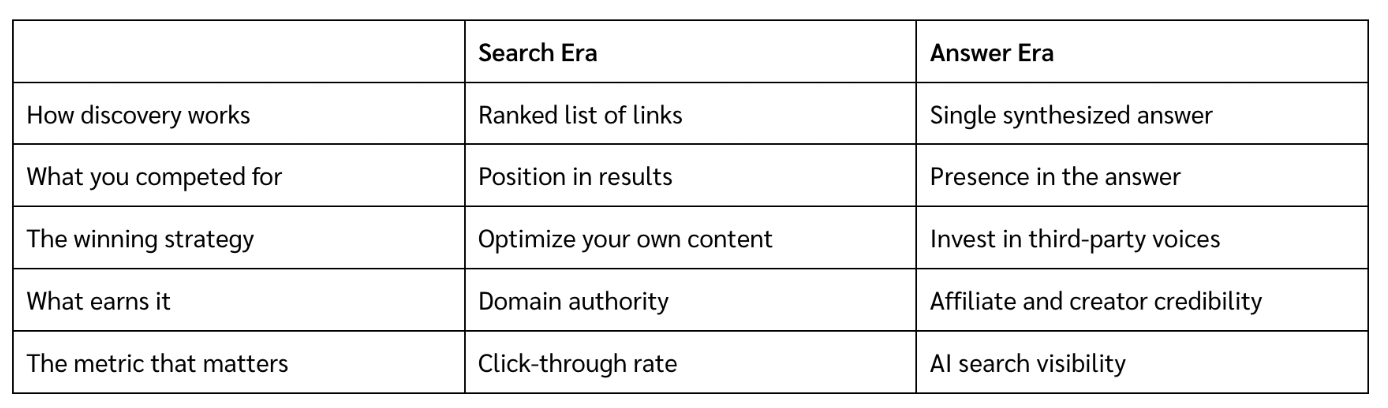
Every year, we spend Q3 fine-tuning our clients' holiday strategy around the same assumption: a shopper searches, clicks a few links, compares options, and lands on a product page. That assumption no longer holds. Search is quietly becoming an answer engine instead of a directory, and for brands heading into the busiest quarter of the year, that shift changes where discovery actually happens.

Here’s what the data is telling us, why it matters heading into Q4, and how we're advising our clients to adapt.

The Numbers Behind the Shift

We don't need to guess at this trend; the research backs it up. Bain & Company's consumer survey found that roughly 80% of shoppers now rely on zero-click, AI-generated results for at least 40% of their searches, with organic web traffic falling an estimated 15% to 25% as a result.

Pew Research Center's independently tracked browsing data tells a similar story from a different angle. For example: When a Google search surfaced with an AI Overview, users clicked through to a traditional result in only 8% of visits. When no summary appeared, CTR rose to 15%. Clicking a link inside the AI summary itself was rarer still, happening in just 1% of visits.

For retail specifically, Adobe Analytics is tracking the flip side of that coin. AI-driven traffic to U.S. retail sites grew 393% year over year in the first quarter of 2026, building on a 693% surge during the November and December 2025 holiday season. That traffic is also converting better than traditional channels now – a full reversal from where things stood just a year earlier.

We're not losing shoppers to AI. We're losing visibility to them at the exact moment they're deciding what to buy.

From Search Results to Shopping Agents

The zero-click shift isn't only about summaries at the top of a search page anymore. It's also about who (or what) is doing the shopping. Forbes recently outlined how agentic AI is increasingly researching, comparing, and recommending products before a shopper ever opens a browser tab. That means the "discovery moment" brands have spent years optimizing for is now being mediated by an assistant rather than a person.

A few things we're watching as this trend accelerates into Q4:

  • Structured data is doing the work SEO copy used to do. If an AI agent can't interpret our clients' product specs, inventory, and pricing cleanly, it moves on to a competitor who makes that easy.

  • Citations are the new rankings. Being named as a source inside an AI Overview or agent response is quickly becoming as valuable as a first-page ranking used to be, and it's not guaranteed to any brand by default.

  • Conversion, not just traffic, is the metric that matters. Because AI-referred shoppers tend to be further along in their decision by the time they land on a site, we're advising clients to measure conversion lift from these visits rather than judging AI traffic against old click-volume benchmarks.

What This Means for Our Q4 Strategy

We're heading into the highest-stakes shopping quarter of the year with a genuinely different discovery landscape than we had even twelve months ago.

Here's how we're thinking about it for our clients:

  • Audit product and content data for machine readability, not just human readability, so it can be surfaced accurately in AI Overviews, shopping agents, and chat-based assistants.

  • Diversify the content formats we're producing. Video, structured FAQs, and clearly attributed expert content all have a better shot at being cited than a traditional blog post alone.

  • Keep an eye on brand consistency across every platform, from Google Business Profile to Wikipedia to review sites, since AI systems weigh consistency heavily when deciding which brands to trust and recommend.

  • Treat AI visibility as its own line item in Q4 reporting, separate from traditional organic and paid performance, so you can see the shift clearly rather than watching it get buried in a blended traffic number.

Our Take

This is a genuine structural change, not a passing algorithm update, and brands that treat it that way will be the ones positioned to capture demand their competitors won’t even see. The brands that show up inside AI answers now are the ones building trust with a buyer who may never click through at all.

If you're rethinking your discovery strategy ahead of the holidays, reach out to the RMP team. Let's talk about what a Q4 built for AI-first discovery looks like for your brand.

Sources:

  • Bain & Company, "Goodbye Clicks, Hello AI: Zero-Click Search Redefines Marketing" — bain.com/insights/goodbye-clicks-hello-ai-zero-click-search-redefines-marketing/

  • Pew Research Center, "Do people click on links in Google AI summaries?" — pewresearch.org/short-reads/2025/07/22/google-users-are-less-likely-to-click-on-links-when-an-ai-summary-appears-in-the-results/

  • Adobe Analytics / Adobe Digital Insights, Q1 2026 AI Traffic Report — business.adobe.com/blog/ai-traffic-surge-retail-sites-not-machine-readable

  • Forbes, "A 2026 Guide To Getting Agentic AI To Recommend Your E-Commerce Site" — forbes.com/sites/catherineerdly/2026/02/22/a-2026-guide-to-getting-agentic-ai-to-recommend-your-e-commerce-site/

Q4 Readiness: How to Prepare Your Affiliate Marketing Strategy For The Holidays

Brands that consistently outperform in Q4 don’t start preparing in October. They start now. The ones that win the holiday season have already locked publisher placements, aligned promotions, refreshed creative, and optimized their programs before the rush hits. Here’s how to build that foundation before the window closes.

Finalize Your Promotional Calendar

Nail down what offers and promotions you're supporting in the back half of the year. What’s planned for the following occasions?

  • Halloween

  • Early Holiday Sales

  • Black Friday

  • Cyber Week

  • Giving Tuesday

  • Green Monday

  • Free Shipping Day

  • Shipping Deadlines

  • Boxing Day/End of Year Clearance

Publishers often plan their content calendars weeks or months in advance, so having promotions locked in early improves your chances at securing placement opportunities, especially where inventory is limited (for example, with loyalty sites). 

Identify Your Top Performers 

Your top performing partners are the ones you can count on to deliver in Q4, start there. These publishers are partners that have consistently performed well for you in the past, that you can most likely count on to continue providing strong performance for you in the future. This is your first group of publishers to reach out to and discuss: their Q4 opportunities, what they need, and how you can work together. 

Prioritize Publisher Outreach

At the start of Q4, many publishers will go into code freezes and not add any new partners to their sites. On top of that, placements for this time of year are at a premium, and likely to sell out if you don’t have your Q4 media purchased by early-October. 

If you wait until you get closer to Q4 to investigate partner and placement opportunities, you’ll find that most of those spots have gone to your competitors. 

Build Trust With Customers

Shoppers start with research, not intent. Gift guides, review roundups, and editorial comparisons shape purchase decisions well before Black Friday hits. That research happens largely on the same publisher properties that power your affiliate program. Getting placed in those editorial features early puts your brand in the consideration set before your competitors do. By the time a shopper is ready to act on a promotion, the brands they already know have a meaningful conversion advantage.

Determining Which Placements Are The Right Fit

Buying early matters, but placement fit matters just as much. When searching for placements opportunities, you should consider a few things:

  • What key shopping moments align with your promotional calendar? 

  • What budget is available for Q4 placements? Does a flat-fee, or commission model make more sense?

  • Is your content in platform seasonally relevant, and up-to-date? 

  • Have you bought media with this publisher in the past? How did it perform?

    • If not, do they have case studies or relevant performance information they can share with you?

Review Your Commissioning Strategy

Beyond paid placements, your commissioning strategy can provide an opportunity to increase visibility with publishers. Consider the following optimizations:

  • Temporary commission increase to boost publisher performance

  • Performance-based commission increases

  • Category-specific commission boosts

  • Exclusive commission tiers for top partners

The holidays significantly increase competition. Providing competitive payouts to publishers can help secure greater visibility, increase your potential to be written about by content sites, and boost your potential conversion rate on cashback sites. 

A successful Q4 doesn't happen by chance. It starts with the decisions made now: which publishers to prioritize, which placements to lock in, how to position your program before your competitors do.  The brands that win the holiday season aren’t reacting to it; they’ve already set the terms.  If you’d like an experienced team to help build that foundation, RMP’s affiliate specialists are ready to dig in. Start planning now, and you'll enter Q4 with a program that's built to compete and win.

Sources: 

Audience Layering Strategies: Turning Q2 Upper Funnel Efforts into Q4 Conversions

In June, a shopper scrolls past a video ad showing how a new moisturizer looks on the skin. A few weeks later, another ad brings her to the brand’s website, where she browses several products but leaves without purchasing. By December, she needs a refill. She remembers the brand, searches for it by name, and finds a holiday promotion offering 20% off. 

The promotion might’ve closed the sale, but it didn’t create the demand on its own. In a standard report, the shopper’s branded search might receive most of the credit, even though the brand had been building familiarity for months. 

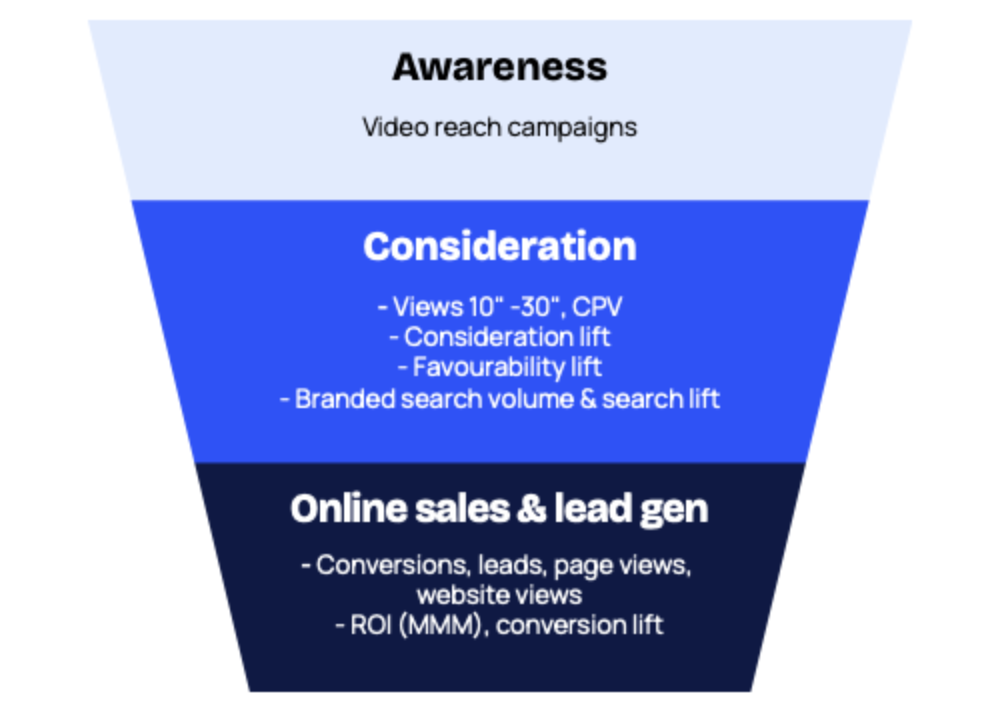
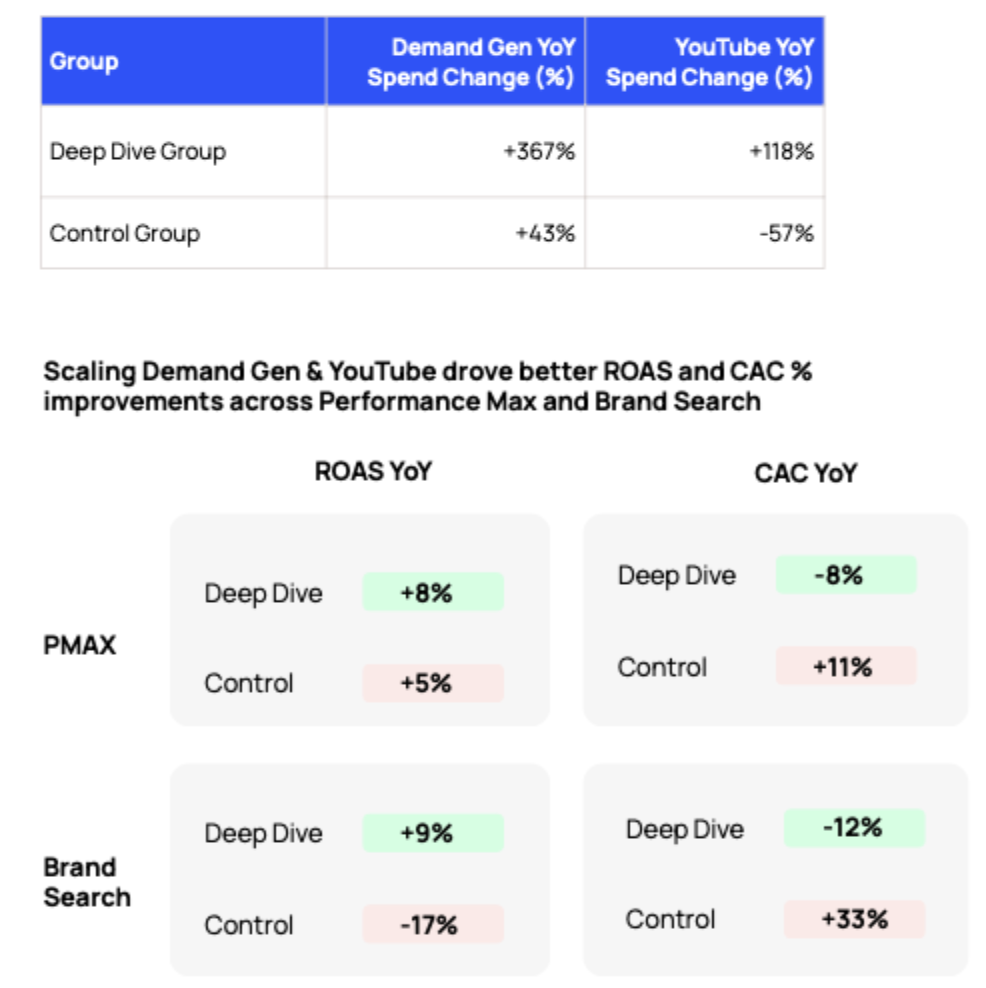
We’ve previously explored how Demand Gen and YouTube can build audiences that convert in Q4. Creating early demand is only the beginning. Marketers also need a way to distinguish a passing impression from developing interest and, eventually, purchase intent. 

Audience Layering Distinguishes Interest From Intent

An “all website visitors” list is technically an audience, but it’s not much of an audience strategy. 

Someone who watched part of a video shouldn’t automatically receive the same message as someone who returned to the website twice and abandoned a cart. The video viewer has shown interest. The cart abandoner has shown intent. Combining them into one group ignores the most useful difference between their behavior. 

Audience layering separates users according to their relationship with the brand:

  • New prospects haven’t meaningfully interacted with the brand.

  • Engaged users might’ve watched a video, interacted with an ad, or visited the website.

  • High-intent users have returned to the site, explored products, or abandoned a cart.

  • Customers include previous purchasers, high-value customers, and lapsed customers. 

Q2: Build First-Party Audiences Early 

Demand Gen, YouTube, and other upper-funnel campaigns can introduce a brand before someone is actively searching for it. A shopper watching an ad in June might not be ready to buy, but her engagement offers an early indication of what exactly captured her attention.  

Not every video viewer will become a customer, and audience size alone doesn’t indicate value. Separating video viewers, website visitors, category and product visitors, repeat visitors, leads, and purchasers allows marketers to see which groups continue engaging as the year progresses. 

Audience duration also requires judgment. Google Analytics allows membership durations of up to 540 days, but someone who briefly visited six months ago might be less relevant than someone who returned last week. The appropriate duration should reflect the brand’s buying cycle and typical research period. 

That research period can extend further than the final conversion date suggests. The National Retail Federation found that 42% of 2025 holiday shoppers planned to begin browsing or buying before November, while 60% expected to finish in December. This extended timeline gives early familiarity time to develop into consideration. 

Q3: Refine Audience Segmentation Before Holiday Competition

By Q3, advertisers can begin separating people who briefly encountered the brand from those who continued engaging with it. Did video viewers eventually visit the website? Did category visitors return to individual product pages? Which messages attracted people who kept exploring, rather than those who produced an inexpensive click and disappeared? 

These patterns also guide creative strategy. A person encountering the brand for the first time might respond to a lifestyle, problem, or use case. Someone comparing products might need more specific information: benefits, demonstrations, reviews, or proof that the product is worth its price. 

Q3 is also the time to refresh Customer Match lists, confirm that acquisition campaigns are excluding existing customers where needed, and check whether key audiences are large enough to activate. By the time Q4 begins, the window for discovering which audience differences actually influence performance is already narrowing. 

Q4: Use Audience Targeting Across Google Ads 

By December, the shopper knows the brand exists, and she’s deciding whether to purchase from it. Another broad introduction does little to answer the questions that remain. 

High-intent users might respond to product-specific creative, promotions, availability, or urgency. Engaged users who have not yet explored products might still need reviews and differentiators. Existing customers might be better suited for gifting, complementary products, or reactivation messaging. 

The audiences can also serve different functions across Google Ads:

  • In Search, audiences can be added in Observation mode to compare performance without limiting keyword reach. 

  • In Performance Max, first-party audiences can be used as signals that help guide Google’s optimization. They don’t restrict delivery exclusively to those users. 

  • In Demand Gen, website visitors, video viewers, and customer data can support re-engagement. Advertisers can also create Lookalike segments to reach new users who resemble their first-party audiences, a capability currently unique to Demand Gen. Beginning in March 2026, Google started shifting Lookalikes from a firm targeting constraint toward an AI-powered audience signal that guides optimization rather than strictly limiting reach. 

  • In YouTube, video ad sequence campaigns can deliver creative in a defined order, introducing the brand first and following with more specific messaging as the viewer progresses through the sequence. 

  • Through Customer Match, advertisers can distinguish acquisition from retention and create more relevant campaigns for current or lapsed customers.  

The platform mechanics matter, but the underlying principle is simple: the follow-up should reflect what the customer has already done. Audience layering loses most of its purpose when everyone receives the same holiday promotion in the same way. 

Measure the Progression, Not Only the Final Click

Nielsen recommends measuring upper-and lower-funnel activity separately because each stage serves a different purpose. In Q2, engagement and audience growth can show whether a campaign is attracting attention. By Q4, revenue, conversion rate, CPA, and ROAS become more important. 

Attribution reporting can identify the interactions that preceded a conversion, but it can’t prove that every Q4 purchase was caused by a Q2 impression. Marketing platforms cannot reconstruct every customer’s journey with perfect certainty, and advertisers shouldn’t waste time pretending they can. Audience layering provides a practical way to recognize that different behaviors carry different levels of intent and respond with greater relevance. 

Build the Handoff Before It’s Needed

A branded search or holiday promotion might produce the final sale, but neither explains how the brand entered the shopper’s consideration. Building audiences in Q2, refining them in Q3, and activating them in Q4 connects those earlier interactions to the conversion strategy. The final click is the conclusion of that work, rather than the entire customer journey. Ready to put your Q2 and Q3 audience data to work in Q4? Let’s talk. 

Sources

How to Improve Your Ad Hook Rate and Use It to Reach the Right Audience

The first few seconds of an ad do a lot of work.

Before someone understands your product, evaluates the offer or clicks through to your site, you have to give them a reason to stop scrolling. That is where hook rate comes in.

Hook rate helps you understand whether the beginning of your video is strong enough to earn attention. It can also tell you whether your message is connecting with the right audience. That makes hook rate an important targeting signal, not just a measure of creative performance. Comparing it across audiences can help reveal where your message feels most relevant and who is most likely to keep watching.

The important part is not looking at hook rate by itself. A high hook rate does not automatically mean you have a winning ad. Sometimes it means you have a great opening. Other times, it means you created something interesting that attracted a lot of people who were never going to buy.

The real goal is not to catch the attention of everyone. It is to engage with the right people.

What Is Hook Rate?

Hook rate measures how many people watched the opening portion of your video after seeing the ad.

Most teams calculate it using:

Hook rate = 3-second video views ÷ impressions

Some platforms or reporting tools may use video starts instead of impressions. Either method can work. The most important thing is using the same calculation every time so you are making an apples-to-apples comparison.

Hook rate answers one basic question:

Was the beginning of the ad strong enough to get someone to keep watching?

There is not one universal benchmark for a “good” hook rate. Performance will vary by platform, placement, audience, video length and creative format.

Benchmarks are a great starting point, but you want to compare your hook rate against other ads in the same account. That will give you a much better idea of what is actually strong for your brand.

Your Creative Is Doing Some of the Targeting

Meta, TikTok and other paid-social platforms are increasingly pushing advertisers toward AI targeting.

That means your creative is doing more of the audience targeting than it used to.

The person featured in the ad, the language being used and the problem being discussed all help the platform understand who might be interested. They also help viewers quickly decide whether the ad is relevant to them.

Compare these two hooks:

  • “Meet the skincare product everyone is talking about.”

  • “Still dealing with breakouts on your back and chest?”

The first hook could apply to almost anyone. The second immediately speaks to someone dealing with a specific problem.

The more specific hook may reach fewer people, but that is not necessarily a bad thing. If the people who stop are more likely to click and purchase, it is doing a better job.

This is also why the ad with the highest hook rate is not always your best ad. A broad or entertaining hook may earn more views, while a more specific hook may bring in fewer, but much more qualified, viewers.

Start With a Specific Problem or Outcome

One of the easiest ways to improve hook rate is to get to the point faster.

Do not spend the first few seconds introducing your company, explaining your background or slowly building up to the product. Start with the problem your customer wants to solve or the result they want.

For example:

  • “Why does your skin clear up everywhere except your back?”

  • “If getting dressed feels impossible after having kids, try this.”

  • “Here’s how I cut ten minutes from my morning routine.”

The more specific the problem, the easier it is for the right person to recognize that the ad is meant for them.

Generic hooks may reach a larger audience, but specific hooks are usually better at qualifying that audience.

Call Out the Audience Early

Sometimes the simplest way to target the right person is to name them.

That could mean calling out a demographic, life stage, frustration, use case or goal:

  • “For busy moms who need an easier weeknight dinner…”

  • “If you have sensitive skin but still struggle with breakouts…”

  • “For anyone tired of jewelry that irritates their skin…”

This will naturally cause some people to keep scrolling. That is okay.

Good targeting is not only about attracting people. It is also about helping people who are not a fit quickly move on. You do not need every impression to turn into a three-second view. You need the right impressions to turn into clicks and purchases.

Show the Product or Result Immediately

Do not make people guess what the ad is about.

Show the product, demonstration, transformation or finished result within the opening frames. Ideally, someone should be able to understand the basic idea even if they are watching without sound.

The first few seconds should communicate at least one of the following:

  • What the product is

  • What problem it solves

  • How it is used

  • What result it creates

  • Why it is different

On-screen text can help, but the visual still needs to do some of the work. A strong headline over an unrelated opening shot will only get you so far.

Make the Ad Feel Native

People are very good at recognizing ads.

Highly polished creative can work, but it can also make someone scroll before they have processed the message. Creator-led videos, reviews, demonstrations and casual product footage often feel more natural in a social feed.

Native-looking does not mean sloppy or low-quality. It means the ad looks and sounds like something the person might already consume on that platform.

The best version usually falls somewhere in the middle: natural enough to earn attention, but structured enough to clearly explain the product and offer. Nuance: high AOV and luxury brands can use more produced or polished creative since that helps align expectations to the high-quality and higher price nature of those products.

Test the Hook Without Changing Everything Else

A common creative-testing mistake is changing too many things at once.

If you change the hook, video body, offer, call to action and landing page, you will have no idea what actually improved performance.

Instead, take one core video and test several openings:

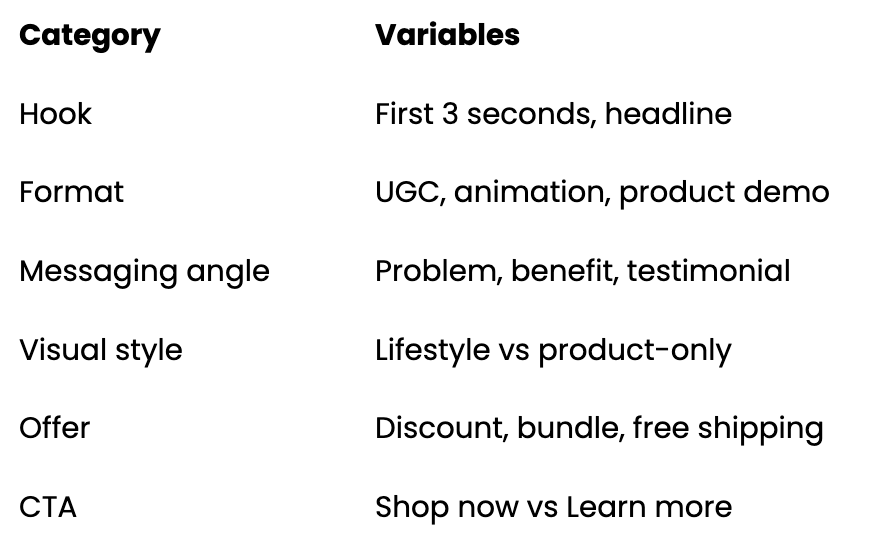
  • A problem-focused hook

  • A benefit-focused hook

  • A customer-review hook

  • A direct audience callout

  • A surprising statement

  • A question

  • A product demonstration

Keeping the rest of the ad relatively consistent gives you a much cleaner read on which message is actually earning attention.

It also makes creative production more efficient. You do not need seven completely different videos to test seven hooks.

Hook Rate Is Only the First Step

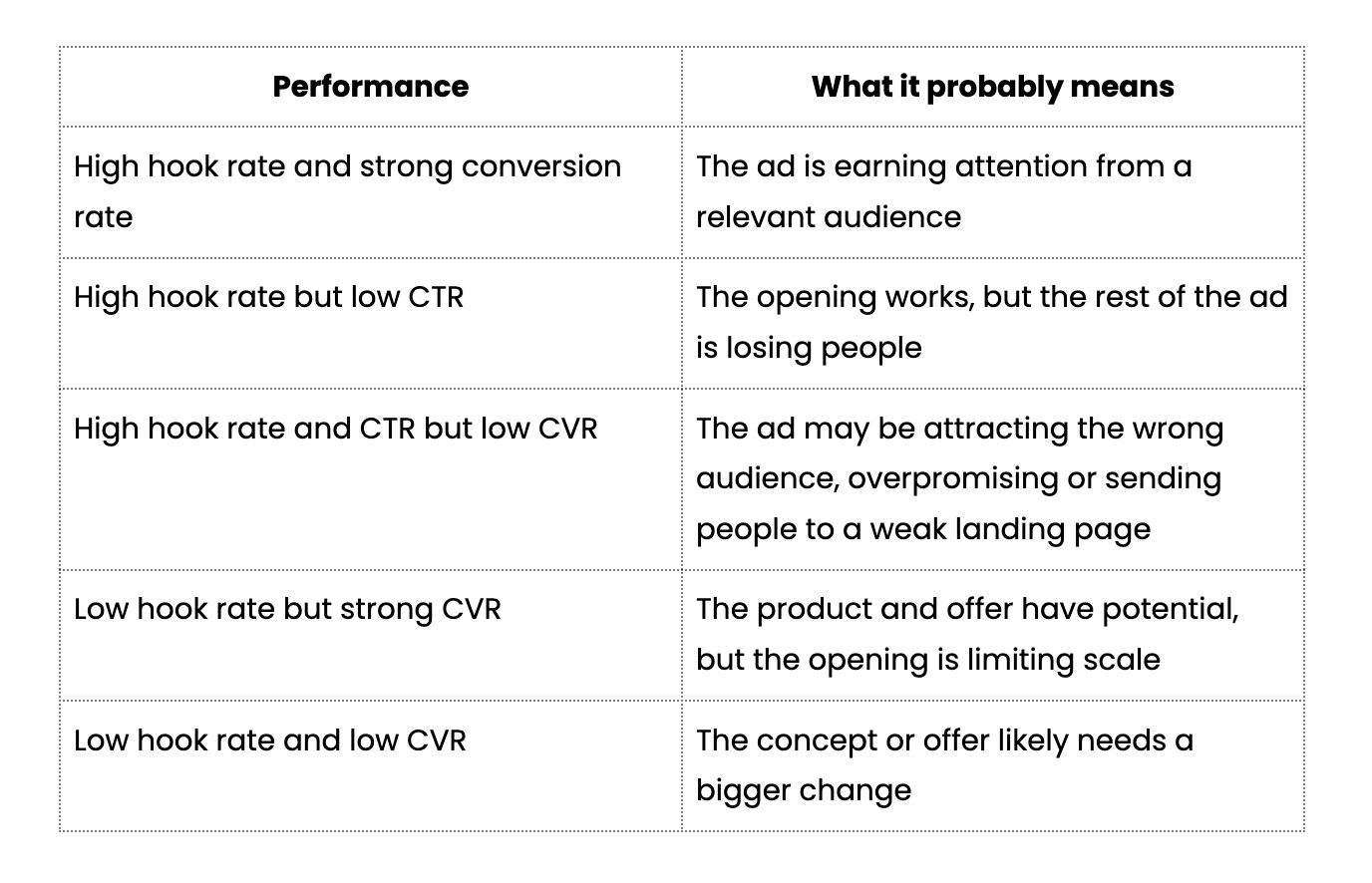
Hook rate tells you whether the opening worked. It does not tell you whether the rest of the ad worked.

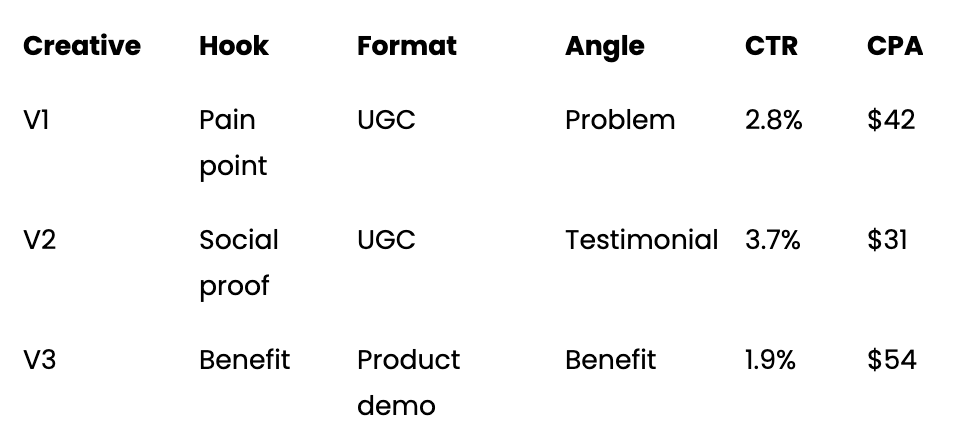
You still need to evaluate click-through rate, conversion rate, CPA and ROAS.

Here is how to interpret the most common performance combinations:

This is where advertisers can get into trouble by optimizing only toward engagement.

You can create a sensational hook that generates a lot of video views, but if those viewers never click or purchase, you did not actually improve the campaign. You just made the top of the funnel look better.

If new-customer acquisition is the goal, take it one step further. Look at new-to-file orders, new-customer CPA and new-customer ROAS. A high hook rate and strong platform ROAS do not mean as much if the ad is mainly reaching existing customers.

Hook Rate Can Also Help Identify Creative Fatigue

Creative fatigue happens when an audience has seen the same ad enough times that it stops getting the same response.

A declining hook rate can be one of the earliest signs. An opening that originally stopped people may become easy to ignore after repeated exposure.

Other signs include:

  • CTR steadily declining

  • Frequency increasing

  • CPM or CPA rising

  • Video completion rate falling

  • Conversions declining despite similar delivery

  • Comments mentioning that the ad keeps appearing

The key word here is “steadily.”

One bad day does not mean your creative is fatigued. Performance can move because of competition, seasonality, budget changes, site conversion rate or normal day-to-day volatility.

Creative fatigue is more likely when hook rate and CTR continue to trend down while frequency and costs move up.

It is also important to consider spend and audience size. A high-spend campaign targeting a limited audience can fatigue quickly. An ad running at a lower budget against a large audience may stay productive much longer.

There is no set number of days after which an ad automatically becomes fatigued.

Refresh the Part That Is Actually Fatigued

Creative fatigue does not always mean you need to throw out the entire ad.

If hook rate is declining but the people who continue watching are still clicking and converting, the opening may be the problem. Try a new first visual, opening line or on-screen headline while keeping the rest of the video.

If hook rate is still strong but CTR and conversion rate are falling, the problem may be deeper. People are interested enough to watch, but the product story, value proposition or offer is no longer convincing them.

Think about creative refreshes at three levels:

  1. Hook refresh: Change the first visual, opening line or headline.

  2. Format refresh: Turn the same message into a review, demonstration, comparison, static image or creator video.

  3. Concept refresh: Introduce a new customer problem, benefit, objection or use case.

Small changes such as switching the music, background color or caption style may extend an ad’s life, but they usually will not fix true concept fatigue.

Use Your Customers to Find Better Hooks

The best hooks usually come from real customer language.

Look at:

  • Product reviews

  • Customer-service questions

  • Social comments

  • Website searches

  • Frequently mentioned objections

  • Reasons customers say they purchased

  • Products or solutions they tried before finding yours

These sources will show you how customers describe the problem in their own words.

From there, build different hooks around different motivations. A skincare brand, for example, could test hooks focused on embarrassment, convenience, sensitive skin, visible results or failed alternatives.

Each hook gives the platform a slightly different audience signal. More importantly, each one gives a different type of customer a reason to stop.

The performance data will then tell you which problems and motivations are attracting the most valuable people, not just the most viewers.

The Takeaway

Improving hook rate is not about making every ad louder, faster or more dramatic.

It is about making the opening more relevant.

A strong hook should quickly communicate who the ad is for, what problem it addresses and why someone should keep watching. From there, your click and conversion metrics will tell you whether that attention came from the right audience.

Watch how hook rate changes over time, compare it against downstream performance and look for fatigue as frequency increases.

The goal is not just to stop more thumbs. It is to stop the right thumbs and give those people a reason to take the next step.

Traditional Out-of-Home vs. Digital Out-of-Home: Which Is Right for Your Brand?

Out-of-home (OOH) advertising has been helping brands build awareness for decades. Whether it's a billboard along a busy highway or a wrap on a public transit bus, OOH remains one of the most effective ways to reach consumers beyond their personal devices. While traditional OOH and Digital Out-of-Home (DOOH) generally share the same end goal, the way campaigns are bought, managed, and measured differs significantly. 

Traditional Out-of-Home (OOH)

Traditional OOH included static placements such as billboards, wall murals, bus wraps, and subway posters that remain in place for the duration of a campaign.

The media buying process involves selecting markets, reserving inventory through media owners, producing creative, and scheduling installation. Because physical production is required, campaigns need to be planned well in advance and offer little flexibility once they're in motion.

Traditional OOH is a powerful awareness channel, offering brands visibility in premium locations and helping build long-term brand recognition through repeated exposure.

Digital Out-of-Home (DOOH)

DOOH builds on the foundation of traditional OOH by replacing static placements with digital screens. Today, DOOH inventory can most commonly be found in airports, shopping malls, transit stations, office buildings & gyms. 

Because the creative is served digitally, advertisers can update messaging quickly without the need for printing or installation. This makes DOOH a great option for promotions, product launches, seasonal pushes, or messaging that may change throughout the duration of the campaign.

The Biggest Difference: Media Buying

The biggest distinction between OOH and DOOH isn't necessarily what consumers see, it's how advertisers purchase the inventory.

Traditional OOH is typically bought directly from media owners, with placements reserved weeks or even months in advance. Once the campaign launches, budgets, locations, and creative are largely fixed.

DOOH offers much more flexibility. Inventory can often be purchased programmatically through Demand Side Platforms (DSPs), allowing advertisers to launch campaigns faster, update creative, optimize budgets, schedule ads by time of day, and make adjustments while the campaign is still running.

Impact & Measurement

Both formats are highly effective for building awareness, but they each offer unique advantages.

Traditional OOH delivers scale and long-term visibility. A single premium billboard can generate millions of impressions over its campaign, making it an excellent tool for building brand recognition and staying top of mind.

DOOH offers many of those same awareness benefits while adding greater precision. Advertisers can tailor messaging based on factors like time of day, weather, or location, and gain access to more detailed reporting on impressions, delivery, and audience reach. While it's still primarily an awareness channel, the added flexibility and optimization capabilities make it easier to maximize campaign performance. Some programmatic DOOH platforms also offer retargeting capabilities. Using privacy-compliant, anonymized mobile device data, advertisers can reconnect with audiences who were likely exposed to a DOOH ad by serving follow-up ads across channels like display, CTV, & paid social. This helps extend the campaign beyond the initial impression and reinforce the message across multiple touchpoints.

Which One is Right for Your Brand?

The best choice ultimately depends on your campaign objectives, budget, and desired level of flexibility. If your goal is to establish a consistent brand presence, maximize visibility in high-traffic locations, and reinforce long-term messaging, traditional OOH remains a highly effective option. Its static placements are well-suited for sustained awareness campaigns that prioritize broad reach and repeated exposure over time. DOOH, on the other hand, is ideal for brands looking for greater agility. The ability to update creative and optimize campaigns while they're live makes it particularly effective for product launches, seasonal activations, and campaigns that require more dynamic, targeted messaging. DOOH also offers advertisers greater control over budgets & scheduling than traditional OOH.

Ultimately, the most effective approach isn't always choosing one format over the other. Whether you incorporate traditional OOH, DOOH, or a combination of both, out-of-home advertising is a valuable way to diversify your media mix beyond consumers' personal devices.  By adding OOH alongside platforms like Google, Meta, and TikTok, brands can broaden their reach and create a more balanced omnichannel strategy.

ChatGPT Ads Just Grew Up: What CPA Bidding, Audience Uploads, and Product Feeds Mean for Your Q4 Budget

Earlier this year, OpenAI launched ChatGPT self-service ads in the US, giving advertisers direct access to one of the world's fastest-growing AI platforms. The announcement made headlines, but the bigger story is what's happened since.

When the beta rolled out in May, we published a step-by-step guide to setting up campaigns, highlighting the features that were still missing. In the weeks since, the platform went live in four more countries and has rolled out new capabilities, including CPA bidding, product feeds, and custom audiences.

Let’s break down everything you need to know about these changes and what they mean for your Q4 planning.

CPA Bidding Is Live. Is It Ready for a Real Budget?

When ChatGPT ads first launched, clicks and reach were the only campaign objectives advertisers could set. As of June 5, that is no longer the case. Per Digiday and The Keyword, OpenAI activated conversion-optimized CPA bidding, meaning advertisers only pay for a completed action like a click-through, sign-up, or purchase, while OpenAI absorbs the cost of any impression or click that doesn't convert. This shift allows ChatGPT Ads to optimize the lower funnel, where it can tie campaigns directly to outcomes. 

Our hypothesis is that the current model will evolve as it scales. It's possible ChatGPT Ads eventually shifts toward something like Google's Target CPA bidding, where advertisers pay for every click, whether it leads to a conversion or not, but the system automatically adjusts bids to hit a target CPA.

The ultimate question is whether ChatGPT ads are worth the spend. So here's a straight answer: CPA bidding is real, but the measurement underneath it is still green. OpenAI's dashboard is currently the only source of truth on your CPA, because there is no independent, third-party verification yet. Digiday reports that OpenAI's global head of ads, David Dugan, called the arrival of third-party measurement "a natural evolution." This is not a reason to write off the feature but a reminder to treat the number on your dashboard as directional, not complete, and use a test budget against CPA objectives. 

A few things to note: CPA bidding wasn't formally announced. The update came through an email to pilot advertisers, which Digiday later reported on, revealing that only accounts with Pixel or Conversions API set up prior to June 1st would be granted early access on June 5th. Businesses that missed that window weren't part of the first wave. OpenAI hasn't given a broader rollout date yet, but we expect this gate to matter less as the platform matures. For now, the safest move is to get your tracking in place before the next wave, whenever it comes. 

Product Feeds are Here. What That Means for Ecommerce

OpenAI has officially shipped product feed ads in Ads Manager, allowing retailers to upload their current catalog directly into the platform and automatically generate ads from it, instead of building them one by one. Search Engine Land broke the news, sourced from an email JXT Group founder Menachem Ani received directly from OpenAI. The goal is to bring more inventory into the platform at scale and put the right products in front of users when intent is highest. For ecommerce businesses already running PMax, Google Shopping or Meta's catalog-based dynamic ads, the mechanics will feel familiar.

According to OpenAI, catalog ads are already outperforming other formats, but there are a few practical details worth knowing before you get started: feeds require a minimum of 1,000 products and can contain up to 2 million, but each ad account can only connect one feed at a time, so multi-brand or multi-region catalogs will need to be consolidated. Products in your feed won't show up in organic ChatGPT conversations, just in paid placements, though OpenAI has signaled that could change down the line. If you're ready to get started, OpenAI's Help Center walks through the full setup, from creating your feed to launching your first campaign.

Audience Uploads vs. Customer Match

The rumors are true, custom audiences are live. Custom audience uploads are ChatGPT's version of first-party targeting. It's the same idea behind Google Customer Match or Meta Custom Audiences: take a list of existing customers or prospects, upload it, and use it to tell the AI who gets served the ad.

The good news is that ChatGPTs identifier formatting rules are similar to Google and Meta, so using an email address or phone number from lists you've built for those platforms should upload here with little to no lift. Once that list is uploaded, you can put it to work in three ways: use it as an inclusion audience to limit a campaign to only people on that list, useful for reaching known customers or qualified prospects directly. Use it as an exclusion audience to keep a campaign from showing to people on the list, to avoid re-targeting existing customers or recent purchasers. Or apply it as a bid adjustment, raising or lowering how competitively you bid depending on the value of a customer.

What doesn't carry over automatically is your match rate. ChatGPT's identity graph is younger than Google's or Meta's. Some contacts may not use ChatGPT, others may have signed up with a different email or phone number. Expect your matched size to run lower than your uploaded list once duplicates and unmatched identifiers get filtered out. Craig Graham, CEO of Grayvault Consulting, told MediaPost that a modest match rate is perfectly normal.

ChatGPT requires a minimum of 25,000 matched users before an audience can go live, but recommends at least 100,000 for better measurement, so prioritize volume and quality when deciding which list to use first. There's also no lookalike modeling yet, so a small, high-quality list can't be used to find new, similar prospects the way it can on other platforms.

The Q4 Decision Framework

So where does that leave your Q4 budget planning? 

If your business has been quietly testing ChatGPT Ads since Q2 or Q3, this is your signal to formalize a Q4 line. Confirm your conversion event has been live long enough to qualify for CPA bidding, get your product feed submitted and approved, and set a real number against the channel. Do this now, and you'll be optimizing on live data by the time Q4 peak spend hits.

Adthena's research on AI-driven search found that brands cited within Google's AI Overviews saw a 91% higher paid CTR than brands that weren't cited (7.89% vs. 4.14%). That's not a ChatGPT-specific number, but it points to the broader theme of where conversational platforms seem to be heading: visibility inside the AI response itself is starting to shape how paid placements perform. Brands that pay attention to how they show up in AI-generated answers, may be the ones who see this channel pay off first.

If you haven't started at all, it's not too late to get in position, but the clock is ticking. Account verification alone has been running 5 to 15 business days, and feed review adds more time on top of that. If your Q4 planning locks in the next few weeks, get your account verified and your Pixel or Conversions API live now, even if your strategy isn’t fully baked in.

The pattern here is clear: this technology is evolving faster than most clients plan for. Brands with clean measurement and organized first-party data get to act the moment a new feature rolls out. Everyone else spends their first month catching up. As always, our team is watching every update as it lands and we'll keep you posted on what's worth acting on.

Sources

The Incremental Value of Affiliate Marketing in a Cross-Channel Mix

Why Affiliate Marketing Deserves More Credit in Today's Cross-Channel Customer Journey

Affiliate marketing has long faced the same challenge: proving its true impact.

As customer journeys become increasingly complex, marketers are under growing pressure to understand not just which channels receive credit for conversions, but which channels actually drive incremental growth. 

This is why understanding the incrementality of affiliate marketing is more important now than ever before.

Many brands still evaluate affiliate performance through a last-click lens, overlooking the role affiliate partners have throughout the customer journey. Whether a consumer discovers a product through a content creator, researches options on a review site, or ultimately converts through a cashback site, an affiliate publisher often influences outcomes long before the final click.

To understand the true value of affiliate marketing, brands need to look beyond attribution and focus on incrementality—the additional sales, customers, and revenue that would not have occurred without affiliate participation in the mix.


Attribution Tells You The Effect. Incrementality Tells You The Cause.

Attribution and incrementality are often discussed together, but they answer different questions.

Attribution identifies which marketing touchpoints receive credit for a conversion.

Incrementality measures whether a marketing activity generated outcomes that would not have happened without that activity.

This difference is especially important in affiliate marketing because partner influence often occurs across multiple touchpoints throughout the customer journey.


For example:

  • A content creator introduces a shopper to a new brand.

  • A product review site helps validate the the creator's recommendation.

  • A loyalty partner finalizes the buying process at checkout.

Without a cross-channel view, affiliate may appear to have contributed little value. In reality, it may have played a critical role in moving the customer toward purchase.


When evaluating affiliate incremental performance, brands should look beyond conversion credit and ask:

  • Did affiliate partnerships drive net-new customers?

  • Did affiliate activity increase sitewide conversion rates?

  • Did affiliate contribute to higher average order values?

  • Did affiliate improve overall channel efficiency?

  • Did affiliate influence purchases that may have otherwise gone to competitors?

These questions move the conversation beyond attribution and toward business impact.


Why Affiliate Marketing Is Undervalued in Cross-Channel Measurement

One of the biggest challenges facing affiliate marketing today isn't performance—it's measurement.

Many organizations still evaluate affiliate programs using attribution models designed around the final conversion event. While those models can identify who received credit for a sale, they often fail to capture how affiliate partners influenced the customer journey before the purchase occurred.

Remember, Incrementality focuses on determining whether a marketing activity generated outcomes that would not have happened otherwise. This distinction becomes particularly important in affiliate marketing because partner influence often occurs throughout the consideration process rather than at a single conversion point.


For example, a customer might:

  • Discover a product through an influencer partnership.

  • Research options through a content publisher or review site.

  • Engage with paid social or search advertising.

  • Convert after interacting with a loyalty or rewards partner.

In a last-click model, only the final interaction receives credit. In reality, multiple affiliate touchpoints may have contributed to moving the customer closer to purchase.

This is why brands increasingly evaluate affiliate performance alongside other channels rather than in isolation. Looking at affiliate within the broader marketing ecosystem provides a more complete picture of how partnerships influence customer acquisition, consideration, and conversion.


What the Data Says About Incremental Affiliate Sales

Proving out incremental value is always an ongoing conversation that we have with brands, and the metric we use most often is new vs. returning customer data that we support with wider sitewide metrics like CVR and AOV. We do these analyses most often for loyalty partners, and the result always proves these partners are incremental with more than half of customers converting being new. 

One of the most widely cited studies on affiliate incrementality comes from CJ, which analyzed more than 20 million retail consumers and 5.5 million transactions using a test-and-control methodology.


The findings were notable:

  • Affiliate shoppers converted at a 46% higher rate than non-affiliate shoppers.

  • Affiliate customers spent 29% more per customer.

  • Affiliate engagement generated 88% higher revenue per shopper compared to consumers who did not interact with affiliate partners.

While every affiliate program is different, the study and our anecdotal findings highlight an important point: affiliate marketing can influence customer behavior in ways that extend beyond a single transaction.

Affiliate participation was associated with stronger conversion rates, higher spending, and greater long-term value when compared to similar consumers who did not engage with affiliate partners.


Affiliate's Role Across the Modern Marketing Mix

Affiliate marketing has evolved far beyond coupon sites and last-click conversions.

Today's partnership ecosystems include creators, influencers, editorial publishers, strategic brand partners, loyalty programs, review platforms, and media partners. Each contributes differently across the customer journey.

Partnerships create incremental growth by reaching consumers in moments where traditional paid media may have limited influence. These partner relationships can introduce brands to new audiences, reinforce purchase decisions, and support conversions alongside other marketing investments.

Viewed through a cross-channel lens, affiliate often serves as a bridge between awareness and conversion.


A customer journey may include:

  1. Creator content or influencer exposure.

  2. Paid social engagement.

  3. Organic search activity.

  4. Product review research.

  5. Affiliate publisher interaction.

  6. Purchase.

The key takeaway is that affiliate rarely operates alone.


Instead, affiliate frequently works alongside channels such as:

  • Paid social

  • Search

  • Email marketing

  • Influencer marketing

  • Organic content

When marketers evaluate affiliate strictly as a standalone channel, they risk overlooking how partnership activity contributes to overall marketing effectiveness.


How Brands Can Better Measure Affiliate Incremental Value

While no measurement framework is perfect, several approaches can help brands better understand affiliate impact.


Analyze Cross-Channel Customer Journeys

Look for patterns where affiliate consistently appears before customer acquisition, higher-value purchases, or conversion events. Understanding affiliate's position within the journey often reveals influence that single-touch attribution models miss.


Use Test-and-Control Methodologies

Many incrementality studies rely on comparing audiences exposed to affiliate activity against similar audiences that were not exposed.

This approach helps isolate the true impact of affiliate participation and identify measurable lift.


Measure Outcomes Beyond Revenue

Incremental value can show up in multiple ways, including:

  • New customer acquisition

  • Higher average order value

  • Increased purchase frequency

  • Improved customer lifetime value

  • Greater conversion efficiency

Not every affiliate partner should be evaluated against the same KPI. Content partners, influencers, loyalty publishers, and strategic partnerships often contribute value differently throughout the customer journey.


Evaluate Partner Types Individually

Not all affiliates drive the same outcomes.

It’s important to understand how different partner types contribute to performance. Brands that segment publishers by role and contribution often gain a clearer understanding of where incremental value is being created and where optimization opportunities exist.


The Future of Affiliate Measurement Is Incremental

As marketing measurement continues to evolve, brands are increasingly looking beyond attribution alone to understand what truly drives growth.

Affiliate marketing sits at the intersection of discovery, consideration, validation, and conversion. Yet its contribution is often underestimated when measurement frameworks focus exclusively on who received the final click.

The most sophisticated marketers are asking a different question: Which channels create incremental value?

When affiliate performance is evaluated alongside paid social, search, email, creator partnerships, and other marketing investments, a clearer picture begins to emerge—one that reflects the full role partnerships play in driving business outcomes.

Affiliate marketing isn't competing with other channels for credit. It's contributing to outcomes alongside them.

For brands seeking a more complete understanding of their marketing mix, measuring affiliate incremental value is no longer optional. It's becoming essential.

SOURCES:

https://impact.com/partnerships/incrementality-101-optimize-affiliate-partnerships/

https://junction.cj.com/report/affiliate-incrementality-whitepaper

https://junction.cj.com/affiliate-customer-journey

https://help.awin.com/docs/understanding-incrementality-in-affiliate-marketing

https://partnerize.com/resources/blog/how-partnership-unlocks-incremental-growth

https://odysseyattribution.co/academy/incrementality/

https://www.forbes.com/sites/forbescommunicationscouncil/2018/04/02/how-to-prove-your-partner-marketing-drives-true-incremental-sales/

Summer Social Strategy: Platform Trends, Seasonal Content, and Budget Reallocation for Peak Performance

Summer presents both opportunities and challenges for advertisers. Consumer behavior shifts as vacations, holidays, and key promotions periods compete for attention, often leading to fluctuating engagement and conversion rates. While many brands experience softer performance during the summer months, those that use this time as an opportunity to test new creative, optimize budgets, and maintain a full funnel paid social strategy are often best positioned for success heading into the Fall.

Here are a few specific strategies we recommend to help brands get the most out of their social investment this summer.

Understand How Consumer Behavior Changes

Summer doesn't necessarily mean consumers stop shopping, they may just shop differently.

While people continue discovering brands and interacting with ads, they're often less ready to purchase immediately as disposable income is spent on travel, entertainment, and other seasonal expenses. This makes upper-funnel engagement and remarketing even more important.

Lean Into Seasonal Creative

Creative is often the biggest lever advertisers can pull during slower periods.

Summer messaging should feel fresh and reflect the season without forcing promotions and messages on users that ultimately don't align with the brand. 

Consider incorporating:

  • Bright, seasonal imagery paired with on-brand seasonal value propositions

  • Outdoor lifestyle photography that demonstrates summer use cases

  • Vacation-inspired messaging

  • User-generated content to capture top of funnel engagement

  • Fast-paced video demonstrating products in relevant real-life settings

Refreshing creative every few weeks is key to combating ad fatigue, particularly on Meta and TikTok where creative newness heavily influences performance.

Reallocate Budget Based on Seasonal Performance

Summer is an especially important time to evaluate channel efficiency when setting budgets, rather than maintaining static ad spend.

Thoroughly analyze which campaigns and channels are consistently generating the most profitable returns or the strongest top-of-funnel efficiency, then reallocate investment accordingly.

For example:

  • Allocate more spend to creative formats with stronger engagement, such as Reels or TikTok Spark Ads.

  • Reduce investment in campaigns experiencing rising CPMs and declining conversion rates.

  • Reserve budget for major promotional / key shopping moments like Back to School or Labor Day if historical performance shows stronger returns.

Don't Ignore Upper-Funnel Campaigns

When performance softens, it's tempting to cut awareness campaigns entirely and focus only on campaigns generating conversions and strong ROAS. While revenue efficiency remains important, eliminating top-of-funnel campaigns can shrink your future retargeting audience and make conversion campaigns even more expensive over time, which is especially detrimental as we approach fall & the holidays. 

That said, summer campaigns should be evaluated holistically and measured beyond revenue and ROAS. Metrics such as click through rate, video completion rate, and add to cart rate can provide valuable signals that future conversions are being built even if purchases temporarily soften. Identifying where performance trends exist among these metrics can also help uncover which creative messaging is most impactful at grabbing users attention and moving them along the path to purchase.

Prepare for Fall While Summer Is Still Running

One of the biggest mistakes advertisers make is waiting until September to begin planning for fall campaigns.

Summer is the ideal time to:

  • Test new creative concepts

  • Build remarketing audiences

  • Identify winning messaging

The learnings gathered during summer campaigns can significantly improve efficiency heading into higher volume shopping periods.

Final Thoughts

While conversion rates may soften during the summer, the season presents a valuable opportunity to improve long-term performance. By leveraging seasonal content, proactively reallocating budgets based on performance, and maintaining a balanced full-funnel approach, brands can maximize efficiency during the summer months while setting themselves up for stronger results in the busy shopping season ahead.

Instead of viewing summer as a period to simply maintain performance, use it as an opportunity to learn, optimize, and build momentum for what's next.

Creative Fatigue Solutions: Advanced Refresh Strategies and Performance Indicators Across Platforms

As digital marketers, we all know the importance of staying on top of refreshed creative in our accounts. If you're already rotating headlines, swapping assets, and refreshing CTAs, you're probably addressing creative fatigue at the surface level. To take it a level deeper, we need to look at reframing the core message, content structure, and creative execution of the ad. Let’s dive into some elevated strategies used to fight creative fatigue. 

Rotate Angles, Not Assets

Most brands' first instinct is to refresh creative by changing the visuals and keeping the same message. The impact of changing the narrative to reach a new audience should not be underestimated. For example, a beauty brand’s product can be repositioned through completely different customer motivations.

Product: Vitamin C

  • Angle 1: Brightening

    • Dull skin? This vitamin C serum helps visibly brighten and even skin tone in as little as 2 weeks.

  • Angle 2: Anti-Aging

    • Fine lines don't start overnight. Add antioxidant protection that helps support firmer, smoother-looking skin.

  • Angle 3: Confidence

    • The makeup artist secret: skin that looks radiant before foundation ever goes on.

  • Angle 4: Efficiency

    • One serum. Multiple benefits. Brightening, antioxidant protection, and hydration in a single step.

  • Angle 5: Ingredient Education

    • Not all vitamin C is created equal. Here's why stabilized vitamin C matters for real results.

One product can support a variety of different angles. 

Move Users Through The Funnel

Often, brands will refresh their creative with the same content throughout the funnel. As audiences become familiar with a message, it's easier for them to scroll past your ads, forget the message, or move on to other options. Instead, we can guide audiences through the funnel with creative messaging, rather than refreshing creative randomly. 

  • Stage 1: Awareness

    • Simple problem statement

  • Stage 2: Education

    • Teach why the problem exists

  • Stage 3: Contrarian

    • Challenge common assumptions

  • Stage 4: Social Proof

    • Customer evidence

  • Stage 5: Authority

    • Industry trends and expertise

  • Stage 6: Conversion

    • Offer-focused messaging

Structuring creative in this way allows us to guide the message, and ensure users are experiencing a cohesive customer journey. 

Don’t Underestimate Social Listening

There’s a rich source of inspiration right under our noses that often gets neglected— the comment section! While most brands can be quick to disregard a negative comment, or breeze past a positive one, social listening provides an opportunity for brands to create content that directly addresses consumer concerns. For example, if you receive the following comment: “This product doesn’t look like it does anything”, use that as an opportunity to create a new ad highlighting the product benefits. 

Any objection, praise, misunderstanding, or question can be turned into new content. 

Turn Winning Ads Into Series

Most marketers follow this pattern: Find a winning ad, scale it, performance drops, replace with something new. This approach disregards the learnings contained in that winner. Instead, ads should be treated like a TV series, not a movie. 

Let’s say your top performing ad focusing on a customer reducing her dark spots in 8 weeks using your vitamin C serum. Instead of making a handful of before-and-afters, create a series from this video:

  1. The transformation

  2. Her exact routine

  3. What she tried before

  4. The mistake that slowed progress

  5. Week-by-week journey

  6. Her morning routine

  7. Her favorite product in the regimen

Now you’ve turned this success story into seven creative assets. With this structure, users feel like they’re learning, not being sold to. The product becomes a natural conclusion instead of the entire ad. 

Refresh Based on Audience Saturation Signals

Different fatigue symptoms require different solutions. If you encounter the below performance indicators, try the following adjustments:

  • Falling CTR: Refresh CTA or update core video

  • Falling Thumbstop Rate: Refresh first 3 seconds

  • Falling CVR: Refresh offer

  • Stable CTR + Rising CPA: Audit landing pages

  • Stable CPA + Rising CPM: Refresh creative volume

Diagnose the issue before rebuilding. 

Refresh With Intention

At the end of the day, there’s not a one size fits all strategy for refreshing creative fatigue. When performance begins to dip, we must first ask ourselves: “Has the audience exhausted the angle, the messenger, the format, or the offer?” Each answer requires us to approach the problem with a different strategy. Let Revel Marketing Partners be your collaborator to find creative solutions that work.

Sources

Ecommerce Lead Gen Pop-Ups That Don’t Feel Generic

If you’ve shopped online, you are all too familiar with the standard ecommerce pop-up. Nine times out of ten, you’re probably seeing the same ecommerce pop-up offer: “10% off your first order!” You might even be offer-blind at this point, because you are so used to seeing the same thing on every website.

Here’s the thing - there’s nothing inherently wrong with that offer. New customers love an incentive to make a purchase decision, and offering a discount is great to get someone to try your product. The problem is that consumers have seen it thousands of times. At this point, most shoppers can identify a generic pop-up before they even finish reading the headline.

The brands seeing the best conversion rates today aren’t necessarily offering bigger discounts. For most ecommerce brands, email signup pop-ups and SMS pop-ups are still some of the most effective tools for email list growth and customer acquisition. The most effective brands are creating lead gen experiences that feel more engaging, interactive, personalized, or aligned with their brand. They also make the experience feel less intrusive.

With that in mind, we’ve put together a collection of different spins on the classic lead generation pop-up that you can try on your website. Here are some of our favorite lead gen pop-up concepts ecommerce brands should test if they want to stand out from the standard template.

1. The Standard Discount Pop-Up (Done Well)

Let’s start with the obvious one.

A percentage-off pop-up can absolutely still perform well — especially for first-time visitors. But there’s a big difference between a polished, branded experience and a generic Shopify pop-up template that looks identical to every other ecommerce store.

The best versions typically:

  • Use stronger headline copy

  • Give shoppers a compelling reason to subscribe beyond the discount (the exchange should be equitable) 

  • Feel aligned with the brand (in both imagery and copy)

  • Keep the messaging simple

  • Create a little urgency or exclusivity

  • Avoid cluttered designs

Instead of:

“Sign up for 10% off”

Try:

“Join for early access, new drops, and 10% off your first order.”

Or:

“Become a VIP member and unlock your welcome offer.”

The offer itself hasn’t changed much — but the framing feels more intentional.

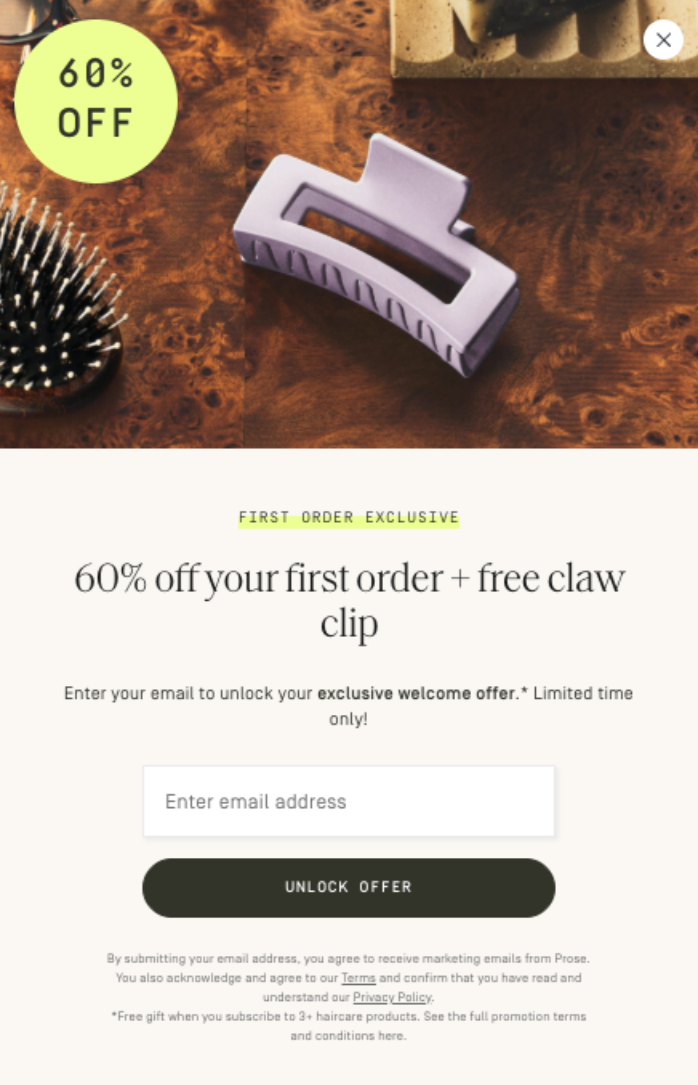
First Order Offer Pop-Up Example

LATHER

2. Spin-to-Win Pop-Ups

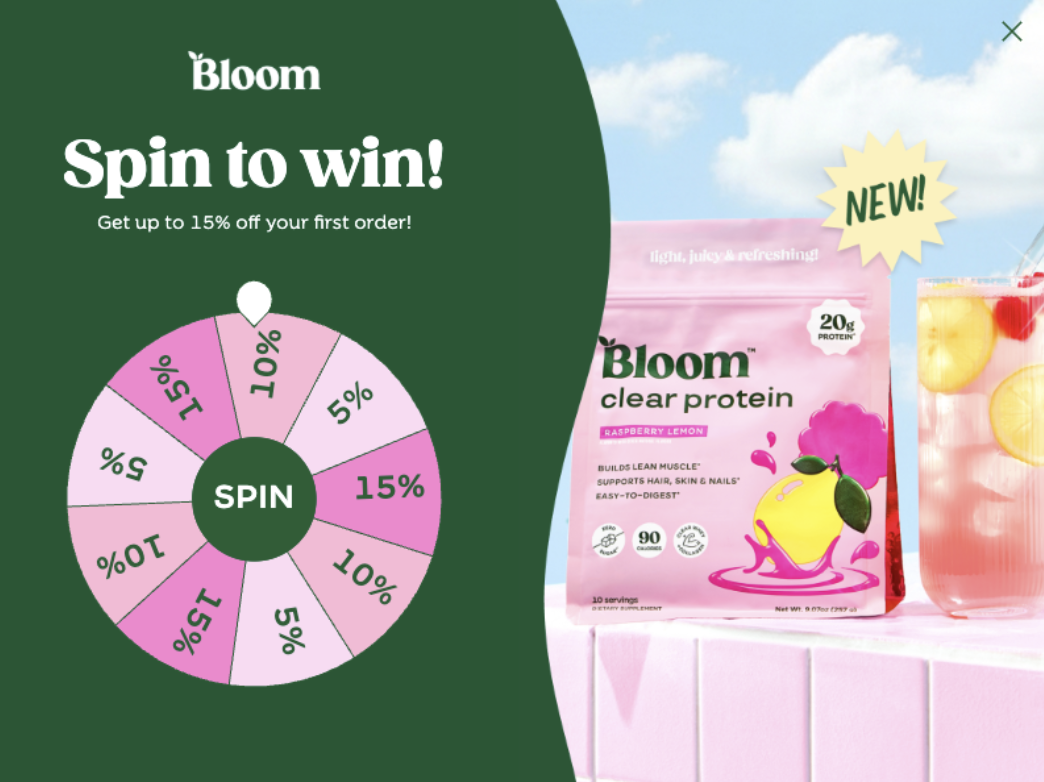
Spin-to-win pop-ups have been around for years, but they still work because they add interactivity to a familiar offer.

Even if most users understand they’re going to land on a common discount tier, the experience feels more engaging than a static email form. For many ecommerce brands, spin-to-win pop-ups continue to drive strong pop-up conversion rates because they encourage interaction before asking for an email capture.

These tend to work especially well for:

  • High-traffic ecommerce stores

  • Beauty & Fashion brands

  • Lower AOV products

  • Mobile-heavy traffic

That said, they aren’t the right fit for every brand. Luxury or premium-positioned companies may find them too gimmicky.

The key is matching the experience to the brand identity.

Spin To Win Pop-Up Example

Bloom

Bloom

3. Quiz & Personalized Pop-Ups

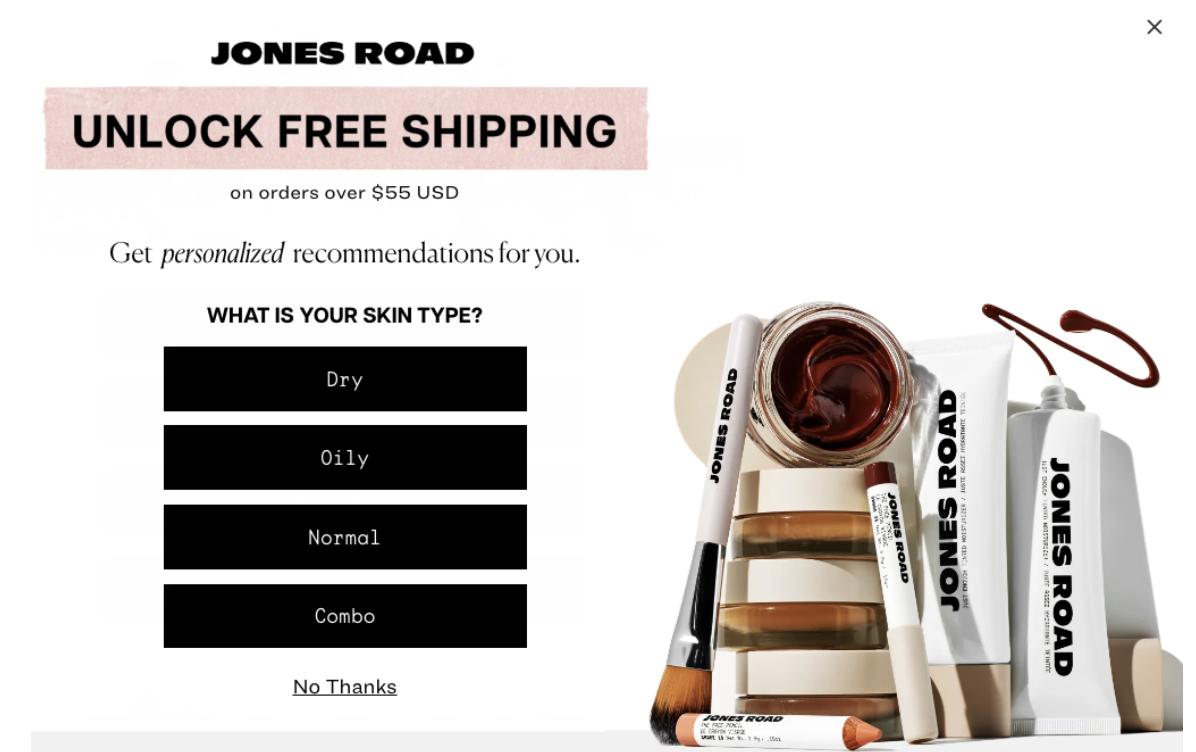
Quiz pop-ups work because they create engagement before asking for the email address.

Instead of immediately presenting a discount, the brand invites the visitor into a personalized experience:

  • “Find Your Routine”

  • “Take the Quiz”

  • “Get Personalized Recommendations”

This format is especially effective for brands where product discovery matters:

  • Beauty & Wellness

  • Supplements

  • Apparel

  • Haircare

Quiz pop-ups help collect valuable zero-party data that can later improve email and SMS personalization. A quiz pop-up can also vary in the level of detail being collected before an email is submitted. Even asking one simple question before asking for someone’s email can increase conversion as well as populate extra data in your customer database. More importantly, quiz pop-ups simply feel less transactional. They also work well as ecommerce lead generation tools because visitors engage with the experience before reaching the email signup form.

A visitor who answers questions about skin type, fitness goals, or style preferences is far more valuable than a generic subscriber who only entered their email for a discount.

Quiz Pop-Up Example

JONES ROAD

4. Micro-Commitment Pop-Ups

One of the biggest trends in ecommerce lead generation right now is the rise of micro-commitment pop-ups.

Instead of immediately asking visitors to enter their email address, these pop-ups first ask a simple low-friction question:

  • “Would you like 15% off?”

  • “Want early access?”

  • “Ready to unlock your offer?”

Once the visitor clicks “Yes,” the actual signup form appears.

It’s a small UX shift, but psychologically it changes the interaction completely. Rather than immediately confronting visitors with a form, brands first encourage a tiny engagement action.

This format has become especially common among beauty, fashion, and wellness brands because it feels more interactive while still keeping the overall offer straightforward.

It’s also a good reminder that improving pop-up performance doesn’t always require a brand-new offer. Sometimes the biggest lift comes from small experience changes.

Microcommitment Pop-Up Example:

iT COSMETICS

5. VIP or Early Access Pop-Ups

One of the easiest ways to make a pop-up feel less generic is to position it around exclusivity instead of discounts.

Rather than asking users to “sign up for emails,” brands can frame the offer as access:

  • Early access to launches

  • VIP-only promotions

  • Limited drops

  • Insider updates

  • Members-only releases

This approach tends to work especially well for:

  • Fashion & Lifestyle brands

  • Limited-release products

  • Creator-led brands

The psychology is simple: people want to feel like they’re joining something, not subscribing to marketing.

VIP and Early Access Pop-Up Example

SKIMS

6. Free Gift Offers

Sometimes perceived value converts better than a percentage discount.

That’s why many brands are shifting toward:

  • Free gifts

  • Free samples

  • Trial-size products

  • Gift-with-purchase offers

Instead of just offering a discount, the ecommerce pop-up frames the incentive around receiving something extra with the first order. This strategy works especially well for beauty & wellness brands.

A free gift often feels more tangible and exciting than a relatively small discount — especially when the featured product is visually appealing.

It also gives brands an opportunity to introduce customers to additional products that may drive repeat purchases later.

Free Gift Offer Pop-Up Example:

Prose

7. Pop-Ups That Align With Current Campaigns

One of the easiest ways to make an ecommerce pop-up feel more intentional is to align it with whatever campaign the brand is already running on-site.

Too many brands keep the same evergreen pop-up live year-round, even while homepage banners, email campaigns, and paid ads are promoting something completely different.

The strongest pop-up experiences usually feel connected to the current marketing moment:

  • Seasonal sales

  • Product launches

  • Holiday campaigns

  • Limited-time collections

  • Sitewide promotions

For example, if a brand is running a summer sale, the pop-up might promote:

  • Early access to the sale

  • Additional perks for subscribers

  • SMS access to limited inventory

  • A gift tied to the campaign

This creates a more cohesive customer experience and makes the pop-up feel less like a generic interruption layered on top of the site.

It also naturally increases urgency because the offer feels timely instead of permanent.

Promotion Pop-Up Example:

ILIA

8. Behavior-Based Pop-Ups

It’s no surprise that some of the highest converting ecommerce pop-ups are customized to the user and what they are viewing on your site. Instead of showing every visitor the exact same message, brands can trigger different lead capture offers based on behavior:

  • Product specific call outs based on what a user is viewing

  • Back-in-stock notifications

  • Product education on PDPs

  • Category-specific offers

  • Exit-intent messaging

  • Returning visitor offers

For example:

  • A visitor browsing skincare products might see a quiz offer

  • A shopper viewing sold-out inventory might see a restock signup

  • A returning visitor might receive a stronger incentive than a first-time user

Relevance almost always converts better than generic messaging.

Behavior-Based Pop-Up Example:

Glossier

Best Practices for Higher-Converting Pop-Ups

Even the best offer can underperform if the experience itself feels overwhelming.

Here are a few principles the highest-converting brands consistently follow.

Keep the Experience Simple

Most pop-ups fail because they try to do too much.

Focus on:

  • One message

  • One CTA

  • Minimal form fields

  • Clear visual hierarchy

The easier the experience feels, the better it usually performs. Small UX improvements can have a major impact on ecommerce pop-up conversion rates over time.

Match the Pop-Up to the Brand

A luxury skincare brand should not use the exact same pop-up style as a fast-fashion retailer.

The design, copy, animation style, and overall tone should feel aligned with the rest of the website experience.

When pop-ups feel disconnected from the brand, they immediately come across as intrusive.

Use Smarter Triggers

Timing matters just as much as the offer itself.

Some of the most effective trigger strategies include:

  • Exit intent pop-ups

  • Scroll depth

  • Product-page targeting

  • Returning visitor logic

  • Time-on-site delays

Showing a pop-up immediately after page load is one of the fastest ways to create a bad user experience.

Don’t Overwhelm Visitors

Too many ecommerce sites stack:

  • Email pop-ups

  • SMS pop-ups

  • Chat widgets

  • Announcement bars

  • Spin wheels

…all at the same time.

The result is usually lower engagement, not more.

A good pop-up strategy should improve the customer experience, not interrupt it.

Test More Than Just the Offer

Most brands only test the incentives themselves.

But some of the biggest conversion improvements often come from:

  • Headlines

  • CTA copy

  • Layout

  • Timing

  • Mobile optimization

  • Imagery

  • Trigger behavior

Small UX improvements compound quickly over time.

The Best Pop-Ups Don’t Feel Like Pop-Up

At the end of the day, most ecommerce brands are not struggling because pop-ups stopped working. They are struggling because customers have learned to ignore generic experiences.

The brands getting the best results right now are not necessarily offering bigger discounts or more aggressive incentives. In most cases, they are simply creating lead capture experiences that feel more relevant, more interactive, or more aligned with the rest of the brand.

Sometimes that means using quizzes or micro-commitments. Sometimes it means tying the pop-up into a larger campaign already happening on-site. And sometimes it just means making a standard first-order offer feel more intentional.

Because the difference between a pop-up that gets instantly closed and one that actually converts usually comes down to one thing:

Does it feel like part of the customer experience, or just another interruption?

Sources

  • LATHER – 10% off email sign-up pop-up screenshot, captured from brand website

  • Bloom Nutrition – Spin-to-win first-order offer pop-up screenshot, captured from brand website

  • Jones Road Beauty – Free shipping skin type quiz pop-up screenshot, captured from brand website

  • IT Cosmetics – 15% off offer pop-up screenshot, captured from brand website

  • SKIMS – Launch updates sign-up pop-up screenshot, captured from brand website

  • Prose – First-order exclusive offer pop-up screenshot, captured from brand website

  • ILIA – Friends + Family sale access pop-up screenshot, captured from brand website

  • Glossier – Email sign-up offer pop-up screenshot, captured from brand website

Demand Gen Campaign Playbook: Creative Testing Frameworks That Scale

We’ve made the case before for why Demand Gen deserves a seat in your full-funnel strategy. But knowing why to invest in the channel and knowing how to run it well are two very different things. We see a lot of accounts where Demand Gen is live but the creative is basically on autopilot, one or two assets per ad group, no real testing structure, no clear read on what’s actually working. The campaign is running. It’s just not learning anything. 


Creative Is the Lever, Not the Afterthought

In search, bid strategy and match types do a lot of the heavy lifting. Demand Gen doesn’t work that way. You’re showing up in someone’s YouTube feed or Gmail inbox before they’ve typed a single query. The creative has to earn that attention cold.

Google’s own Creative Excellence Guide for Demand Gen is pretty direct about this: your assets are the primary driver of campaign performance. The algorithm tests combinations of your images, videos, and headlines, figures out what’s resonating, and allocates budget toward the winners. Which means if your creative pool is thin or untested, you’re asking the algorithm to optimize against a pretty limited set of options.

The accounts we see performing best aren’t necessarily the ones with the biggest budgets. They’re the ones that have invested in creative variety and have a process for figuring out what’s working. 


A Structured Approach to Creative Testing

The most common mistake in Demand Gen is dumping all your creative into a single campaign and hoping Google sorts it out. That approach produces data, but not the kind you can actually act on. You end up knowing a campaign is working without knowing why, which makes it really hard to replicate.

For new launches with enough budget to split traffic intentionally, Google’s native A/B Experiments feature is worth exploring. It requires setting up a new campaign as the experiment arm and needs 60 to 90 days to generate results worth acting on, so it’s not the right tool for every situation.

For most accounts, the more practical approach is building creative variety from the start, keeping clear separation between campaign types and audience signals, and paying attention to what the algorithm surfaces as top versus low performers over time. The real discipline is keeping a running log of what’s working and what isn’t, not just for your own optimization calls but to show clients over time. That record is what turns individual asset wins into an actual creative strategy. 


Match Your Creative to Your Campaign Type

Demand Gen audience targeting is more nuanced than most accounts give it credit for. The starting point isn’t just what audience you’re targeting, it’s what type of campaign you’re running and what message you want to convey.

We map this out before any campaign launches:

Table comparing prospecting and remarketing campaigns

The exclusions matter just as much as the targeting. Excluding existing customers, site visitors, and email subscribers is what keeps you truly going after new audiences rather than just reaching people who already know you. Without those exclusions, your prospecting campaign is doing some amount of retargeting and you won’t have a clean read on who you’re actually reaching.

On optimized targeting: Google’s data from the first half of 2025 shows advertisers with it enabled see 20% higher conversions at the same cost. For prospecting, leave it on. 

What “Good” Creative Looks Like in Demand Gen

Demand Gen runs across YouTube in-stream, Shorts, Discover, and Gmail. These are visually competitive placements. Your assets are showing up next to content people chose to be looking at, so the bar is higher than a standard display ad.

A few things that matter here:

Cover all three aspect ratios

Google recommends at least three images or videos in landscape (1200 x 628), square (1200 x 1200), and portrait (960 x 1200). As of late February 2025, 9:16 vertical image ads are available for YouTube Shorts too. If you’re not covering vertical, you’re not competitive on Shorts.

Lead with the outcome, not the product

This is the pattern we see consistently across accounts: lifestyle imagery and in-use creative outperforms product-isolated shots every time. The assets that convert are the ones where the finished dish is the hero, the room looks lived-in, the person looks like your customer. Catalog-style photography where the product is the sole subject tends to get scrolled past. Clean product imagery has its place in Shopping and on PDPs. In Demand Gen, outcome-led creative is what earns the click.

The same holds for video

Tutorial-style and how-to content consistently outperforms product showcase formats. Someone watching a video on how to properly use a product is more engaged than someone watching a feature reel. The hook matters too: low view rates are almost always a weak first three seconds, not a weak product.

Keep image text minimal

High-quality brand imagery with good lighting and minimal text overlays consistently outperforms busy, text-heavy visuals. The image earns the attention. The copy does the explaining.

Start with enough variety to actually test, not so much that nothing gets data

Store Growers puts it well: aim for Good or higher on Ad Strength, but don’t sacrifice quality chasing Excellent. Five images and two to three videos is a solid starting point. Upload clearly different creative concepts, not the same shot in slightly different crops.

Watch for fatigue before it shows up in your CTR

In Demand Gen, CTR and video engagement, watch time and skip rate specifically, are your clearest signals that an asset is losing steam. When you need to refresh and you still have room, add new assets before pulling old ones so the algorithm can compare them against what’s been running. If you’re already at the asset limit, removing your lowest performers to make room is completely fine, just keep a record of what you swapped out and why. That log is your creative history and it’s genuinely useful in client reporting.

Repurpose what’s already proven elsewhere

If something is converting on Meta or driving clicks in email, Google says to bring it into Demand Gen. There’s no reason to start from scratch when you have signals from other channels. 

Writing Copy That Actually Earns the Click

Demand Gen copy is a different skill than search copy. In search, intent does half your work. In Demand Gen, you’re writing for someone who wasn’t looking for you and has a very low threshold for ignoring you.

A few things we think about:

Lead with the benefit, not the feature

“Built for how you cook” is more interesting than “high-performance cookware.” Your creative is already showing the outcome visually. The headline’s job is to make someone feel something about it, not describe what it is.

Write for curiosity, not completion

You’re not trying to answer every question in the headline. You’re trying to open one that they want to close.

Match tone to placement

Shorts copy should be punchy and fast. Discover can carry a little more narrative. Gmail benefits from clarity and a direct call to action.

Test angles, not just wording

Social proof, urgency, transformation, category authority, these are different hypotheses about what motivates your audience. Testing “Join 10,000 customers” against “Finally, cookware that doesn’t warp” tells you something real. Testing two versions of the same headline with slightly different wording mostly tells you nothing.

Use your description space

Descriptions should answer the next question your headline raises, not repeat it. If your headline is the hook, the description is where you earn the click.

Google gives you five headlines, five long headlines, and five descriptions per ad. Use them. The more variation the algorithm has, the more it can learn about what actually works for each audience. 

The Measurement Problem Nobody Wants to Talk About

Here’s where Demand Gen campaigns get written off unfairly. If you’re evaluating this channel on last-click ROAS, you’re structurally penalizing it. Demand Gen is an upper-funnel channel. It influences decisions that convert later, usually through a branded search or a direct visit. Last-click attribution gives all of that credit to whatever channel happened to be last, and Demand Gen looks like it did nothing.

Google’s own data found that 68% of Demand Gen conversions came from users who hadn’t interacted with the brand’s search ads in the prior 30 days. That’s real incremental reach that a last-click model will never surface.

A more complete measurement picture looks like this:

Data-driven attribution (DDA)

Distributes credit across touchpoints instead of piling it all on the last click. It’s the right default for any account running Demand Gen alongside Search.

View-through conversions

Users who saw your ad, didn’t click, and converted later. This is one of the most important signals for an upper-funnel channel where the click isn’t always the conversion moment.

Attributed Branded Searches

Available since January 2026, this shows branded searches that can be traced back to a Demand Gen exposure. It requires activation through your Google rep, so it’s not available by default in every account, but it’s worth requesting. It’s one of the clearest indicators that upper-funnel activity is actually creating demand.

Brand Lift and Search Lift studies

These studies measure incremental changes in awareness, ad recall, and branded search behavior between exposed and unexposed audiences. They answer the question last-click attribution can’t: did the advertising actually change anything?

Conversion Lift experiments

For accounts with enough volume, this is the cleanest way to measure true incremental impact.

If you’re having trouble making the internal case for Demand Gen investment, measurement is usually where that argument is won or lost. Build the right framework before you launch, not after you’re trying to explain a ROAS number that looks low on the surface. 

When You Find Something That Works, Scale It Right

Getting a creative winner is one thing. Knowing what to do with it is another.

The first question to ask isn’t “how do we run more of this.” It’s “what does this tell us?” Was it the format? The messaging angle? The visual treatment? The audience it was served to? The answer to that question is what lets you scale intelligently instead of just spending more on one asset until it fatigues.

From there:

Extend winners across formats before you call them proven

A lifestyle concept that’s winning in landscape should be tested in square and vertical. A strong static image concept should eventually get explored in video. Don’t declare something a winner until you know how it performs across the placements Demand Gen actually runs on.

Build a refresh cadence before you need one

Creative fatigue is predictable. You don’t have to wait for CTR to drop to know it’s coming. Set a schedule for asset refreshes on evergreen campaigns so you’re staying ahead of it instead of reacting to it.

Google’s AI enhancements are a tool, not a replacement

The November 2025 Demand Gen Drop added AI Image and Video Enhancements that generate creative variations from your existing assets. That’s genuinely useful for extending the life of strong creative. Just know that it works best when the source asset is already high quality. The AI is remixing what you give it, not fixing what’s broken.

Keep testing even when things are working

The accounts that plateau are usually the ones that stopped testing once something was working. Keeping a testing process running even on healthy campaigns is what keeps performance moving instead of sitting still.

Where to Start

Pull your asset report first. Look at what’s flagged as low-performing and ask whether it’s really underperforming or just underserved. Check your aspect ratio coverage. Look at how many creative concepts you actually have running versus how many slight variations of the same concept.

From there, check your prospecting campaign structure. If you’re not excluding existing customers and site visitors, that’s the first thing to fix. If everyone across every campaign is getting the same ad regardless of where they are in the funnel, that’s next.

Demand Gen rewards accounts that treat creative seriously. It’s not a hard channel to run well, but it does require having a process, not just having it turned on. The data is there now to actually do this right. Most accounts just aren’t using it yet.

If you’re not sure where your Demand Gen setup stands, or if you’ve been running it but don’t have a clear read on what’s working, reach out to the Revel team. We’re happy to dig in. 

Sources

OpenAI Launches Self-Serve ChatGPT Ads

In an announcement that could be described as the biggest news in all of digital marketing this year, OpenAI has launched self service ads for ChatGPT. Advertisers in the US now have the ability to serve ads on one of the fastest growing platforms across the web, with other countries on the horizon. Self service ads remove spend minimums previously reported during early access testing while introducing new features like a cost per click delivery option. In this article we will break down everything you need to know about ChatGPT ads, including how to get started, targeting options, new features, and if your business is a good fit for testing these ads.

How to Set Up a ChatGPT Ad Account

As soon as we share the news about ChatGPT ads rolling out more broadly the first question we typically get is how to get started. Luckily, the process is pretty easy. Currently, ads are only offered in the US. You can go to ads.openai.com to create an ad account and follow the steps to verify your business. Be careful while filling out this information because once it is entered it cannot be changed. Early advertisers have reported that verification is taking closer to 5–15 business days, so factor that in before expecting campaigns to go live.

Once verified, there are a few steps needed to set up your account. We recommend navigating to the general settings, before running ads, to edit your account name & logo to what you want them to appear as in ads. From there you will need to navigate to billing and enter your billing information for ads. Finally, if there are any other individuals from your organization that should have access to the ad account you can add them in the users section under settings. Now you are ready to start building your first campaign!

Before you launch, it is also worth knowing that ads only show to users on ChatGPT’s Free and Go tiers. Users on Plus, Pro, Business, Enterprise, and Education plans don’t see ads. The majority of ChatGPT’s user base is on the free tier, but it’s a good thing to keep in mind when setting reach expectations with your team.

Creating Your First Campaign

Advertisers that have spent time running ads on other popular platforms like Google Ads or Meta Ads will feel comfortable working in ChatGPT’s ad manager. The ad manager takes a similar approach to account structure following the Campaign > Ad Group > Ad hierarchy. Campaigns can be created using a bulk upload file or a guided campaign creation in platform.

At the campaign level is where you will set your objective, location targeting, budget, conversion event, start date, & optional end date. At the ad group level you can set your max cpc bid, default destination url, & contextual hints. Contextual hints are open ended and help OpenAI serve your ads to your target audience. Hints can include descriptions of conversations, topics, or keywords where your products or services may be relevant. It is important to mention these hints guide matching, but are not exact match rules like you might see in targeting on other platforms.

Since contextual hints are the closest thing to audience targeting on the platform right now, it pays to be thoughtful about how you write them. The most effective hints describe a situation or problem your customer is working through, not just a product category. So instead of writing “project management software,” something like “teams trying to coordinate tasks and collaborate across multiple projects” is going to get you better matching. Think about what your customer is actually asking ChatGPT before they find you, and write your hints around that conversation.

The next step is to configure your ad. You will need to include an ad name, destination URL, headline, description, & image. Headlines currently have a character limit of 50 characters while descriptions have a limit of 100. Ad images are square and can be either .jpg or .png files. Afterwards you just need to review your setup and launch the campaign.

CPM vs. CPC: Which Should You Pick?

Once you’re in the platform, one of the first decisions you’ll make is whether to run on CPM or CPC. Here’s how to think about it.

CPM was the original buying model when ChatGPT ads launched in February 2026, with rates starting around $60 per thousand impressions. According to Digiday, those rates dropped to as low as $25 within about ten weeks as the platform scaled. CPM is the better fit if you’re running a brand awareness play and care more about visibility than clicks.

CPC launched in May 2026, with starting bids in the $3–$5 range per Digiday and Search Engine Land. That puts it in competitive territory with Google Search CPCs in a lot of verticals. With CPC you only pay when someone actually clicks, which makes spend easier to forecast and easier to compare against other channels you’re already running.

For most brands testing this platform for the first time, CPC is the smarter starting point. It limits your exposure while you gather baseline data, and it gives you a number clients can make sense of. Once you know your click-through rate, you can model out whether CPM would be more efficient at your volume.

One thing to set expectations on upfront: conversion tracking on ChatGPT is still catching up. OpenAI has a Conversions API and pixel in place, but early advertisers have found the attribution isn’t as reliable yet as what you’d get from Google or Meta. Plan to use UTM parameters and your own analytics to track what happens post-click, and treat this as more of an upper-funnel channel until the measurement matures.

What Features Are Missing?

At the launch of these new self-serve ads there are a few noticeable features missing. The first is conversion campaign objectives. At launch OpenAI has introduced the ability to measure campaign performance using a Conversion API and pixel-based measurement. However, only clicks and reach are available options to set as a campaign objective. Reach objective campaigns are charged based on a CPM while click objective campaigns charge on a new cost per click basis.

When it comes to ads there is only 1 standard ad type in the self-serve portal. This means there are no ads utilizing product catalogs yet, which will become a huge unlock for ecommerce businesses once available. Finally, there are no audience targeting options available at launch, however, there have been rumors that this will be introduced in the near future with more developments to the platform.

A few categories are also off limits at launch, including healthcare, financial services, legal services, gambling, alcohol, and political content. OpenAI has signaled some of these may open up over time, but right now they’re firm. If your clients fall into any of these verticals, it’s something to keep an eye on rather than a reason to write the platform off entirely.

On the roadmap side, OpenAI has confirmed that CPA bidding is coming later in 2026. That’s the feature that will make this a real direct response channel for most advertisers. If you start running CPC campaigns now and building up conversion data, you’ll be in a much better position to optimize once CPA rolls out.

Are ChatGPT Ads Right for My Business?

While ads in ChatGPT are definitely the current most exciting thing in digital marketing they aren’t right for every business, at least not yet. The inability to optimize towards lower funnel conversions makes ChatGPT ads highly costly for brands that have specific ROI metrics to hit. Within the beta test of ads on ChatGPT, CPMs were reported as high as $60, dropping to an observed range of approximately $25–$45 as the platform scaled. Incremental budgets in many cases can be used more efficiently via a number of channels and platforms to better scale your business.

With all that said there are a number of businesses where ChatGPT ads can make a lot of sense. Businesses with complex, high consideration offerings that users research or compare before buying make an ideal fit for ChatGPT ads. Some business categories that should excel on ChatGPT include travel, B2B software, education, professional services, & some high consideration consumer goods.

First Page Sage projected ChatGPT ad conversion rates by vertical, and high-consideration categories like higher education and B2B software come out on top. Criteo has also reported that traffic referred from large language models converts at roughly 1.5x compared to other digital channels, which speaks to the quality of intent users are bringing to these conversations. A pretty simple gut check: if your customer would turn to ChatGPT to research a purchase before making it, you have a reason to be there. If they wouldn’t, the budget is better spent elsewhere for now.

How We Got Here: What We Predicted vs. What Launched

Earlier this year we published a breakdown of what to expect when ChatGPT ads arrived, including three scenarios for how the buying experience might be structured. One of those scenarios was a standalone platform built and run by OpenAI directly, separate from Microsoft Ads. That’s exactly what launched.

We also recommended clients start building out Microsoft Ads infrastructure as a prep move, given the OpenAI-Microsoft partnership at the time. The platform ended up going standalone instead. That said, a strong Microsoft Ads foundation is still a smart setup for any brand looking to expand into AI-adjacent channels, and none of that infrastructure work goes to waste.

The platform moved faster than most people expected, going from a $200K+ enterprise-only pilot to a no-minimum self-serve tool in about three months. If you want the full strategic context for where ChatGPT ads fit in the broader paid media picture, our original post is still worth a read.

All in all, it is an exciting time in digital marketing and we expect more changes in the coming months to make ChatGPT ads more available and effective for both advertisers and consumers. As the ad platform evolves with new formats, objectives, and capabilities our team at Revel will be sure to help you stay on top of new changes and opportunities for your business.

TikTok Algorithm Updates 2026: Content Strategies That Work for Brands vs. Creators

TikTok Algorithm Updates 2026: What Brands Need to Know to Compete with Creators

TikTok’s algorithm in 2026 is no longer just about virality, it’s about sustained attention, intent, and relevance at scale. For brands, this marks a critical shift: success on the platform now depends less on one-off wins and more on building a repeatable content system that performs under algorithmic scrutiny.

At Revel Marketing Partners, we’re seeing this play out across industries—brands that approach TikTok like a performance channel, not just a social platform, are the ones driving measurable results.

How the TikTok Algorithm Has Evolved

The current algorithm is built to prioritize content that holds attention and satisfies user intent, not just content that generates surface-level engagement.

Key signals shaping performance in 2026 include:

  • Watch time and completion rate now outweigh follower count or likes, making retention the primary driver of reach (Darkroom Agency)

  • Search optimization plays a larger role, with keywords in captions and on-screen text influencing discoverability (Presence News)

  • Tiered distribution means content must perform in small test groups before scaling (Green Frog Labs)

  • High-intent engagement (shares, saves, replays) carries more weight than passive interactions (VidGrow)

For brands, this means every video must be engineered to perform—not just produced.

Creators vs. Brands: A Strategic Divide

While the algorithm treats all content equally, how success is achieved differs significantly.

Creators win by maximizing attention on a per-video basis. Their advantage lies in agility and authenticity, producing content that feels native, relatable, and immediate.

Brands, on the other hand, must balance creativity with consistency. The challenge isn’t just capturing attention, it’s doing so in a way that can scale, repeat, and align with broader marketing goals. 

What’s Working for Creators

Creators continue to outperform when they align closely with how TikTok evaluates content at the individual level. Their strategies are rooted in capturing and retaining attention quickly.

Common patterns include:

  • Strong hooks within the first 1–3 seconds

  • Content that prioritizes personality over production value

  • Clear niche alignment to reinforce algorithmic signals

  • Formats designed for rewatchability and looping (Analytics Insight)

This approach works because TikTok rewards content that keeps users engaged, regardless of who publishes it.

What’s Working for Brands

For brands, success comes from translating those same principles into a structured, performance-driven content model.

Effective brand strategies in 2026 include:

  • Retention first editing: tighter cuts, faster pacing, and immediate value delivery

  • TikTok SEO integration: intentional use of keywords in captions, voiceover, and on-screen text

  • High volume testing: producing enough variations to identify repeatable winning formats

  • Value driven content: focusing on education, entertainment, or utility to drive shares and saves

The takeaway is clear: brands can no longer rely on polished creative alone. Content must be built to perform within the algorithm’s logic (Green Frog Labs).

Where High-Performing Content Converges

Despite different approaches, top-performing content across both brands and creators shares consistent traits:

  • High retention and completion rates

  • Clear topic relevance and keyword alignment

  • Strong engagement signals beyond likes

  • Consistent formats that reinforce audience expectations

TikTok’s algorithm doesn’t prioritize who you are, it prioritizes how your content performs.

The brands seeing the strongest results today are those that blend creator style storytelling with performance marketing discipline.

This means:

  • Thinking like a creator when developing content

  • Acting like a marketer when measuring and scaling it

TikTok in 2026 is not just a brand awareness channel, it’s a full funnel opportunity. But only if content is built with both attention and performance in mind.

The shift in TikTok’s algorithm signals a broader change in digital marketing: platforms are rewarding content that earns attention, not just interrupts it.

For brands, the opportunity isn’t to compete with creators, it's to operate like them strategically, while leveraging the structure and resources creators don’t have.

That balance is where long term growth happens.

Sources

AI Is Rewriting Discovery. Creator Partnerships Decide Who Gets Seen

For years, brands relied on SEO tactics and backlinks to secure visibility in traditional search results. That formula still matters but it’s no longer enough.

AI-powered search is reshaping how consumers discover products. And the rules have changed: visibility is no longer driven by keywords alone. It’s increasingly influenced by the sources AI models recognize as credible, trusted, and relevant. If creators and publishers aren’t consistently talking about your brand, your brand is less likely to surface in AI-generated recommendations and summaries. That means losing ground during the consideration phase before a consumer ever reaches your website or product page.


Creator Partnerships Are Now a Visibility Play

Brands consistently appearing in AI-generated search results aren't just optimizing for conversions. They're taking a broader, more strategic approach to partnerships — investing in a diverse network of voices that shape consumer discovery and build category authority.

This shift is forcing a real rethink of how affiliate and paid media budgets get allocated. Success in an AI-driven discovery landscape isn't only about optimizing for direct-response performance. It's about ensuring your brand is consistently represented across the publishers, creators, and content sources AI platforms rely on when generating recommendations and answers.

The strategic question every brand should be asking: which creators and publishers are shaping conversations in your category, and how are you actively investing in those relationships? The table below from Impact helps illustrate the dynamic shift:

What This Means for Your Affiliate Program?

Investing in creator content and partnerships across your vertical builds more than awareness. It builds presence within the broader digital ecosystem that informs AI search. Over time, that presence becomes a competitive advantage helping brands earn visibility not just at the point of conversion, but at the earliest stages of consumer discovery and intent. 

That requires letting go of a strictly last-click mindset. Creators who don't drive immediate revenue can still be doing meaningful work higher in the funnel, making your brand the one a consumer thinks of, or that AI surfaces, when it's time to buy. The strategic question becomes: which creators and publishers are shaping conversations in your category, and how are you investing in those relationships to strengthen your brand’s visibility?

As Partnerize puts it, the brands that win will be those that blend automation with human-led storytelling to maintain trust and search visibility. Creator partnerships are a direct investment in both.

Success in an AI-driven discovery landscape is no longer just about optimizing for direct-response performance; it’s about ensuring your brand is consistently represented across the publishers, creators, and content sources AI platforms rely on to generate recommendations and answers. (eMarketer)

Where to Start

Whether you're scaling an existing affiliate program or exploring creator partnerships for the first time, the path forward starts with an honest audit of who's talking about your brand, where, and how often. From there, it's about building the right relationships — not just with the creators who convert today, but with the voices your category trusts.

Your RMP team can help you identify the right partners, structure the right incentives, and build a presence that compounds over time.

Sources

The Invisible Shadow: Why It Feels Like Your Phone Is Listening

It’s a classic "glitch in the matrix" moment. You’re sitting at dinner, talking to a friend about how you’re dying to escape to a cabin in the Rockies. You haven't Googled it. You haven't looked at flights. But an hour later, you open your phone and there’s a vacation rental ad for that mountain cabin staring you in the face.

It feels creepy. It feels invasive. And the immediate thought we all have is: My phone is definitely listening to me.

But as much as it feels like your mic is eavesdropping, the reality is actually way more impressive, and a bit more unsettling, than that. Your "digital shadow" is so detailed that advertisers don't need to hear you speak to know exactly what you’re dreaming about.

Here is what’s actually happening behind the scenes.

The Breadcrumbs: Why Ads "Follow" You

We’ve all heard of cookies, but in 2026, they aren’t just remembering your login info. "Third-party" cookies are essentially digital bounty hunters that follow you across the web. If you spend five minutes on a travel blog reading about Colorado, a tracking cookie gets dropped. Because that blog is part of a massive ad network (like Google or Meta), that cookie follows you to your weather app, your news feed, and even your favorite mobile games.

Even if you clear your cookies, sites can identify you by your screen resolution, battery level, and even the specific fonts you have installed. It creates a "fingerprint" that ensures the cabin rental ad finds you on your laptop, your tablet, and your phone simultaneously.

The Myth of the "Eavesdropping" Phone

Let’s settle the big debate: Is your phone actually listening to your conversations?

Most experts say no. From a technical standpoint, uploading 24/7 audio from billions of people would crash the internet's bandwidth and require more processing power than even the biggest tech giants currently want to pay for.

So, how did it "know" about the cabin? It’s usually a mix of three things:

  • Predictive Modeling: Algorithms are scary-good at math. Based on your recent behavior, maybe you've been looking at hiking boots or searching for "stress relief", the algorithm predicts you're yearning for a vacation before you even say it out loud.

  • The Baader-Meinhof Phenomenon: This is a brain trick. You probably see 500 ads a day and ignore 499 of them. But the second you have a conversation about a topic, your brain "flags" the next related ad as a huge coincidence, making it feel targeted when it might have just been random luck. And honestly, you’ve probably already scrolled past a handful of ads without even noticing them.

  • Proximity Tracking: This is the one that trips people up. If you’re at dinner with a friend and they search for flights to Denver while their phone is physically next to yours, the ad network notes that you two are together. It assumes that if they’re going, you might be going too.

The Digital Mirror: It Knows You Better Than Your Family

The most jarring part isn't that an algorithm knows what you want to buy. It’s that it knows who you are.

Back in 2015, a famous study by Cambria and Stanford University showed that with just 300 "likes," an algorithm could predict a person’s personality more accurately than their own spouse. Fast forward to today, and the data from our short-form video habits (what we pause on, what we re-watch) has made those profiles even more accurate.

You aren't just "User #1234" to an advertiser. You’re part of a "lookalike audience." If 10,000 other people with your exact scrolling habits and stress levels just booked a wellness retreat, the algorithm is going to serve you that same ad. It knows you’re burnt out before you’ve even admitted it to yourself.

The Bottom Line

Our internet footprint isn't just a trail of where we’ve been anymore; it’s a map of where we’re going. Your phone doesn't need to listen to your voice because it can already read your intentions through your behavior.

The next time an ad feels like it’s "following" you, remember: it’s not magic, and it’s likely not a hidden mic. It’s just the result of thousands of digital breadcrumbs being swept up by a machine that has spent years learning exactly how you move.

Sources

How to Scale Beyond the FYP & Convert With Influencer Marketing

The Shift from Awareness to Conversion

As influencer marketing matures, the focus is shifting from brand awareness to measurable ROI. Traditionally, campaigns were judged by reach and engagement, and success meant hitting a target number of likes, comments, or views. But expectations have changed. Marketers are now asking a more critical question: how does this drive actual business results? Did engagement translate into purchases?

This shift has fueled the rise of shoppable content. This interactive media includes  photos, videos, blog posts, and social content that enables users to purchase directly or seamlessly navigate to product pages. By blending ecommerce with engaging storytelling, shoppable content reduces friction in the buying journey and creates a more fluid, conversion-driven experience.

As a result, influencer content is evolving into a true sales channel, not just a top-of-funnel marketing tactic.

Why Shoppable Influencer Content Matters

Shoppable influencer content matters because of shifting consumer behavior. Social media platforms like TikTok have conditioned users to expect instant gratification, creating an environment that encourages impulse buying. When discovery and purchase happen in the same moment, consumers are far more likely to convert. By making content immediately shoppable, brands can capitalize on this behavior, turning passive scrolling into active purchasing with minimal friction.

Platforms like TikTok Shop and Instagram Checkout are accelerating this shift by enabling users to complete purchases without ever leaving the app. This seamless experience removes traditional barriers, making it easier than ever to act on impulse.

And when it comes to influencers, their role is embedded in the name. They are modern-day curators: trusted voices who shape opinions and guide purchasing decisions. By combining that influence with seamless commerce, brands can turn inspiration into transactions in real time. 

What Makes Content “Shoppable”? 

So, what exactly makes content “shoppable”? At its core, shoppable content reduces the distance between discovery and purchase, either by embedding products directly into the content or by linking users seamlessly to where they can buy.

At a foundational level, brands can use trackable links, such as UTM parameters or affiliate links, to connect influencer content to conversions. These links allow marketers to measure performance while guiding users directly to product pages.

Social platforms have taken this a step further by building native shopping experiences. Instagram’s Shop and product tagging features allow businesses to integrate their storefronts directly into the platform, enabling creators to tag products in posts, Stories, and Reels so their followers can purchase without leaving the app. Similarly, TikTok Shop allows creators to link products within videos, livestreams, and dedicated product showcases on their profiles, creating a fully integrated shopping experience.

TikTok also offers an affiliate ecosystem on the TikTok Shop Seller Center, where brands can invite creators to earn commissions directly through the platform, simplifying both tracking and payouts. Instagram has begun moving in a similar direction, introducing affiliate tools and expanding product linking capabilities, particularly within Reels, signaling a broader shift toward in-app commerce.

Across all of these formats, the common thread is a seamless user experience. The fewer steps it takes for a consumer to go from inspiration to checkout, the more effective shoppable content becomes.

Types of Shoppable Content

Short-Form Video (TikTok, Reels, YouTube Shorts)

Short-form video allows creators to showcase products in an authentic, engaging way – often integrating them naturally into content like “day in the life” videos, quick demos, or trend-driven posts. This format is especially effective for driving impulse purchases. 

Source: @riannagail

Long-Form Content (YouTube, Blogs, Substack)

Longer content formats provide space for deeper storytelling, such as tutorials, reviews, or product comparisons. Shoppability is enabled through links in video descriptions or hyperlinked within blog copy, guiding users directly to purchase.

Source: @sidtilt

Livestream Shopping (TikTok)

Livestream shopping, particularly on TikTok, enables real-time interaction and purchasing. Creators can pin products directly from their TikTok Shop showcase during a live session, allowing viewers to buy instantly while engaging with the content.


Static Posts & Stories (Instagram)

Static content like feed posts, carousels, and Stories can be made shoppable through product tags and link stickers, which can be customized with text. These formats offer a simple, low-friction way for users to explore and purchase featured products.

Source: @clarapeirce

How Brands Can Enable Shoppable Content

When building shoppable campaigns, brands should prioritize creator selection based on purchase intent – not just reach. A large following doesn’t always translate to conversions, so it’s critical to vet creators for how effectively they integrate shoppable tactics. This includes using features like link-in-bio tools, Instagram Story links, product tags, or maintaining a TikTok Shop Showcase.

Beyond audience size, brands should evaluate performance metrics such as engagement rate to ensure the creator has an active, responsive audience that is more likely to convert.

To support measurement and optimization, brands should equip creators with trackable assets like UTM links or exclusive discount codes. These tools not only streamline the path to purchase but also provide clear visibility into campaign performance, helping brands understand what’s driving real revenue.

Best Practices for High-Converting Shoppable Content

Creating shoppable content is only the first step—ensuring it actually converts is where the real strategy comes in. At the core of every successful campaign is authenticity. When briefing creators, brands should emphasize the importance of producing content that not only aligns with brand values but also fits naturally within the creator’s existing niche. Audiences are far more likely to engage—and convert—when the content feels genuine rather than forced.

Clear and compelling CTAs are also critical. Especially in short-form video, incorporating a strong CTA within the first few seconds can capture attention and guide viewers toward taking action before they scroll away.

Creator alignment is equally important. Partnering with influencers who genuinely resonate with the brand’s mission helps ensure the content feels organic, increasing both trust and performance.

Finally, campaigns should be tailored to the nuances of each platform. TikTok content tends to perform best when it feels casual, trend-driven, and native to the platform, while Instagram often favors more polished, curated visuals. Adapting creative to match user expectations on each platform can significantly impact conversion rates.

Measuring Success

Since shoppable content is correlated to driving revenue, then the way you measure success needs to align with this objective. Engagement in a report is a win, but these don’t directly generate revenue. 

Here are the metrics that actually tell you if your influencer content is working:

Click-Through Rate (CTR)

First things first – are people taking action? CTR tells you whether your content and CTA are strong enough to move someone from scrolling to clicking. If this number is low, your hook or messaging likely isn’t landing.

Conversion Rate

Clicks are great. Conversions are better. This is where you see if your content – and the shopping experience behind it – actually closes the deal. A strong conversion rate means you’re not just grabbing attention, you’re driving real intent.

Engagement vs. Sales

Here’s the reality: high engagement doesn’t always mean high revenue. Some posts go viral but don’t convert, while others drive serious sales. The key is understanding what kind of engagement actually leads to purchase and doubling down on that.

The Attribution Problem

The path to purchase isn’t always linear. A user might see a product on TikTok, research it on Instagram, and convert somewhere else entirely. That makes attribution messy. The fix? Use trackable links, affiliate codes, and platform analytics to piece together the journey and get a clearer picture of what’s working.

Test, Learn, Repeat

There’s no perfect formula here. The brands winning in shoppable content are the ones constantly testing: different creators, hooks, CTAs, and formats. The more you iterate, the faster you find what drives real revenue.

The Future of Influencer Commerce

Shoppable content isn’t just a trend, it’s the foundation of where influencer marketing is headed. As platforms, creators, and brands continue to evolve, the line between content and commerce will only get thinner.

AI-Driven Personalization

The next wave of influencer commerce will be powered by personalization at scale. Algorithms are already curating content feeds, now they’re starting to shape shopping experiences too. Expect to see more tailored product recommendations based on user behavior, preferences, and past purchases. For brands, this means influencer content won’t just reach audiences—it will reach the right audiences at the right moment, increasing the likelihood of conversion.

In-App Checkout Expansion

The goal is simple: keep users on-platform from discovery to purchase. Platforms like TikTok and Instagram are investing heavily in native checkout experiences, removing the need to redirect users to external sites. As these features expand and become more seamless, friction will continue to drop and conversion rates will rise with it.

Creator-Owned Storefronts

Creators are no longer just promoting products, they’re becoming retailers in their own right. With tools like TikTok Shop, Amazon Storefronts, and link-in-bio commerce hubs, influencers can curate and sell products directly to their audience. This shifts the dynamic from one-off partnerships to long-term, creator-led commerce ecosystems where trust and consistency drive repeat purchases.

The Blurring of Content, Ads, and Retail

Perhaps the biggest shift is that these categories are starting to merge. A TikTok video can be entertainment, an ad, and a storefront all at once. The most effective content doesn’t feel like advertising—it feels native, engaging, and actionable. As a result, brands will need to rethink how they approach campaigns, focusing less on traditional ad formats and more on content that seamlessly integrates into the user experience.

The Bottom Line

Influencer marketing is no longer just about visibility—it’s about velocity. The speed at which a consumer can move from discovery to purchase is now a defining factor in campaign success. Shoppable content bridges that gap, turning passive engagement into measurable action.

As platforms continue to integrate commerce more deeply and creators take on a greater role in driving sales, the brands that win will be the ones that adapt early. This means thinking beyond reach, prioritizing seamless user experiences, and treating influencer content as a core revenue channel—not just a marketing play.

In a landscape where attention is fleeting, the ability to convert in the moment isn’t just an advantage, it’s the new standard.

SOURCES

Beyond Bottom-Funnel: How Demand Gen and YouTube Build Audiences That Convert in Q4

There's a ceiling that every bottom-funnel-heavy program eventually hits. Search and Shopping are good at capturing demand that already exists. The problem is you can only capture so much of it before you run out of people to reach.

The brands seeing real growth right now are investing earlier in the funnel. YouTube and Demand Gen aren't just awareness plays. They're what make your lower-funnel channels more efficient when it counts most. And Q4 is when that gap shows up hardest.

Q4 Performance Doesn't Start in Q4

The audiences converting in November and December are built in Q2 and Q3. If you wait until peak season to start investing in demand creation, you're already behind, competing for the same high-intent traffic as everyone else at the most expensive time of year to do it.

The funnel works in layers. YouTube is where you build familiarity at scale. Demand Gen is where you stay present as users move from passive awareness into consideration, reaching them across YouTube, Discover, and Gmail. Search, remarketing, and Performance Max are still closing the deal. They just do it better when the audience is already warmed up. These pieces work best when they're connected, and the return compounds when upper-funnel activity starts early enough.

That compounding effect is backed by real data. According to Fospha's Full-Funnel Google Report, brands that added just one additional channel to their Google mix saw 14% higher ROAS compared to those that kept their mix unchanged, and brands that added two channels achieved 37% higher ROAS. A broader mix gives Google's systems more signal to optimize against and creates more entry points across the customer journey.

Building Audiences That Pay Off in Q4

Most brands approach audience strategy like a retargeting checklist. Tag visitors, build lists, remarket to people who almost converted. That works fine in a normal environment, but it breaks down during peak season when everyone else is doing the exact same thing with the same audiences.

Building ahead of time looks different. A YouTube view isn't a vanity metric. When someone watches your content beyond a few seconds, that's an early signal of interest. Retargeting those viewers later through Demand Gen is a fundamentally different starting point than going cold. Layering first-party data (customer lists, site visitors, engaged users) across both prospecting and remarketing means your data is working across placements, not just in search. Custom segments built on search behavior let you reach users before they've even clicked an ad, pulling them into environments where you can shape perception earlier.

What ties it all together is thinking in sequences rather than single interactions. Awareness builds in Q2. Consideration develops in Q3. By Q4, you're not introducing your brand. You're reinforcing it. That sequence is what makes peak season more efficient rather than more expensive.

The downstream impact of investing this way shows up clearly in the Fospha data. Brands in their Q4 2025 program that scaled Demand Gen and YouTube saw ROAS and CAC improvements not just in those channels, but in Performance Max and Brand Search as well. Deep Dive brands increased Demand Gen spend 367% and YouTube spend 118% year over year and saw PMAX ROAS improve 8% and Brand Search ROAS improve 9% year over year. The control group, which scaled back YouTube and grew Demand Gen more modestly, saw the opposite.

Measuring What Actually Matters Before Q4

Measurement is usually where the full-funnel argument falls apart internally. If you're relying on last-click attribution, upper-funnel activity will always look undervalued, and that becomes a real problem when you're trying to justify investing in it ahead of peak.

A more complete picture looks at a few things together. Branded search lift is one of the clearest indicators that YouTube investment is working. If people are searching for your brand more after being exposed to video ads, demand is being created at the top of the funnel. Fospha's full-funnel measurement consistently finds that click-based attribution significantly understates YouTube's contribution, with true ROAS coming in substantially higher than what platform reporting shows. Beyond that, blended metrics including revenue trends, new customer acquisition, and overall CPA give you a better read on program health than channel-level ROAS in isolation. And for campaigns where you need a clear business case, incrementality testing through geo holdouts answers the simple question: what wouldn't have happened without this investment?

The budget allocation question also has a more concrete answer than most clients expect. In Fospha's research, brands allocating 10-20% of their total Google budget to Demand Gen achieved double the ROAS of brands allocating 0-5%. Most accounts spend well below that threshold, which means there's real headroom before hitting diminishing returns.

Creative That Actually Works on YouTube and Demand Gen

Getting the strategy right is only half of it. Creative usually gets treated as a supporting piece when it actually does most of the work, and if you're planning for Q4, not all creative can do the same job.

On YouTube, the first few seconds carry most of the weight. A clear hook, movement, or a relatable problem gets you past the skip button. Branding needs to show up early enough to be remembered, not saved for the end. On Demand Gen, clarity matters more than cleverness. Headlines have limited space and visuals do most of the work, so the product, use case, or outcome needs to be immediately obvious across Discover and Gmail. Across both, consistency is what builds familiarity. If someone sees your brand on YouTube and then again in Demand Gen, it should feel connected. Visual identity, messaging, and positioning should carry through. Google's ABCD framework (Attention, Branding, Connection, Direction) is worth keeping in mind here, and ads that follow those principles have shown measurable lifts in both short-term sales and long-term brand impact.


RMP's POV: Growth Starts With Demand Creation

The biggest risk heading into Q4 isn't wasted spend. It's underinvesting in the channels that build your future pipeline. At RMP, we treat YouTube and Demand Gen as the upstream investment that makes your entire Google program more effective over time. They're not meant to replace conversion channels, but the data is clear that brands running a connected full-funnel approach consistently outperform those optimizing only for what's easiest to measure. If your strategy only prioritizes immediate returns, you end up reacting to demand instead of creating it, and in Q4, that gets expensive fast.

If you're looking to reduce reliance on bottom-funnel channels and build a strategy that performs when competition peaks, it starts with audience development now. Reach out to our team to start building a full-funnel approach that's ready before peak season hits.

SOURCES

Paid Social Creative Testing Guide: Framework, Strategy, and Iteration

In the world of paid social, we’re always being told by platform reps that “creative is the new targeting”, and that creative diversification and volume are becoming increasingly important as platforms lean into AI-heavy targeting. As performance marketers, what this means for us is that we need an ironclad creative testing approach to maximize the learnings we get from platforms, as our insight into targeting continues to devolve. Let’s dive into what this approach looks like.


The Hypothesis

Every great test must start with a clear hypothesis. Doing so keeps the vision for the test clear, prevents random testing, and ensures insights accumulate over time. Here’s an example of what that might look like: “If we use UGC-style video instead of product demos, CTR will increase because the creative appears more authentic.”


Set Your Testing Criteria

To ensure validity, you should plan on all creative tests following the minimum benchmarks below: 

  • 50 conversion events per test

  • Minimum 2-week test window (1 week to get out of learning phase, and a second week to ensure clear results)

  • Equal budget distribution

If the results aren’t statistically significant, extend the test rather than drawing inconclusive results. 


Define Your Testing Variables

For clear results, only one variable should be tested at a time; Isolating variables helps identify what is really driving performance. Here’s an example of variables you might test:

Leverage New Testing Features

Utilize Meta’s creative testing feature to test creatives against one another and designate a specific amount of your budget to the test ads, without having to scale ads in a separate campaign and constantly restart the learning phase. 


Structure Your Ad Variations

Creative used in your test should follow a structured format that allows clear variables to be identified and tested. If you wanted to test 6 ad variations for example, it might look like this: 

  • 3 Angles: Problem, Benefit, Testimonial

  • 2 Formats: UGC, Product Demo

  • 1 CTA: Shop Now


Follow a Phased Testing Process

Your creative testing should include three main phases: exploration, validation, and scaling.

  1. Exploration: Your primary goal here is to discover what works. Test several different creatives variations (5-10) with different hooks and angles, reviewing engagement metrics like CTR, CPMs, Thumpstop rate, etc.

  2. Validation: Take your top 2-3 winners from phase 1. Test these against existing winners, or other variations of the same hook. Metrics to evaluate are CPA, CVR, ROAS.

  3. Scaling: Once winners are determined, you should increase investment, expand formats and create iterations (shorter version, different hook, new opening frame, etc.). 


Utilize a Creative Testing Matrix

Now that you’ve done all this testing, it's important that you store results in a way that’s clear, organized, and easy to reference. By building and updating a creative testing matrix, you can begin to see trends over time of what has worked and what hasn’t. For example, your matrix may look something like this:

There’s no exact science to the perfect matrix, but it should clearly track everything you are testing and provide valuable insights that are easy for you to reference. Were there nuances from your test you should be aware of? Perhaps a creative performed really strongly with one audience, and struggled with another. You matrix should include data that makes it easy for you to report results and iterate going forward. 


Identify Winners & Iterate

So you’ve completed your test, filled out your matrix with data, and now you can determine winners and iterate on those ads. This cycle would follow this general pattern: launch new creatives, analyze performance, iterate winners, introduce new concepts, then rinse and repeat. 

Ads platforms today are increasingly creative-driven. Formulating a systematic testing plan helps us determine trends and compound insights over time, rather than relying on random experimentation and putting our learnings at the mercy of the algorithm. Let Revel Marketing Partners help you jumpstart your creative testing strategy today.


SOURCES