

We’ve made the case before for why Demand Gen deserves a seat in your full-funnel strategy. But knowing why to invest in the channel and knowing how to run it well are two very different things. We see a lot of accounts where Demand Gen is live but the creative is basically on autopilot, one or two assets per ad group, no real testing structure, no clear read on what’s actually working. The campaign is running. It’s just not learning anything.
Creative Is the Lever, Not the Afterthought
In search, bid strategy and match types do a lot of the heavy lifting. Demand Gen doesn’t work that way. You’re showing up in someone’s YouTube feed or Gmail inbox before they’ve typed a single query. The creative has to earn that attention cold.
Google’s own Creative Excellence Guide for Demand Gen is pretty direct about this: your assets are the primary driver of campaign performance. The algorithm tests combinations of your images, videos, and headlines, figures out what’s resonating, and allocates budget toward the winners. Which means if your creative pool is thin or untested, you’re asking the algorithm to optimize against a pretty limited set of options.
The accounts we see performing best aren’t necessarily the ones with the biggest budgets. They’re the ones that have invested in creative variety and have a process for figuring out what’s working.
A Structured Approach to Creative Testing
The most common mistake in Demand Gen is dumping all your creative into a single campaign and hoping Google sorts it out. That approach produces data, but not the kind you can actually act on. You end up knowing a campaign is working without knowing why, which makes it really hard to replicate.
For new launches with enough budget to split traffic intentionally, Google’s native A/B Experiments feature is worth exploring. It requires setting up a new campaign as the experiment arm and needs 60 to 90 days to generate results worth acting on, so it’s not the right tool for every situation.
For most accounts, the more practical approach is building creative variety from the start, keeping clear separation between campaign types and audience signals, and paying attention to what the algorithm surfaces as top versus low performers over time. The real discipline is keeping a running log of what’s working and what isn’t, not just for your own optimization calls but to show clients over time. That record is what turns individual asset wins into an actual creative strategy.
Match Your Creative to Your Campaign Type
Demand Gen audience targeting is more nuanced than most accounts give it credit for. The starting point isn’t just what audience you’re targeting, it’s what type of campaign you’re running and what message you want to convey.
We map this out before any campaign launches:
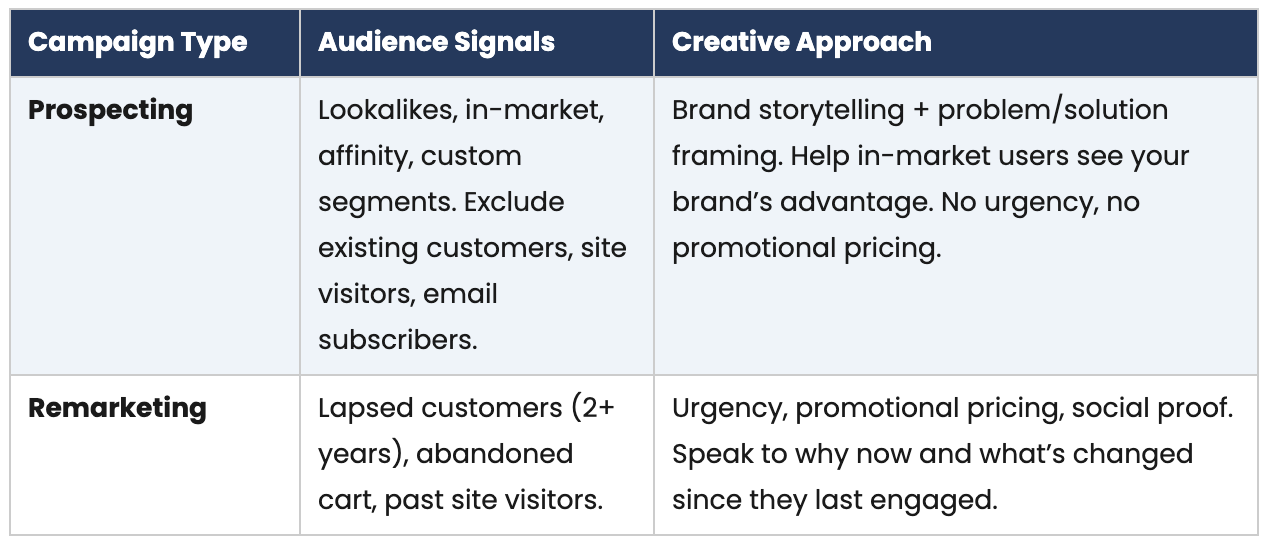
The exclusions matter just as much as the targeting. Excluding existing customers, site visitors, and email subscribers is what keeps you truly going after new audiences rather than just reaching people who already know you. Without those exclusions, your prospecting campaign is doing some amount of retargeting and you won’t have a clean read on who you’re actually reaching.
On optimized targeting: Google’s data from the first half of 2025 shows advertisers with it enabled see 20% higher conversions at the same cost. For prospecting, leave it on.
What “Good” Creative Looks Like in Demand Gen
Demand Gen runs across YouTube in-stream, Shorts, Discover, and Gmail. These are visually competitive placements. Your assets are showing up next to content people chose to be looking at, so the bar is higher than a standard display ad.
A few things that matter here:
Cover all three aspect ratios
Google recommends at least three images or videos in landscape (1200 x 628), square (1200 x 1200), and portrait (960 x 1200). As of late February 2025, 9:16 vertical image ads are available for YouTube Shorts too. If you’re not covering vertical, you’re not competitive on Shorts.
Lead with the outcome, not the product
This is the pattern we see consistently across accounts: lifestyle imagery and in-use creative outperforms product-isolated shots every time. The assets that convert are the ones where the finished dish is the hero, the room looks lived-in, the person looks like your customer. Catalog-style photography where the product is the sole subject tends to get scrolled past. Clean product imagery has its place in Shopping and on PDPs. In Demand Gen, outcome-led creative is what earns the click.
The same holds for video
Tutorial-style and how-to content consistently outperforms product showcase formats. Someone watching a video on how to properly use a product is more engaged than someone watching a feature reel. The hook matters too: low view rates are almost always a weak first three seconds, not a weak product.
Keep image text minimal
High-quality brand imagery with good lighting and minimal text overlays consistently outperforms busy, text-heavy visuals. The image earns the attention. The copy does the explaining.
Start with enough variety to actually test, not so much that nothing gets data
Store Growers puts it well: aim for Good or higher on Ad Strength, but don’t sacrifice quality chasing Excellent. Five images and two to three videos is a solid starting point. Upload clearly different creative concepts, not the same shot in slightly different crops.
Watch for fatigue before it shows up in your CTR
In Demand Gen, CTR and video engagement, watch time and skip rate specifically, are your clearest signals that an asset is losing steam. When you need to refresh and you still have room, add new assets before pulling old ones so the algorithm can compare them against what’s been running. If you’re already at the asset limit, removing your lowest performers to make room is completely fine, just keep a record of what you swapped out and why. That log is your creative history and it’s genuinely useful in client reporting.
Repurpose what’s already proven elsewhere
If something is converting on Meta or driving clicks in email, Google says to bring it into Demand Gen. There’s no reason to start from scratch when you have signals from other channels.
Writing Copy That Actually Earns the Click
Demand Gen copy is a different skill than search copy. In search, intent does half your work. In Demand Gen, you’re writing for someone who wasn’t looking for you and has a very low threshold for ignoring you.
A few things we think about:
Lead with the benefit, not the feature
“Built for how you cook” is more interesting than “high-performance cookware.” Your creative is already showing the outcome visually. The headline’s job is to make someone feel something about it, not describe what it is.
Write for curiosity, not completion
You’re not trying to answer every question in the headline. You’re trying to open one that they want to close.
Match tone to placement
Shorts copy should be punchy and fast. Discover can carry a little more narrative. Gmail benefits from clarity and a direct call to action.
Test angles, not just wording
Social proof, urgency, transformation, category authority, these are different hypotheses about what motivates your audience. Testing “Join 10,000 customers” against “Finally, cookware that doesn’t warp” tells you something real. Testing two versions of the same headline with slightly different wording mostly tells you nothing.
Use your description space
Descriptions should answer the next question your headline raises, not repeat it. If your headline is the hook, the description is where you earn the click.
Google gives you five headlines, five long headlines, and five descriptions per ad. Use them. The more variation the algorithm has, the more it can learn about what actually works for each audience.
The Measurement Problem Nobody Wants to Talk About
Here’s where Demand Gen campaigns get written off unfairly. If you’re evaluating this channel on last-click ROAS, you’re structurally penalizing it. Demand Gen is an upper-funnel channel. It influences decisions that convert later, usually through a branded search or a direct visit. Last-click attribution gives all of that credit to whatever channel happened to be last, and Demand Gen looks like it did nothing.
Google’s own data found that 68% of Demand Gen conversions came from users who hadn’t interacted with the brand’s search ads in the prior 30 days. That’s real incremental reach that a last-click model will never surface.
A more complete measurement picture looks like this:
Data-driven attribution (DDA)
Distributes credit across touchpoints instead of piling it all on the last click. It’s the right default for any account running Demand Gen alongside Search.
View-through conversions
Users who saw your ad, didn’t click, and converted later. This is one of the most important signals for an upper-funnel channel where the click isn’t always the conversion moment.
Attributed Branded Searches
Available since January 2026, this shows branded searches that can be traced back to a Demand Gen exposure. It requires activation through your Google rep, so it’s not available by default in every account, but it’s worth requesting. It’s one of the clearest indicators that upper-funnel activity is actually creating demand.
Brand Lift and Search Lift studies
These studies measure incremental changes in awareness, ad recall, and branded search behavior between exposed and unexposed audiences. They answer the question last-click attribution can’t: did the advertising actually change anything?
Conversion Lift experiments
For accounts with enough volume, this is the cleanest way to measure true incremental impact.
If you’re having trouble making the internal case for Demand Gen investment, measurement is usually where that argument is won or lost. Build the right framework before you launch, not after you’re trying to explain a ROAS number that looks low on the surface.
When You Find Something That Works, Scale It Right
Getting a creative winner is one thing. Knowing what to do with it is another.
The first question to ask isn’t “how do we run more of this.” It’s “what does this tell us?” Was it the format? The messaging angle? The visual treatment? The audience it was served to? The answer to that question is what lets you scale intelligently instead of just spending more on one asset until it fatigues.
From there:
Extend winners across formats before you call them proven
A lifestyle concept that’s winning in landscape should be tested in square and vertical. A strong static image concept should eventually get explored in video. Don’t declare something a winner until you know how it performs across the placements Demand Gen actually runs on.
Build a refresh cadence before you need one
Creative fatigue is predictable. You don’t have to wait for CTR to drop to know it’s coming. Set a schedule for asset refreshes on evergreen campaigns so you’re staying ahead of it instead of reacting to it.
Google’s AI enhancements are a tool, not a replacement
The November 2025 Demand Gen Drop added AI Image and Video Enhancements that generate creative variations from your existing assets. That’s genuinely useful for extending the life of strong creative. Just know that it works best when the source asset is already high quality. The AI is remixing what you give it, not fixing what’s broken.
Keep testing even when things are working
The accounts that plateau are usually the ones that stopped testing once something was working. Keeping a testing process running even on healthy campaigns is what keeps performance moving instead of sitting still.
Where to Start
Pull your asset report first. Look at what’s flagged as low-performing and ask whether it’s really underperforming or just underserved. Check your aspect ratio coverage. Look at how many creative concepts you actually have running versus how many slight variations of the same concept.
From there, check your prospecting campaign structure. If you’re not excluding existing customers and site visitors, that’s the first thing to fix. If everyone across every campaign is getting the same ad regardless of where they are in the funnel, that’s next.
Demand Gen rewards accounts that treat creative seriously. It’s not a hard channel to run well, but it does require having a process, not just having it turned on. The data is there now to actually do this right. Most accounts just aren’t using it yet.
If you’re not sure where your Demand Gen setup stands, or if you’ve been running it but don’t have a clear read on what’s working, reach out to the Revel team. We’re happy to dig in.
Sources
Google Accelerate – Creative Excellence Guide for Demand Gen Campaigns
Google Ads Help – Create A/B Experiments for Demand Gen Campaigns
Google Ads Help – About Ad Strength for Demand Gen Campaigns
Google Blog – New Ways to Help You Drive Performance with Demand Gen
ALM Corp – Google Demand Gen Shoppable CTV, Attributed Branded Searches, Travel Feeds 2026
Store Growers – Google Demand Gen Campaigns: The Complete Ecommerce Guide (2026)
Store Growers – Demand Gen Ad Creative: What Works for Ecommerce in 2026
Search Engine Land – Google Demand Gen Campaigns: When to Use Them and Best Practices